
How Stanley Black & Decker’s Brand Power and Working Capital Drive Growth in Q2 2026
Q2 2026 results reflect margin expansion and working capital shifts reinforcing operational resilience in a competitive industrial hardware sector.
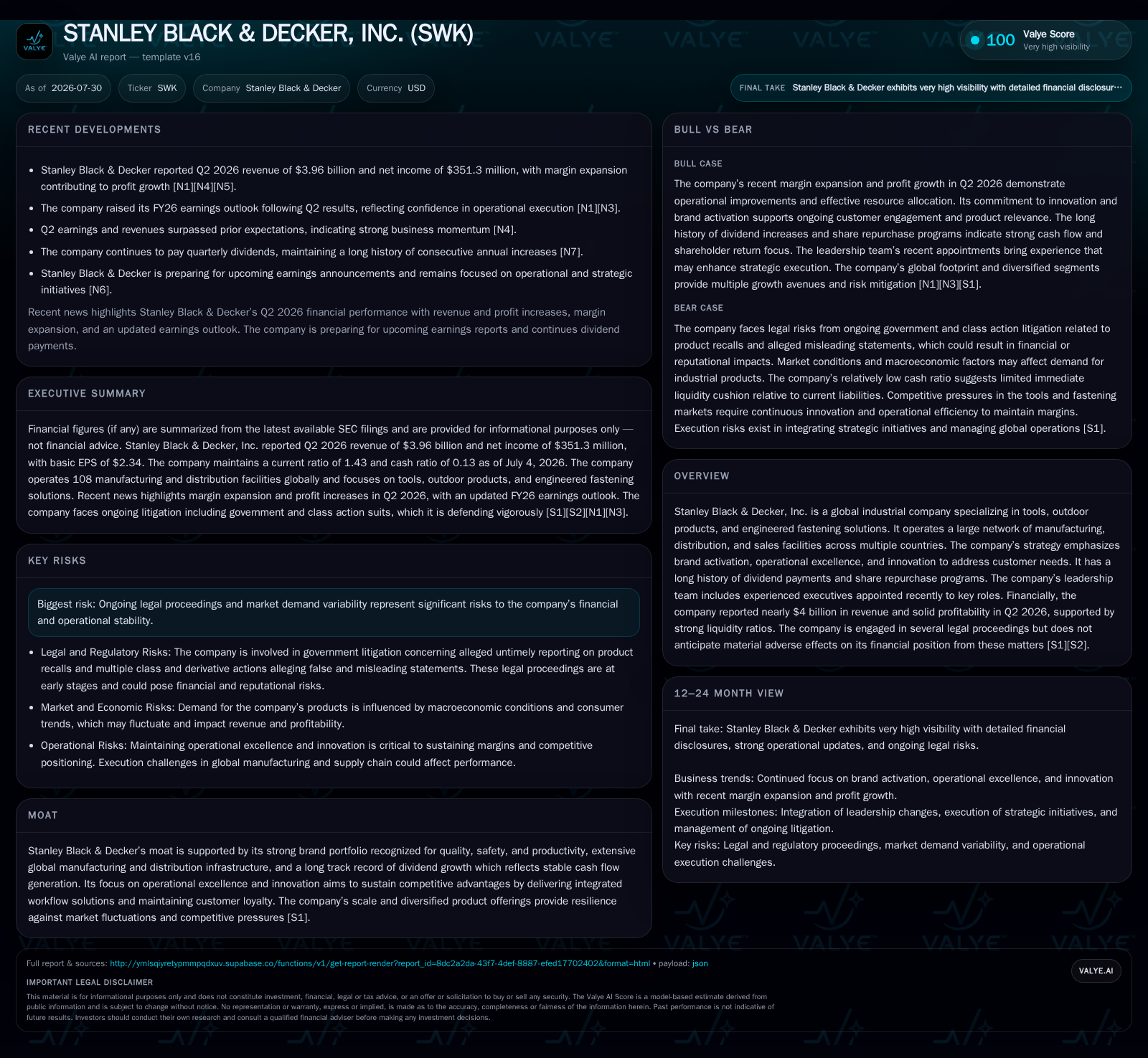
Stanley Black & Decker reported significant operating margin improvement and a strengthened liquidity position in Q2 2026, driven by operational excellence initiatives and the effective deployment of divestiture proceeds for debt reduction. The company’s substantial rise in trade receivables signals robust customer demand, albeit with working capital efficiency needing careful monitoring going forward. Its diversified portfolio of hand tools, power tools, and engineered fastening solutions benefits from strong brand equity, supporting pricing power amid cyclical market pressures. As the company navigates ongoing legal proceedings and demand cyclicality, growth prospects are underpinned by innovation pipelines and geographic diversification strategies.
Margin Expansion Reflects Operational Excellence amidst Macro Pressures
Stanley Black & Decker demonstrated a clear improvement in operating margins during Q2 2026, reflecting the success of its operational excellence initiatives [S2][N1]. Despite ongoing pressure from raw material cost volatility—a common challenge in the industrial hardware sector—the company managed to outpace input inflation with productivity gains and pricing actions embedded within its broad brand portfolio. This margin expansion is significant as it substantiates earnings quality beyond mere top-line growth, emphasizing the scalability of Stanley's manufacturing footprint and distribution network. Confirmation of sustained margin trajectory through subsequent quarters would validate ongoing competitive positioning amid cyclical industry dynamics
Working Capital Changes: Trade Receivables Surge Signals Demand but Tests Efficiency
A highlight from the latest quarter is the sharp rise in net trade accounts receivable from $775 million at the start of the year to $1.28 billion by July 4, 2026 [S2]. This jump implies robust sales momentum across multiple markets served by Stanley's extensive distribution channels spanning retailers, distributors, and industrial clients globally. However, such an increase also stresses working capital management frameworks. The enlarged receivables base can constrict cash conversion cycles if collection processes or inventory turnover do not keep pace. Monitoring accounts receivable turnover ratios relative to peer norms will be essential to gauge whether this receivables build represents sustainable demand or potential collection delays that could pressure liquidity
Brand Portfolio Strength Drives Pricing Power in Diversified Customer Channels
Underlying these financial dynamics is Stanley Black & Decker’s strong brand portfolio encompassing high-recognition names renowned for quality and safety in hand tools and power tools segments. This brand strength facilitates pricing power even as competitors vie aggressively in market segments increasingly sensitive to discounting [S1][N3]. The ability to maintain reorder rates without excessive markdowns suggests durable customer loyalty across retail, industrial manufacturing, and professional end users. Such pricing leverage is crucial given fluctuating raw material costs and global trade uncertainties. It also bolsters resilience against lower-cost manufacturers that typically erode margins in commoditized product lines
Competitive Context: Peer Benchmarks Emphasize Scale, Innovation, and Capital Discipline
When contextualized within its peer universe—including industrial tool manufacturers such as DeWalt (a Stanley brand) and Bosch—Stanley Black & Decker’s focus on operational scale and innovation pipelines aligns well with best-in-class practices that drive sustainable competitive advantage. Sector peers prioritize continuous product innovation—especially in cordless technologies—and operational efficiency within complex manufacturing footprints. Moreover, maturity in capital structure management reflected by disciplined debt reduction efforts distinguishes Stanley among these peers [S1]. This balance supports stable investment-grade credit ratings required for managing working capital financing effectively within cyclical end markets
Growth Outlook Shaped by Innovation Pipeline and Market Diversification Opportunities
The company's stated strategic priorities around innovation—particularly new cordless tool launches—and penetration into emerging markets align with macro trends favoring industrial automation and DIY home improvement booms. These growth vectors underpin replacement demand cycles typical for durable goods sectors like industrial hardware. While detailed timelines for specific launches remain proprietary, consistent investment in R&D alongside extended geographic reach enhances prospects for market share expansion beyond mature economies. Evidence suggests the firm’s integrated approach combining product innovation with channel expansion could drive revenue growth ahead of slower broader GDP growth phases if execution remains on track [S1]
Risk Factors: Legal Proceedings and Cyclical Demand Variability Require Vigilance
Despite these positives, ongoing litigation demands continued vigilance. Notably, suits related to Consumer Product Safety Commission recalls led to DOJ involvement concerning reporting timeliness; while Stanley expects no material adverse financial impact from these matters, reputational effects pose indirect risk to customer trust over time. Additionally, as a capital-intensive manufacturer reliant on end-markets like construction and industry maintenance, cyclical demand fluctuations remain a persistent headwind that can affect volume growth trajectories unpredictably [S1]
Financial Profile Discussion: Deleveraging Progress and Liquidity Strengthen Balance Sheet
The Q2 filing outlined meaningful deleveraging progress via the application of CAM business divestiture proceeds to repay nearly $606 million in commercial paper borrowings outstanding earlier in the year; by quarter-end, no commercial paper was drawn down enhancing short-term liquidity buffers [S2]. This action improved the company’s current ratio to approximately 1.43 as of July 4, 2026 (current assets of roughly $6.34 billion against liabilities near $4.43 billion) per balance sheet metrics [F1]. Cash equivalents stood at $592 million indicative of robust liquidity reserves available for operational needs or opportunistic investments [F1]. This prudent capital allocation approach prioritizes balance sheet flexibility amidst sector cyclicality.
In summary, Stanley Black & Decker's Q2 2026 results demonstrate strategic momentum grounded in brand-led pricing power combined with tangible improvements in operational efficiency yielding margin expansion. The substantial increase in trade receivables underscores vigorous end-customer demand but also necessitates focused working capital management oversight going forward. Debt reduction financed by divestiture cash flows rebalances liquidity profiles favorably relative to peer norms emphasizing disciplined capital stewardship typical of mature industrial hardware leaders like Bosch or DeWalt brands within Stanley's own portfolio. While legal and macroeconomic risks persist—as inherent in this capital-intensive sector—the alignment between innovation-driven growth strategies and expanding geographical reach provides a constructive outlook subject to execution consistency.
Disclaimer:
This analysis is based strictly on publicly available SEC filings and reputable news sources as cited; it presents an informed perspective on Stanley Black & Decker's recent performance without offering investment research views or price targets.
Disclaimer: This is research-only, informational analysis and not investment advice. It may include AI-generated interpretation and general industry context. Always verify important details using primary sources.

Comments