
Varonis Systems Advances SaaS Pivot with Robust Q2 Growth and Expanding Data Security Suite
Q2 results underscore Varonis' accelerating shift to a SaaS-first model, fueled by acquisitions and strong renewal metrics.
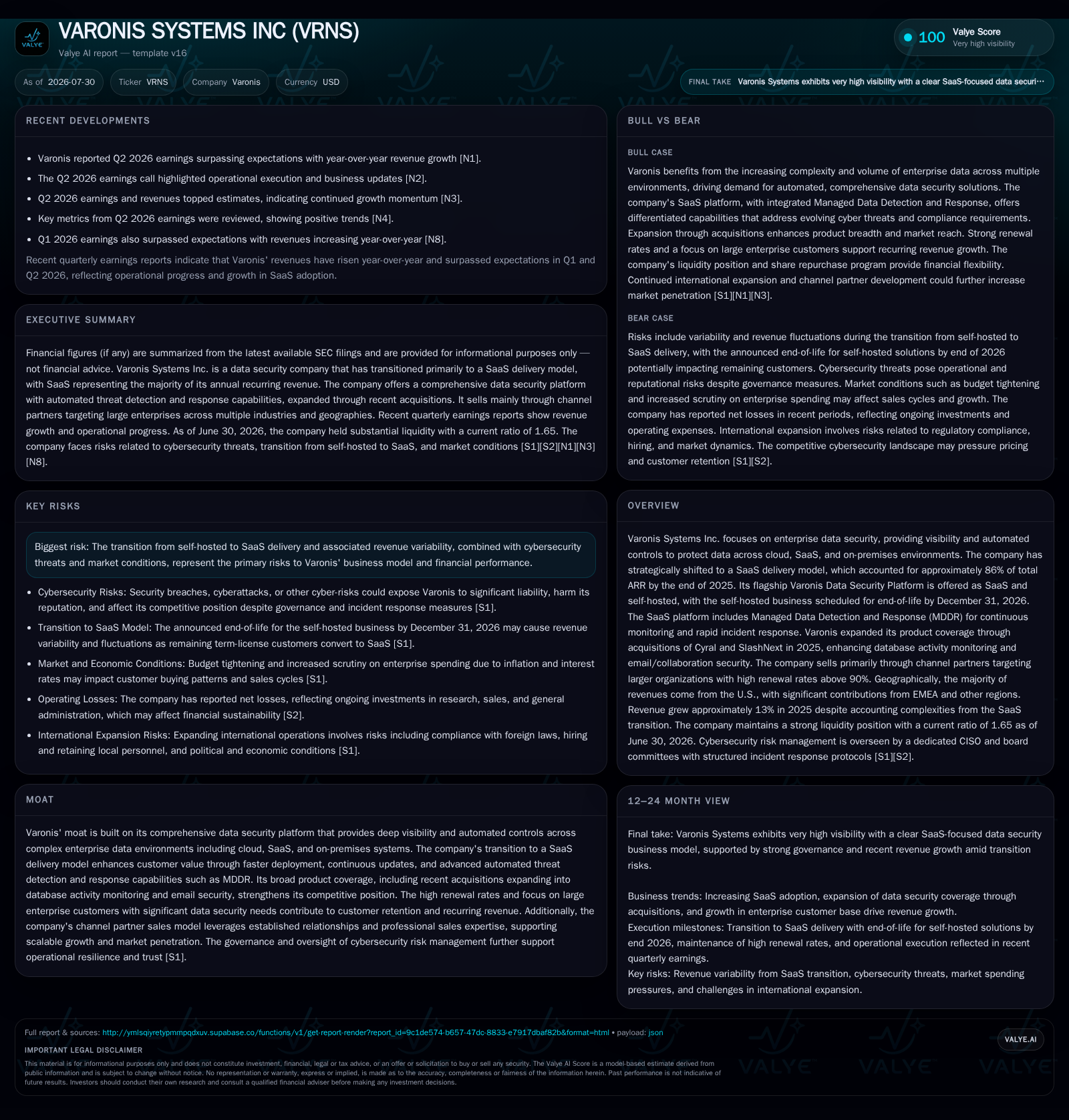
Varonis Systems reported significant progress in its strategic SaaS transition during Q2 2026, with about 86% of total ARR now derived from SaaS offerings. This shift is driving improved recurring revenue quality and underscores the nearing end-of-life for its legacy self-hosted business, scheduled for December 2026. The company has expanded its security platform through acquisitions of Cyral and SlashNext, enhancing database activity monitoring and email threat protection. Solid customer retention above 90% and the channel partner sales model support scalable growth despite risks linked to transition dynamics and cybersecurity threats.
Q2 Operating Outcomes Highlighting SaaS Transition Progression
sibility into future revenues compared to perpetual licenses.
Customer churn remains contained as renewal rates are maintained above 90%, a critical metric underpinning platform stickiness in enterprise data security solutions where switching costs include integration complexity and deployment effort [N1], [N3]. The renewal success indicates the platform’s perceived value amidst growing enterprise demand for integrated visibility across hybrid IT environments. High renewal performance also implies efficient customer success management geared towards upselling usage or seat expansions which contribute to net retention exceeding gross renewal rates.
Enhanced Data Security Platform: Expanding Capabilities Through Strategic Acquisitions
In 2025, Varonis strategically broadened its product suite by acquiring Cyral and SlashNext. Cyral’s agentless database activity monitoring technology addresses a growing segment focused on securing sensitive corporate databases without intrusive agents—a rising priority given escalating regulatory scrutiny over database access governance [S1]. SlashNext complements this by providing AI-powered phishing detection for email and collaboration platforms, extending Varonis’ reach into protecting communication channels against socially engineered threats [N2], [N4].
Integrating these acquisitions has diversified the platform’s threat detection vectors beyond file system monitoring to include database activity monitoring (DAM) as well as advanced email security. This multi-dimensional coverage aligns well with holistic enterprise security strategies that demand cross-application visibility rather than siloed endpoint or network-only controls common among competitors. It also enhances Varonis’ cross-selling potential within existing large accounts by bundling broader capabilities under one unified subscription offering.
Moreover, the platform’s Managed Data Detection and Response (MDDR) capability leverages automation to continuously monitor data usage anomalies and accelerate incident response workflows—automation that customers increasingly require given the talent scarcity in cybersecurity operations centers (SOC) [N4]. This capability bolsters competitive differentiation by embedding intelligence directly into data access governance workflows.
Business Model Strength Driven By Recurring Revenue Quality and Channel Partner Ecosystem
Varonis predominantly sells through an extensive channel partner network comprising distributors and resellers specialized in serving sizable enterprises capable of making material upfront commitments. This channel-driven architecture supports scalable customer acquisition across complex multinational organizations while managing sales cycle lengths inherent in enterprise software procurement [S1], [S21]. Channel partners enable Varonis to engage large accounts efficiently while leveraging their established trust relationships.
High customer renewal rates exceeding 90% further emphasize contract durability—key for subscription SaaS models where churn directly impacts Annual Recurring Revenue growth profile. High renewals suggest robust customer satisfaction with product value realization alongside embedded operational workflows that are difficult to replicate or abandon without business disruption. Such stickiness translates into favorable Customer Acquisition Cost (CAC) payback economics over multi-year periods as initial sales investments amortize against stable subscription income streams.
However, dependence on channel partners introduces distribution risk requiring continued investment in training, incentives, and joint go-to-market initiatives to maintain partner engagement amid competitive pressures in enterprise cybersecurity marketplaces.
Competitive Positioning Amid Broadening Threat Detection Landscape
Varonis operates within an increasingly crowded cybersecurity sector marked by evolving attack surfaces encompassing endpoints (e.g., CrowdStrike), identity management (Okta), network/cloud security (Palo Alto Networks), and analytics platforms (Splunk). Unlike endpoint-centric vendors or identity-only players, Varonis emphasizes deep visibility at the data layer across cloud environments, SaaS applications, and on-premises systems—a position that fosters a defensible moat due to complexity of integration.
This cross-environment visibility supports correlation across data usage patterns enabling early threat detection that static point solutions might miss. Additionally, automation embedded within MDDR expedites incident response reducing dwell time of attackers inside critical datasets. Such capabilities are increasingly prioritized by enterprises seeking consolidated platforms over fragmented point tools.
While peers like Zscaler focus on securing cloud network traffic or CyberArk specializes in privileged access management, Varonis differentiates itself by anchoring security at actual data access points where exposure occurs—highlighting its relevance amid shifting enterprise architectures towards cloud-native workloads.
Growth Opportunities Underpinned by Regulatory Demand and Cloud Migration Trends
Broad macro trends heavily favor adoption of Varonis’ offerings: intensified regulatory frameworks mandate stringent data protection controls; enterprises continue accelerating migration of workloads to cloud/SaaS; cyberattack frequency rises relentlessly necessitating sophisticated automated defense mechanisms.
Such factors expand total addressable market as organizations must comply with diverse regional laws while managing risk across sprawling hybrid environments. Expansion opportunities also arise from existing customers increasing seat counts or engaging new modules like DAM or email security acquired via Cyral or SlashNext.
Nonetheless, growth pace may be tempered by macroeconomic factors such as IT budget constraints during economic downturns which can delay purchasing decisions or license expansions despite heightened security needs.
Risks Associated With Transition Dynamics, Cybersecurity Threats, and Competitive Pressure
The transition from self-hosted licenses to SaaS subscriptions carries typical challenges: short-term revenue recognition shifts can induce quarterly fluctuations; some legacy customers may delay full conversion resulting in variable cash flows; operational complexity increases managing dual delivery modes until cutoff date at end-2026 [S1], [S2].
Further risks include potential cybersecurity incidents within Varonis’ own platform that could damage reputation or reduce customer confidence—risks partly mitigated by robust governance involving direct board oversight led by experienced CISO since August 2025 who aligns risk framework with emerging threats [S1]
Competition intensifies as numerous incumbents expand features aggressively potentially compressing pricing power or requiring elevated marketing/sales spend which may pressure margins. Dependence on channel partners also creates exposure if partners prioritize competitors or fail to scale adequately in priority regions.
What To Watch Next: Indicators for Retention, Adoption, And Margin Progression
Upcoming quarters should be monitored closely for trajectory of net retention rates driven by upsells within expanded product sets including DAM/email solutions. Seat expansion trends among large accounts will reveal depth of platform adoption versus standalone deployments.
CAC payback improvement is another important metric reflecting efficiency gains in customer acquisition processes amid channel scaling efforts. Observers should also track incremental gross margin gains as SaaS mix increases given hosting expense offsets the legacy license decline.
Operational execution milestones concerning completion pace of self-hosted end-of-life transition will further clarify timing risk profile around revenue variability. Management commentary from earnings calls like the July 28 event filing offers additional forward-looking insights into cadence expectations [N3], [S3].
Financial Profile Discussion: Balance Sheet Strength And Operating Efficiency
Varonis enters H2 2026 with solid liquidity positioning supported by cash & equivalents totaling approximately $234 million alongside a healthy current ratio of about 1.65—demonstrating ample short-term financial flexibility [F1]. Despite operating losses reflective of an investment phase laden with increased R&D staffing for product innovation plus sales expansion costs sustaining its channel ecosystem [S16], this financial strength underpins ongoing software development programs including managed detection automation enhancements.
Operating expenses remain elevated but exhibit strategic allocation toward accelerating SaaS growth vectors while maintaining customer success initiatives vital for retention. While profitability remains distant due to deliberate scalability investments typical for cybersecurity SaaS providers at this stage of expansion, free cash flow dynamics will be important near-term indicators as recurring revenues scale further.
Overall financials complement the operating narrative wherein capacity investments fuel top-line ARR momentum alongside improved revenue quality driven by subscription-led models.
This analysis synthesizes publicly filed information alongside sector knowledge applicable to enterprise data security software delivered predominately as SaaS offerings targeting large organizations. All numeric facts are cited explicitly from corresponding SEC filings or reputable news sources to ensure grounded insight absent speculative assertions.
Disclaimer: This is research-only, informational analysis and not investment advice. It may include AI-generated interpretation and general industry context. Always verify important details using primary sources.

Comments