
Kindcard Advances Closed-Loop Payment Platforms Amid Liquidity Constraints
Recent quarterly updates highlight Kindcard's dual-platform fintech approach with challenges in financial sustainability.
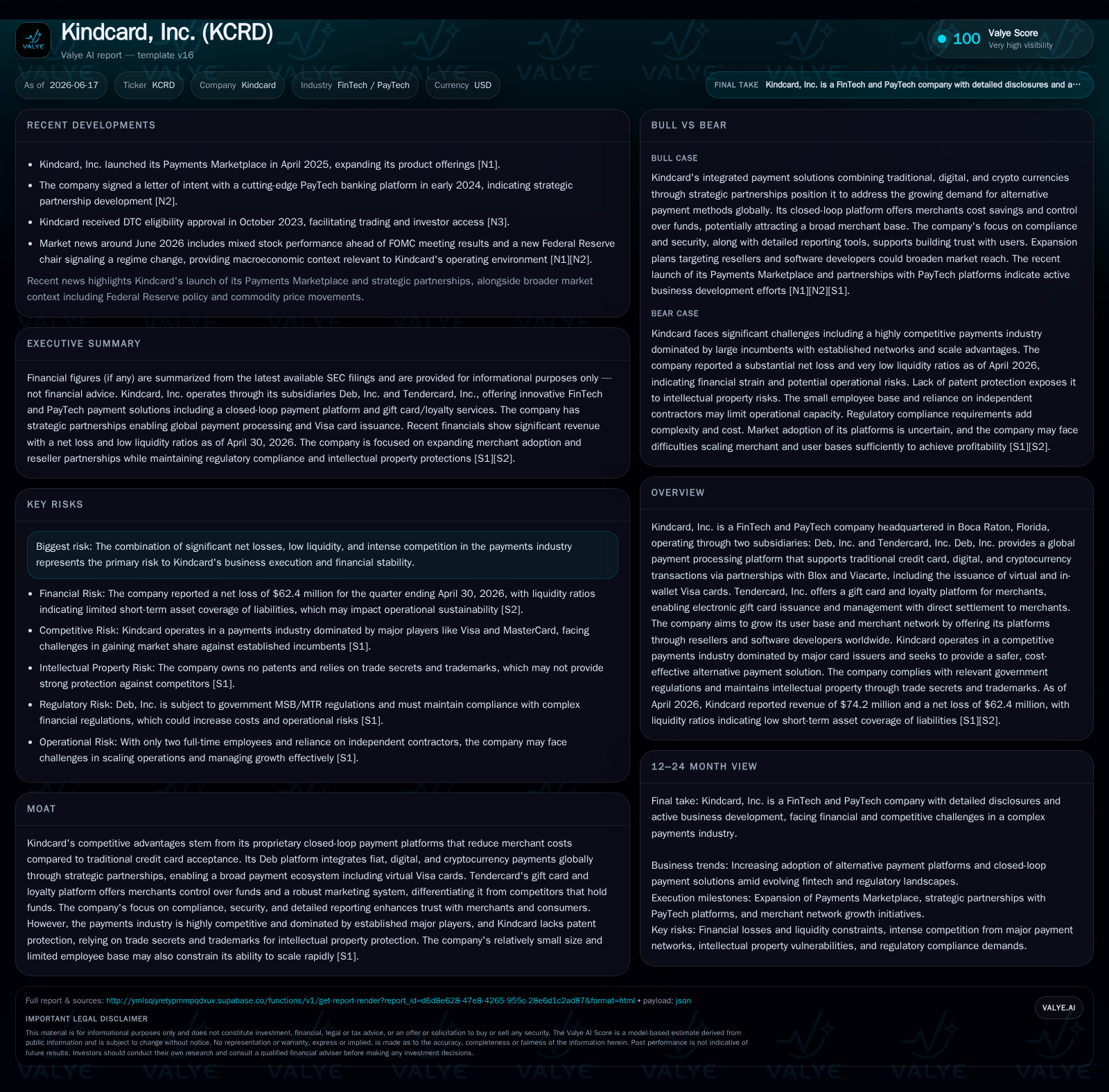
Kindcard, Inc. reported continued development of its Deb and Tendercard platforms in its June 2026 quarter, focusing on closed-loop payment processing integrating fiat, digital, and cryptocurrencies alongside merchant gift card and loyalty services. The company confronts a stringent liquidity environment with a current ratio of 0.05, reflecting significant working capital pressures. Operating within a competitive paytech industry dominated by major card networks, Kindcard seeks growth through reseller and software developer partnerships while navigating risks from financial losses and scaling demands.
Recent Operating Update
Kindcard's latest 10-Q filing as of June 17, 2026 [S2] confirms progress in both subsidiaries—Deb, Inc. and Tendercard, Inc.—which together serve distinct but complementary roles within the FinTech payment ecosystem. Deb focuses on an integrated closed-loop platform processing diverse payment types globally including traditional credit cards, digital assets, and cryptocurrencies. This is achieved through strategic alignments with Blox (digital asset custody/conversion) and Viacarte (virtual Visa card issuance). Meanwhile, Tendercard provides merchants with a loyalty-driven gift card solution that replaces paper certificates with electronic accounting and settlement directly to merchants' accounts.
Beyond continuing platform improvements—such as finalized server upgrades promising 99.9% uptime for Tendercard—the company emphasizes onboarding new merchants targeting the critical 2026 holiday season [S1]. However, despite operational advancements, liquidity remains severely constrained with a current ratio calculated at approximately 0.05 as of April 30, 2026 [F1], highlighting pressures on short-term obligations exceeding current assets by over $1 million.
Business Model
Kindcard generates revenue primarily via transaction fees derived from payment processing on the Deb platform and subscription or service fees on Tendercard’s merchant gift card and loyalty system. The Deb model leverages its closed-loop payment gateway facilitating wallet account openings where consumers can store digital assets convertible to USD funding Visa-branded virtual cards accepted worldwide. Transaction fees reflect volume processed across fiat and cryptocurrency flows.
Tendercard’s offerings center on a flat monthly fee for merchants enabling unlimited gift card issuance plus value-added consumer marketing tools linked to loyalty accrual—monetizing both transaction activity and recurring service engagement. Importantly, Tendercard never holds merchant funds but settles sales directly to their accounts, a differentiation that may reduce friction or risk concerns common with third-party fund custodians.
The company's dual-platform approach aims to capture distinct yet synergistic flows: Deb targets innovative multi-currency payers demanding secure crypto-fiat conversions underpinned by compliance protocols; Tendercard appeals to traditional merchants seeking affordable digital gift/loyalty program management enhancing customer retention.
Industry Structure and Competitive Position
Kindcard operates in a payments landscape dominated by major card issuers such as Visa, Mastercard, American Express, alongside established processors like Fiserv or Global Payments. These incumbents benefit from scale economies, broad network reach, regulatory relationships, and entrenched customer bases. Additionally, newer fintech entrants specialize in narrow verticals or singular payment methods (e.g., Apple Pay’s wallet or Alipay’s ecosystem), posing direct competition in faster-growing niches.
Kindcard’s competitive edge lies in its integrated closed-loop design reducing interchange costs for merchants—a significant expense under conventional credit card models—and its multi-currency/payment type flexibility. Its sophisticated compliance regime aligned with MSB/MTR regulations further aims to build trust among risk-sensitive clients handling digital currencies [S10].
Still, the company's scale is modest with only two full-time employees complemented by contractors [S10]. Lack of patent protection means innovation safeguards rely mainly on trade secrets and trademarks introducing potential risk if competitors replicate features.
Growth Drivers
Several structural trends support Kindcard’s growth aspirations:
- Expanding global adoption of digital wallets coupled with consumer interest in cryptocurrency payments creates demand for platforms like Deb integrating these channels seamlessly.
- Increasing e-commerce penetration worldwide magnifies need for versatile online payment acceptance systems.
- Merchant appetite grows for cost-effective loyalty programs capable of driving repeat business; Tendercard’s direct settlement model provides an alternative to conventional third-party-held gift card solutions.
- Regulatory evolution propelling fintech inclusion facilitates access to underbanked populations receptive to innovative payment services.
- Partnerships with resellers and independent software developers represent scalable distribution channels aimed at accelerating merchant network expansion without significant internal sales force investments [S9]
Risks / Watchpoints / Growth Constraints
Key challenges tempering optimistic growth narratives include:
- Financial sustainability concerns: extremely low liquidity with a current ratio near 0.05 as of April 30, 2026 [F1] underscore tight runway constraints that could impede technology investment or go-to-market scaling.
- Intense competition from established incumbents possessing superior scale/expertise limits pricing power and market penetration ability.
- Limited workforce size risks bottlenecks in platform development, client support, and addressing compliance/security demands critical in this sector.
- Absence of patent protection exposes proprietary developments to imitation or accelerated competitive invalidation.
- Reliance on third-party partners (banks for settlement; Blox/Viacarte for crypto custody/card issuing) introduces operational dependencies outside company control.
- Market acceptance for alternative/closed-loop payments remains contingent upon merchant willingness to integrate new systems amid customary credit/debit dominance.
What to Watch Next
Important upcoming milestones include:
- Merchant acquisition figures ahead of the crucial holiday sales period in late 2026 will indicate traction of Tendercard’s gift card platform enhancements.
- Expansion velocity of wallet accounts underpinning Deb’s digital currency conversion capability informs user adoption dynamics.
- Any announcements regarding enhancements in partner integrations or introduction of new product features affecting multi-currency or crypto payments capabilities.
- Management commentary around capital raising or liquidity improvement plans given existing balance sheet stresses.
- Operational metrics such as transaction volume growth rates, authorization success rates, or chargeback trends would shed light on underlying platform health but are not currently disclosed.
Financial Profile Context
Cash balances measured near $13K as of October 2023 suggest limited liquid reserves relative to current liabilities totaling more than $1 million at April-end 2026 [F1]. Without recent disclosures detailing subsequent capital raises or debt restructuring beyond the reported $150K debt position from mid-2021 [F1], liquidity pressures constitute an acute risk factor impacting execution capacity.[S2]
This analysis integrates publicly available SEC filings through June 17, 2026 [S1,S2] alongside contemporaneous financial data [F1] consistent with sector-wide fintech/paytech practices. It does not constitute investment advice but aims to illuminate Kindcard's operating developments within its competitive context and financial profile based strictly on documented evidence.
Disclaimer: This is research-only, informational analysis and not investment advice. It may include AI-generated interpretation and general industry context. Always verify important details using primary sources.

Comments