
Accenture's Strategic Surge: AI, Acquisitions, and Solid Financial Position in Q3 2026
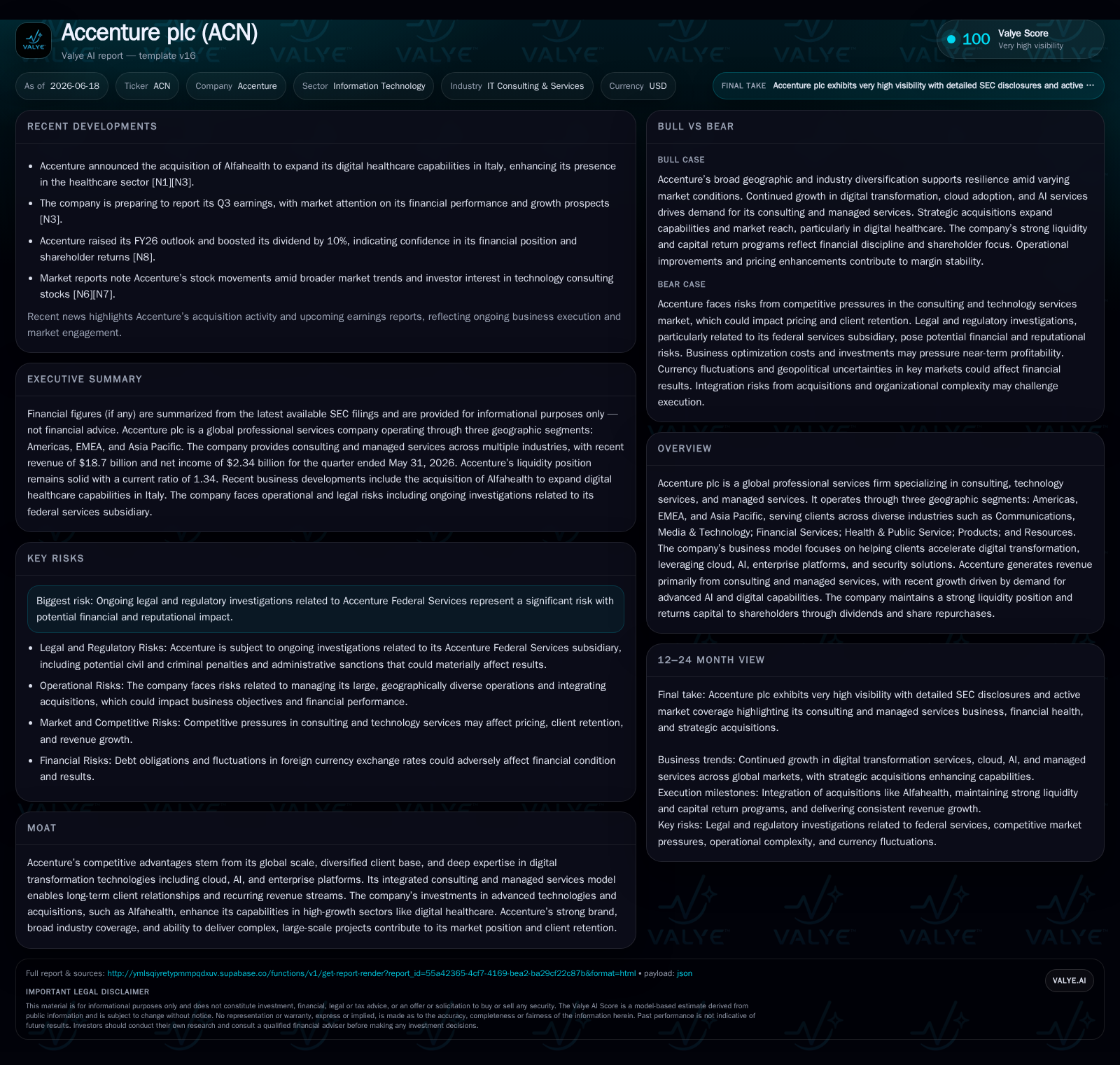
Accenture’s latest quarterly update highlights value creation through AI-driven digital transformation, strategic acquisitions, and robust liquidity underpinning its market leadership.
In its Q3 fiscal 2026 filing, Accenture raised its earnings outlook supported by strong revenue growth across Americas, EMEA, and Asia Pacific segments. The firm’s expanding managed services and consulting revenues are fueled by increasing client demand for cloud migration and AI solutions, further bolstered by recent acquisitions in digital healthcare and cybersecurity. Accenture’s solid balance sheet with a net cash position surpassing $5 billion provides financial flexibility to invest in innovation and shareholder returns. Risks include ongoing regulatory investigations and talent market pressures but current operating metrics signal sustaining momentum.
Q3 FY26 Operating Highlights Showcase Growth Momentum
Significantly, Accenture concurrently issued an 8-K confirming a raised fiscal 2026 earnings outlook alongside a 10% dividend hike — signaling management's confidence in sustainable top-line growth driven by AI-enabled transformation projects and steady managed services expansion [N1], [S3]. The company reported continuing robust new bookings growth supporting future revenue expansion, highlighting the development of large-scale transformation pipelines.
Strategic acquisitions completed around the quarter included Alfahealth in Italy — fortifying digital healthcare capabilities — alongside cybersecurity-focused firms RunZero, NetRise, and a majority stake acquisition in Dragos. These moves align with the thematic focus on specialized enterprise security solutions and compliance-driven service offerings catering to regulated industries amid rising client demand for advanced digital health technologies [N10], [N11], [N12].
Integrated Consulting and Managed Services Model Underpins Stable Revenue Streams
Accenture’s business model derives revenues from a combination of fee-based consulting engagements emphasizing digital strategy formulation (notably AI and cloud adoption) alongside recurring managed services contracts providing operational continuity for clients’ IT infrastructures. Consulting fees represent roughly half of total revenues with managed services comprising the balance — a balance that supports predictable cash flows and client stickiness via long-term outsourcing arrangements.
Key operational KPIs such as billable headcount utilization rates directly impact revenue per consultant metrics which reportedly improved this quarter, reflecting optimized resource deployment amid sustained project demand. Contract renewal rates sustain high client retention across diverse industry verticals including Communications & Media, Financial Services, Health & Public Service, Products manufacturing, and Resources extraction sectors — reflecting Accenture's breadth in serving complex enterprises with tailored technology integration solutions that include cybersecurity safeguards and business process optimization components [S1], [S2].
The company also increasingly incorporates outcome-based pricing structures tied to client performance improvements into these contracts to align incentives more closely with client success metrics.
Competitive Advantages Boiled Down to Scale, Expertise, and Ecosystem Integration
Accenture maintains a competitive edge rooted in its scale as a global consulting leader with offices in over 200 cities worldwide supporting multinational clientele across multiple industries. Its integrated go-to-market approach combining consulting advisory capabilities with technology implementation depth rivals peers such as Deloitte, PwC for consulting breadth while paralleling IBM Global Services and Cognizant for deep technology execution.
The firm’s strategic partnerships with leading cloud providers like AWS, Microsoft Azure, and Google Cloud enable it to rapidly deploy emerging technologies such as artificial intelligence applications alongside cybersecurity infrastructure protections — crucial for navigating increasing regulatory scrutiny faced by clients globally. This broad ecosystem integration supports cross-selling opportunities within account portfolios enhancing client lifetime value.
Additionally, recent targeted acquisitions broaden vertical-specific expertise allowing Accenture to enter or strengthen positions in high-growth arenas like digital healthcare IT solutions while reinforcing its capabilities around industrial control systems security—a niche often underserved by generalist competitors.
Secular Growth Drivers: Digital Transformation Intensifies Demand for Advanced IT Consulting
Demand drivers visibly stem from accelerating enterprise digitalization strategies pushing cloud migrations while embedding AI/automation at scale within organizational processes. Managed services contract expansions fuel recurring revenue growth which buffers earnings stability during volatile economic cycles.
Regulatory complexity around data privacy particularly heightens need for compliance advisory embedded into technology landscapes—driving projects in sectors such as healthcare where Accenture recently expanded via Alfahealth acquisition.
Geographically, the Americas remain the largest contributor but EMEA shows relatively faster operating income growth reflecting increased regional transformation spend amidst Europe’s diverse regulatory environment; Asia Pacific continues steady expansion leveraging its growing economies adopting next-gen IT architectures [S2], [N11]. Backlog increases mentioned in management commentary point toward sustained pipeline strength animated by both repeat business from existing clients and new wins.
Risks Loom Around Legal Investigations and Talent Markets
A significant risk area stems from ongoing U.S. Department of Justice investigations related to Accenture Federal Services pertaining to compliance matters—posing potential reputational fallout or financial penalties if adverse outcomes arise. While management does not currently foresee material impacts on overall results, this remains a key watchpoint given regulatory scrutiny levels in government contracting segments of the business [S1], [S23].
Cybersecurity risk management remains paramount despite mature governance structures detailed in prior filings—the evolving threat landscape poses persistent operational challenges requiring continuous investments in security capabilities across internal operations and client-facing projects.
Talent market tightness also presents headwinds as competition for highly skilled consultants including AI specialists intensifies globally—elevating compensation costs which pressure margins unless offset by productivity gains measured via billing efficiency metrics.
Monitoring Key Operational Signals: Bookings, Renewals, Regional Trends
Looking ahead, monitoring project bookings levels each quarter will provide forward visibility on new work inflows supporting revenue acceleration or deceleration trends. Contract renewal cadence especially among managed services agreements serves as an indicator of client satisfaction and recession resilience.
Geographic segment performance shifts merit close attention: signs of accelerating EMEA margin recovery or Asia Pacific scaling could reshape regional contribution dynamics relative to Americas dominance.
Expansion rate of outcome-based contracts tied directly to measurable client KPIs remains another bellwether influencing margin trajectory given these models' potential higher profitability when executed effectively.
Following refinancing actions on April 22, 2026, syndicated credit facilities aggregate capacity increased to $8.1 billion on favorable terms extending maturity through 2031 for key tranches enhancing financial stability [S2]
Operating margins have remained healthy around mid-teens percentage points supported by scalable consulting fee leverage combined with recurring managed service revenue streams generating stable free cash flow enabling dividends growth alongside strategic acquisitions funding commitments.
Financial position in context
As of 2026-05-31, companyfacts shows $10.17 billion in cash and equivalents and $5.03 billion of total debt [F1]. The same snapshot implies net debt of roughly negative $5.14 billion, keeping balance-sheet context relevant but secondary to the operating story [F1]. Current assets of $28.9 billion and current liabilities of $21.6 billion imply a current ratio near 1.34x for 2026-05-31 [F1].
This analysis synthesizes current public disclosures without offering investment advice or forecasts. It is intended solely for informational purposes reflecting the company’s recent operational status within the professional services IT consulting sector.
Disclaimer: This is research-only, informational analysis and not investment advice. It may include AI-generated interpretation and general industry context. Always verify important details using primary sources.

Comments