
Honda Shifts EV Strategy Amid Market Slowdown and Regulatory Challenges
Latest quarterly filing outlines Honda’s strategic recalibration on EV initiatives amid fluctuating demand and regulatory shifts.
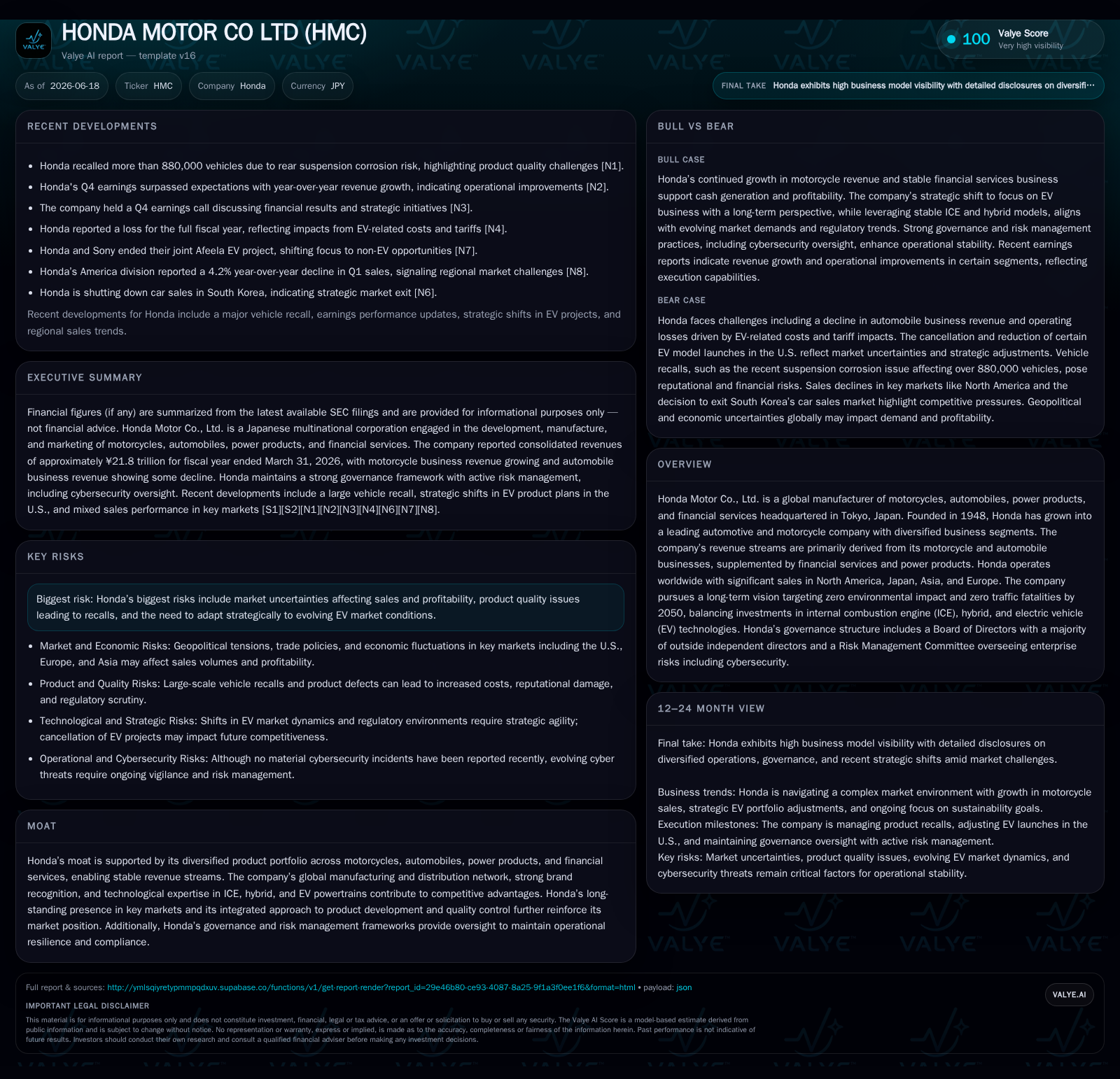
In its latest quarterly filing dated June 3, 2026, Honda announced the indefinite suspension of its comprehensive EV value chain plan in Canada and the cancellation or scaling back of multiple EV model launches in the U.S. due to slowing demand exacerbated by changes in incentive structures and easing fossil fuel regulations. This recalibration underscores Honda's continued reliance on its core ICE and hybrid automobile lineup along with its profitable motorcycle and financial services units. While facing near-term operational headwinds, Honda maintains a long-term commitment to electrification and sustainability, balancing strategic investments between legacy powertrains and EV innovation amid a challenging global environment.
Recent Quarterly Update: Strategic Rollback on EV Plans
Honda’s June 3, 2026 quarterly filing reveals a strategic retreat from previously ambitious electrification projects during unexpected softness in electric vehicle (EV) markets. The company indefinitely suspended plans to build an integrated EV value chain in Ontario, Canada — originally announced in April 2024 — following earlier postponements linked to sluggish demand conditions in North America [S2], [S3]. Concurrently, Honda canceled planned launches of certain EV models in the United States and scaled back production volumes for others developed via alliance agreements. These decisions respond to revisions in U.S. EV incentives and easing fossil fuel regulations that have dampened market expansion prospects there [S1], [S3]. These adjustments significantly reshape Honda's near-term product pipeline and capital expenditure focus.
Despite this pivot, Honda confirmed it will continue investing selectively in electrification while leveraging the profitability of its established internal combustion engine (ICE) and hybrid vehicle platforms. The motorcycle segment reported a 7.2% year-over-year increase in unit sales led by emerging markets including India and Brazil; however, automobile unit sales declined around 4.5%, mainly due to decreased volumes in Asia such as China — tempering overall segment revenue despite gains across other regions like Europe and parts of North America [S1]. Additionally, Honda disclosed recalls affecting over 880,000 vehicles over rear suspension corrosion risks, underscoring ongoing quality control challenges that require diligent management to protect brand reputation [N3], [S2].
Diverse Product Portfolio Anchoring Revenue Streams
Honda operates across four principal segments: motorcycles, automobiles (spanning ICE, hybrids, and some EVs), power products, and financial services. For fiscal year ended March 31, 2026, motorcycle revenues increased notably (JPY4 trillion), driven by higher unit volumes primarily from key developing regions; meanwhile automobile revenues declined slightly due to volume decreases partially offset by pricing improvements [S1], [S13]. The financial services segment delivered stable revenue (JPY3.5 trillion), benefiting from consistent consumer financing activities that help smooth revenue cyclicality linked to vehicle sales.
This diversified portfolio enables Honda to capitalize on its core ICE/hybrid expertise within automobiles while expanding profitable motorcycle operations with efficient manufacturing cost structures. Concurrently, disciplined R&D spending balances refinement of legacy engines with targeted advancement of electrification technologies aligned with Honda’s ambition for carbon neutrality by 2050 across the product lifecycle [S1], [S8]. Although some short- to medium-term EV initiatives are paused or scaled back, Honda emphasizes laying groundwork for future electrified mobility solutions with flexible investment timing responsive to evolving market dynamics.
Industry Landscape and Competitive Positioning
Honda competes among established global automotive OEMs such as Toyota — which has pursued a more aggressive full-line EV transition — alongside pure-play electric vehicle manufacturers like Tesla that lead innovation but face unique scaling challenges. The slowdown of U.S. EV incentive programs has broadly impacted automakers’ North American strategies; Honda’s recalibration mirrors this trend amid ongoing global supply chain disruptions affecting procurement costs and production schedules.
Supply chain management remains critical as semiconductor shortages persist industry-wide. OEMs optimizing manufacturing utilization while maintaining quality standards are better positioned to preserve margins amid demand uncertainty. Regulatory environments vary regionally: European policies increasingly favor electrification through stringent emissions targets or incentives; conversely, fluctuating U.S. policy mandates cautious capital expenditure pacing among automakers including Honda. The integration of financial services offerings further supports customer retention relative to peers focused solely on manufacturing.
Growth Prospects in Electrification and Emerging Markets
Medium- to long-term growth drivers remain positive despite near-term volatility: rising environmental awareness drives steady adoption of hybrids transitioning toward battery electric vehicles contingent on infrastructure improvements. Emerging Asian markets such as India exhibit expanding middle-class populations fueling motorcycle volume growth alongside gradual automobile recovery supported by upcoming next-generation hybrid model introductions per corporate disclosures [S19]
Government incentives promoting clean energy vehicles coupled with advances in battery technology efficiency underpin an expanding pathway for electrified portfolios at Honda. Increasing consumer focus on safety features like advanced driver-assistance systems (ADAS) complements powertrain innovations enhancing competitiveness beyond propulsion technologies.
Risks and Operational Constraints Ahead
Risks include managing execution amid geopolitical tensions affecting raw material prices—especially critical metals—currency exchange fluctuations impacting global supply chains, plus regulatory uncertainties influencing timely product launches for newer electric models [S1], [N3]. Recalls such as those related to rear suspension corrosion pose reputational risks if frequency or remediation costs escalate.
Strategic project suspensions prompt questions about sustaining innovation leadership relative to peers aggressively investing or acquiring technologies. Balancing capital allocation between legacy ICE engines versus emerging mobility technologies demands vigilant oversight amid limited medium-term clarity on EV demand recovery timelines globally.
What to Watch: Indicators for Demand Recovery and Execution
Key indicators include timing of new EV model introductions post-market stabilization; capital expenditure trends signaling renewed electrification investments; regional sales patterns reflecting regulatory shifts; dealer network health tied to after-sales service revenue; evolution of financial services portfolio size indicating credit quality; plus updates on recall rates or quality control improvements.
Clarity on U.S.-based incentives remains pivotal as it influences pricing strategies domestically and export-linked production hubs globally. Consumer preferences between hybrids versus full battery electric vehicles will inform whether Honda’s balanced powertrain approach sustains commercial viability during this transitional period.
This analysis is based exclusively on publicly available regulatory filings up to June 2026 without conjecture beyond documented evidence. It aims to provide detailed insight into Honda Motor Co., Ltd.'s recent strategic adjustments amid evolving market challenges without making investment research views.
Disclaimer: This is research-only, informational analysis and not investment advice. It may include AI-generated interpretation and general industry context. Always verify important details using primary sources.

Comments