
Aprea Therapeutics Advances Precision Oncology Pipeline with APR-1051 Clinical Progress and Robust Liquidity
Strong early clinical signals for WEE1 inhibitor APR-1051 paired with a substantial cash runway highlight Aprea’s focus on synthetic lethality in cancer treatment.
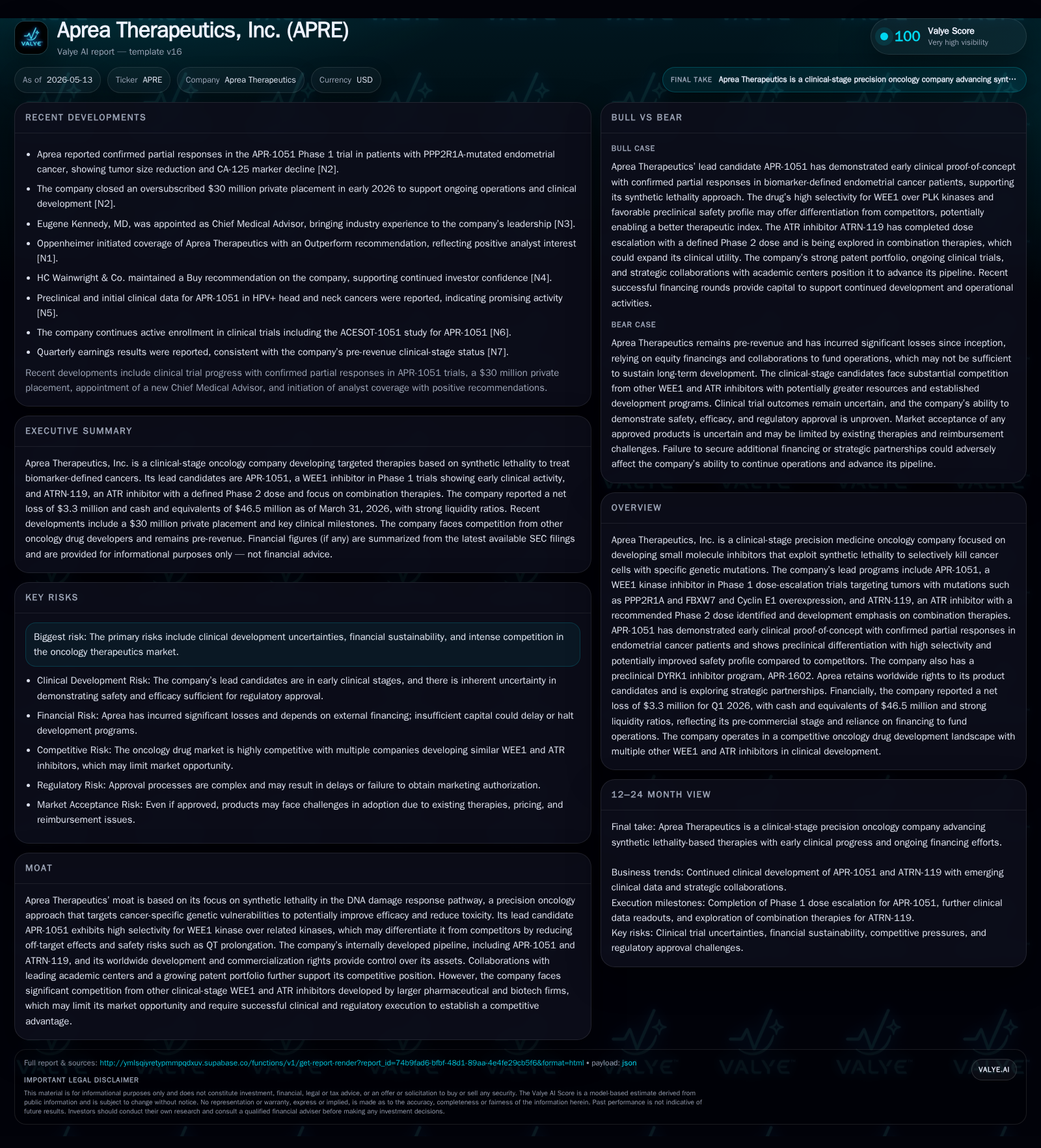
Aprea Therapeutics’ latest quarterly filing underscores encouraging clinical progress with its lead drug candidate APR-1051, a WEE1 kinase inhibitor, now enrolling at higher doses showing potential dose-response benefits. The company continues to advance its ATR inhibitor ATRN-119 and DYRK1 inhibitor APR-1602 programs, maintaining worldwide rights to its pipeline assets. Supported by nearly $46.5 million in cash and a very strong current ratio of 8.9, Aprea remains well-positioned financially to sustain development activities. Its synthetic lethality-driven oncology approach targets genetically defined cancers for improved efficacy and safety but faces significant competitive and regulatory risks ahead.
Recent Operating Update: Clinical Progress and Financial Position
In its latest quarterly report filed May 13, 2026, Aprea Therapeutics highlighted ongoing enrollment in the eighth cohort of its Phase 1 dose-escalation study (ACESOT-1051) for APR-1051, a selective WEE1 kinase inhibitor [S2]. The clinical trial has tested daily doses up to 220 mg, with preliminary data showing a potential dose-response relationship characterized by increased single-agent antitumor activity across cohorts ranging from 70 mg to 220 mg. Notably, Aprea announced confirmed partial responses in patients with endometrial cancer bearing specific mutations such as PPP2R1A and FBXW7 along with Cyclin E1 overexpression—offering early proof-of-concept for the precision oncology approach [S3],[S13].
Alongside this, Aprea is progressing ATRN-119, its ATR inhibitor program that recently identified a recommended Phase 2 dose primarily geared towards combination therapies leveraging the DNA damage response pathway synergy [S1]. It also maintains a preclinical program targeting DYRK1 (APR-1602), underpinning strategic pipeline diversification.
Financially, the company reported cash and equivalents totaling approximately $46.5 million as of Q1-end March 31, 2026, paired with current assets near $47.2 million and limited current liabilities of roughly $5.3 million—yielding a robust current ratio of 8.9 which provides a strong liquidity buffer to support ongoing R&D activities [F1].
Business Model: Synthetic Lethality Drives Targeted Oncology Strategy
Aprea Therapeutics operates as a clinical-stage precision medicine oncology company focused on exploiting synthetic lethality mechanisms within the DNA damage response (DDR) pathway [S1]. Their small molecule inhibitors aim to selectively target cancer cells harboring specific genetic defects while sparing normal tissue, thereby potentially widening the therapeutic window—a critical advantage to reduce toxicity common in conventional chemotherapy.
Revenue mechanics hinge heavily on successful clinical development milestones leading toward regulatory approval and eventual commercialization. Currently not generating product revenues, funding primarily derives from equity financings as evidenced by recent capital raises including a $30 million private placement completed earlier in 2026 [N2],[S13]. Revenues will ultimately depend on successful market entry post-FDA or other health authority approvals.
The core of their offering is APR-1051—a WEE1 kinase inhibitor designed for tumors exhibiting mutations like PPP2R1A and FBXW7 or those overexpressing Cyclin E1. WEE1 kinase regulates multiple cell-cycle checkpoints; inhibiting it can exacerbate DNA damage selectively in tumor cells that have lost compensatory repair pathways [S1]. This mechanism mimics a targeted cytotoxic effect based on underlying tumor genetics.
The company claims that APR-1051 achieves higher selectivity for WEE1 compared to related kinases than competing candidates, potentially mitigating off-target effects including arrhythmogenic QT prolongation commonly observed in similar kinase inhibitors [S1]. The strategic advantage lies in balancing potency with safety—a key differentiation factor attracting oncologists aiming for agents that are both efficacious and tolerable.
Also notable is ATRN-119 targeting ATR kinase—a central DDR regulator often co-dependent with WEE1 pathways—where combination regimens are being pursued to maximize synthetic lethality effects [S1]. The inclusion of a preclinical DYRK1 program broadens their pipeline into complementary regulatory kinases involved in cancer progression.
Industry Structure and Competitive Position
The precision oncology segment focusing on synthetic lethality via DDR inhibition involves heavy competition from well-capitalized pharmaceutical companies working on WEE1 inhibitors like Merck's adavosertib or ATR inhibitors such as AstraZeneca’s ceralasertib. These incumbents enjoy extensive clinical experience and collaborations with large oncology networks.
Aprea’s moat derives from its highly selective small molecules developed internally alongside global IP control—granting flexibility for commercialization strategies without licensing constraints [S1]. Collaborations with academic research centers amplify access to biomarker-driven patient populations critical for trial enrollment.
However, entering markets dominated by large players could impose significant challenges regarding pricing power, market penetration, and payer acceptance. The landscape is shaped by complex reimbursement frameworks increasingly focused on cost-effectiveness alongside clinical benefit—pressuring new entrants to demonstrate clear value propositions against existing standards [S11],[S14].
Growth Drivers
Clinical Milestones Fuel Pipeline Validation
Advancing through dose-escalation cohorts for APR-1051 creates near-term catalysts through additional safety, pharmacokinetic, biomarker correlation, and efficacy signals that could trigger expanded trials or partnership interest. Confirmed partial responses reported invigorate confidence among stakeholders that the therapeutic hypothesis can translate into tangible patient benefit [S13].
Expansion into Combination Therapies
ATRN-119’s recommended Phase 2 dose focused on combinations heralds growth potential as emerging oncology regimens increasingly rely on multi-agent strategies to overcome resistance. Success here would broaden indications beyond monotherapy niches creating cross-selling opportunities within an integrated DDR inhibition approach [S1].
Pipeline Diversification
APR-1602’s preclinical stage DYRK1 inhibitor provides optionality beyond lead assets, representing early-stage innovation that could feed future development cycles if current candidates face setbacks or plateau in utility.
Financial Stability Enables Sustained Development
Maintaining nearly $46.5 million in cash resources supported by minimal liabilities affords runway visibility essential for completing planned pivotal trials without urgent dilution risk [F1],[S2]. Regular public updates articulate management’s roadmap enhancing investor confidence in prudent capital deployment.
Risks / Watchpoints / Growth Constraints
The foremost operational risk is clinical execution uncertainty inherent to early-stage drug development where initial pharmacodynamic promise may fail larger confirmatory tests—potentially requiring program redesign or termination [S4],[S6]. Enrollment challenges or unexpected adverse events could delay timelines significantly.
Financially, while liquidity appears solid now, continued reliance on capital raises subjects the company to financing market volatility risks which might constrain long-term R&D initiatives if unfavorable conditions arise [S12],[F1].
Competitive pressures from established pharmaceutical incumbents with broader development capabilities may limit commercial viability absent clear differentiation or strategic partnerships. Regulatory environments globally remain dynamic; US healthcare reforms intend continued scrutiny on prescription drug pricing which may delay or complicate market access even post-approval [S11],[S20].
Compliance risks are non-trivial given intense regulation governing drug promotion practices under Anti-Kickback Statutes and False Claims Act exposure—missteps here can result in sizeable penalties affecting reputation and resources [S15],[S19].
Market adoption dynamics depend heavily on convincing payors to reimburse precision medicines aimed at smaller biomarker-defined populations—a hurdle involving robust real-world evidence generation alongside compelling trial data.
What to Watch Next
Key upcoming milestones revolve around further accrual data from ACESOT-1051 Phase 1 cohorts at doses beyond 220 mg assessing tolerability limits and efficacy signals which could unlock accelerated development pathways or expansion into new tumor types.
Progression into Phase 2 studies for ATRN-119 including combination therapy results will provide insights into broader clinical applicability.
Any regulatory designations such as breakthrough therapy status granted for either lead candidate would be material given their potential impact on development tempo.[S11]
Additionally, watch financing activities evidencing how management plans capital allocation relative to pipeline progress indications and external funding environments.
Financial Profile (As of Q1 2026)
Latest financial snapshot
| Metric | Value | Period |
|---|---|---|
| Cash & equivalents | $46mm | |
| 2026-03-31 | ||
| Current assets | $47mm | |
| 2026-03-31 | ||
| Current liabilities | $5mm | |
| 2026-03-31 | ||
| Current ratio | 8.92x | |
| 2026-03-31 |
Source: SEC companyfacts cache [F1].
| Metric | Value | Period Ending |
|---|---|---|
| Cash & Equivalents | $46.47M | |
| 2026-03-31 | ||
| Current Assets | $47.25M | |
| 2026-03-31 | ||
| Current Liabilities | $5.30M | |
| 2026-03-31 | ||
| Current Ratio | 8.92x | |
| 2026-03-31 |
This mix reflects prudent balance sheet management typical of biotech firms pre-commercialization stage reliant on equity funding coupled with conservative liability levels enabling longevity without immediate refinancing pressures [F1],[S2]. Operating losses remain consistent due to high R&D spend typical at current stage but funded adequately given cash position.
Disclaimer
This analysis does not constitute investment advice or recommendations. It is based solely on publicly available information up to May 13, 2026 and aims to provide an informed industry perspective integrating SEC disclosures and relevant sector knowledge.
Disclaimer: This is research-only, informational analysis and not investment advice. It may include AI-generated interpretation and general industry context. Always verify important details using primary sources.

Comments