
Nocera’s Strategic Pivot Tests Resilience Amid Listing Challenges
Faced with Nasdaq compliance risks, Nocera adapts its fish trading and e-commerce model while managing legacy aquaculture consulting and financial pressures.
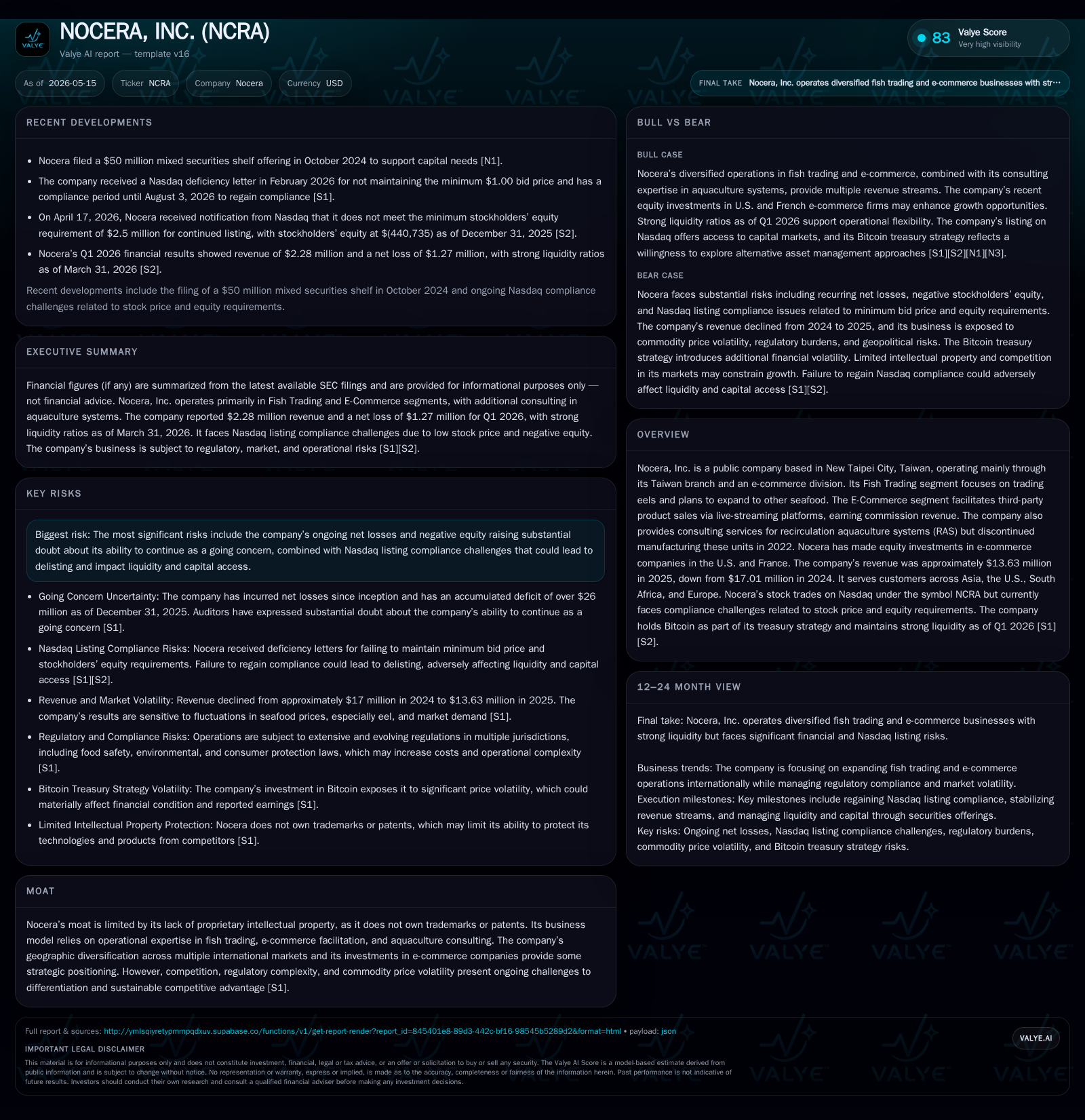
Nocera, Inc. reported in its latest 10-Q filing that it currently fails to meet Nasdaq's minimum stockholders’ equity requirement, triggering an imminent compliance deadline. The company continues its pivot away from manufacturing recirculation aquaculture systems (RAS), focusing on fish trading and commission-based e-commerce facilitation across multiple geographies. While geographic diversification and strategic investments in e-commerce firms may offer growth avenues, Nocera confronts substantial risks including negative equity, ongoing losses, and volatile commodity markets. The near-term outlook is dominated by the urgency of Nasdaq listing compliance efforts and operational restructuring.
Latest Quarterly Operating Update: Compliance and Shifting Priorities
In its latest Form 10-Q dated May 14, 2026, Nocera disclosed receipt of a letter from Nasdaq's Listing Qualifications Staff notifying the company that it no longer satisfies the minimum stockholders’ equity threshold of $2.5 million required under Nasdaq Listing Rule 5550(b)(1) [S2][S3]. As of December 31, 2025, stockholders’ equity was negative $(440,735), prompting a formal compliance notification with a mandated deadline of June 1, 2026 to submit a remediation plan. If accepted, Nasdaq may grant an extension up to 180 days to regain compliance [S3]. Should Nocera fail these requirements, delisting would severely restrict liquidity and access to capital markets.
This near-term regulatory pressure converges with ongoing strategic shifts: Nocera ceased manufacturing recirculation aquaculture systems (RAS) in late 2022 but continues consulting leveraging its RAS expertise [S1]. Additionally, the company actively expanded its e-commerce footprint through substantial equity investments in third-party digital marketplace platforms based in the U.S. and France during 2025 [S1]. Meanwhile, fish trading remains centered on eel products primarily routed through the Taiwan branch operations [S1]. This portfolio diversification is layered atop a legacy catering business divested at year-end 2025 [S1].
Business Model Overview: Diverse Streams with Operational Nuances
Nocera operates two primary segments:
Fish Trading: Conducted through its wholly owned Taiwan branch (NTB), this segment focuses on sourcing and selling live eels alongside plans to expand into additional seafood categories. Upon customer orders, Nocera arranges harvests, quality inspections against customer specs, logistics coordination, and delivery [S1]. Revenue here is volume-driven but susceptible to fluctuations from biological supply cycles and commodity pricing.
E-Commerce: Managed by an unincorporated division named Xinca, this segment acts as an intermediary facilitating third-party sales on live-streaming platforms. It does not hold inventory but earns commission revenue calculated on net sales value realized from live sales events [S1]. This asset-light structure reduces balance sheet risk but faces intense competition given low switching costs among vendors.
Aquaculture Consulting: Post discontinuation of manufacturing RAS bulk units in late 2022 due to capital intensity and operational challenges, Nocera retained consulting capabilities around designing and installing land-based RAS facilities that enable high-density fish farming through water recirculation technologies [S1]. This expertise aligns well with global environmental regulatory trends pushing for sustainable aquaculture practices.
Together these segments represent differing margin profiles and growth complexities. Fish Trading is inherently commodity-exposed and vulnerable to supply volatility; E-Commerce generates commission-based fees with higher scalability but lower pricing power; RAS consulting is specialized but regional with regulatory dependencies.
Competitive Environment: Commodities, E-Commerce Platforms, and Consulting
Fish trading competes within a fragmented seafood supply chain where margins are pressured by biological variability impacting availability (especially for species like eel), plus fluctuating global commodity prices. Managing these supply risks while meeting detailed customer specifications requires operational proficiency but offers limited differentiation absent proprietary technology or scale advantages.
E-Commerce facilitation hinges on platform partnerships leveraged through live-stream events that have surged globally. Yet this space is commoditized with many small agents competing for vendor contracts; thus commission rates are under pressure and clients may switch easily. The lack of direct product control also constrains margin expansion.
In aquaculture consulting for RAS systems, regulatory frameworks incentivize clean water usage and sustainable fish farming practices—creating niche demand for expertise in system design compliant with various local health/environmental laws primarily focused in Taiwan but extending globally [S29]. However, certification processes can be lengthy and costly for clients impeding rapid adoption rates.
Growth Drivers: Geographic Reach, E-Commerce Investments, and RAS Consulting Expertise
Nocera’s multi-region presence—serving customers across Asia (primarily Taiwan), United States, South Africa, and Europe—mitigates single-market cyclicality. This geographical diversification provides avenues for expanding fish trading volumes as well as scaling commission revenues from varied digital shopping cultures increasingly adopting livestream commerce models.
Strategic acquisitions of minority stakes in two foreign e-commerce entities during calendar year 2025 enhance exposure to higher growth markets digitally transforming retail sectors [S1][S2]. These investments augment Nocera’s capability to cross-leverage operational know-how while sharing upside potential without capital-intensive expansions.
RAS consulting leverages the company’s core technological expertise supporting clients aiming to produce fish sustainably with minimal ecological footprint—a trend gaining traction amid global freshwater scarcity concerns [S1]. Potential exists to commercialize proprietary design knowledge as governments impose stricter environmental standards enhancing barriers against less-specialized competitors.
Risks and Constraints: Nasdaq Listing Concerns, Negative Equity, and Market Volatility
A paramount risk shadowing all strategic initiatives remains Nasdaq’s listing compliance threat driven by persistent negative equity balances. With the latest fiscal year-end showing $(440K) in shareholders’ deficit alongside cumulative $26 million+ accumulated deficits ([S1],[S2]), the company faces material doubt about viability reflected explicitly in auditors’ going concern opinions [S1]. Failure to resolve these could lead to delisting disrupting share liquidity besides tarnishing stakeholder perceptions.
Revenue volatility resulting from dependency on commodity markets—specifically eel supply chains—amplifies operational uncertainty coupled with price-sensitive buyers limiting pricing power. Concurrently competitive pressures within low-moat e-commerce intermediation spaces compress margins.
Regulatory environments governing aquaculture—ranging from licensing hurdles to sanitary inspections—introduce execution risks affecting both client onboarding speed for consulting services as well as compliance cost burdens [S29]. Ongoing geopolitical tensions or pandemic-related disruptions could further exacerbate operational constraints.
Next Steps: Key Milestones and Compliance Plan Timeline
Critical near-term milestones center around Nasdaq’s enforcement timetable. Having received deficiency notification on April 17, 2026 requiring submission of a detailed plan by June 1, Nocera aims to outline capital or operational restructuring measures intended to restore minimum equity levels [S3][S19]. Acceptance by Nasdaq would grant up to six additional months for demonstration of compliance providing breathing room.
Market reaction will likely hinge upon perceived credibility of these plans alongside prospective capital raises or cost rationalizations intended. The possibility remains that proposed reverse stock splits or convertible securities issuances might form part of remedies previously approved by shareholders early in 2026 as contingency tools [S24][S28].
Financial Snapshot: Liquidity and Profitability Overview
Latest financial snapshot
| Metric | Value | Period |
|---|---|---|
| Cash & equivalents | $5mm | |
| 2026-03-31 | ||
| Current assets | $6mm | |
| 2026-03-31 | ||
| Current liabilities | $709751 | |
| 2026-03-31 | ||
| Current ratio | 8x | |
| 2026-03-31 |
Source: SEC companyfacts cache [F1].
As of the most recent quarter-end data available in early Q2 2026 filings ([F1]), Nocera holds approximately $5.4 million in cash equivalents against minimal outstanding debt below $25K reflecting a low leverage profile but modest financial cushion given ongoing operating losses estimated at nearly $2.7 million annually ([S1]).
However, recurring net losses have systematically eroded shareholder equity leading to sustained negative net worth ([S1]). Top-line contraction from approximately $17 million revenue in calendar year 2024 down to $13.63 million in 2025 reflects challenges scaling all segments amid competitive intensity.
Notably since January 2026 Nocera has allocated $2 million toward Bitcoin corporate treasury investments aiming at portfolio diversification though such strategy introduces asset volatility unrelated directly to core operations ([S22]).
Disclaimer: This analysis is based solely on publicly available SEC filings and related disclosures as of May 15, 2026. It does not constitute investment advice or recommendations regarding securities of Nocera, Inc. Readers should conduct independent due diligence before forming conclusions about the company’s prospects or market position.
Disclaimer: This is research-only, informational analysis and not investment advice. It may include AI-generated interpretation and general industry context. Always verify important details using primary sources.

Comments