
Western Uranium & Vanadium Advances Proprietary Processing Plant Amid Supply Deficit
Western Uranium & Vanadium reports significant progress on its Mustang Mineral Processing Plant and mining operations, positioning itself amid a tightening uranium supply-demand landscape.
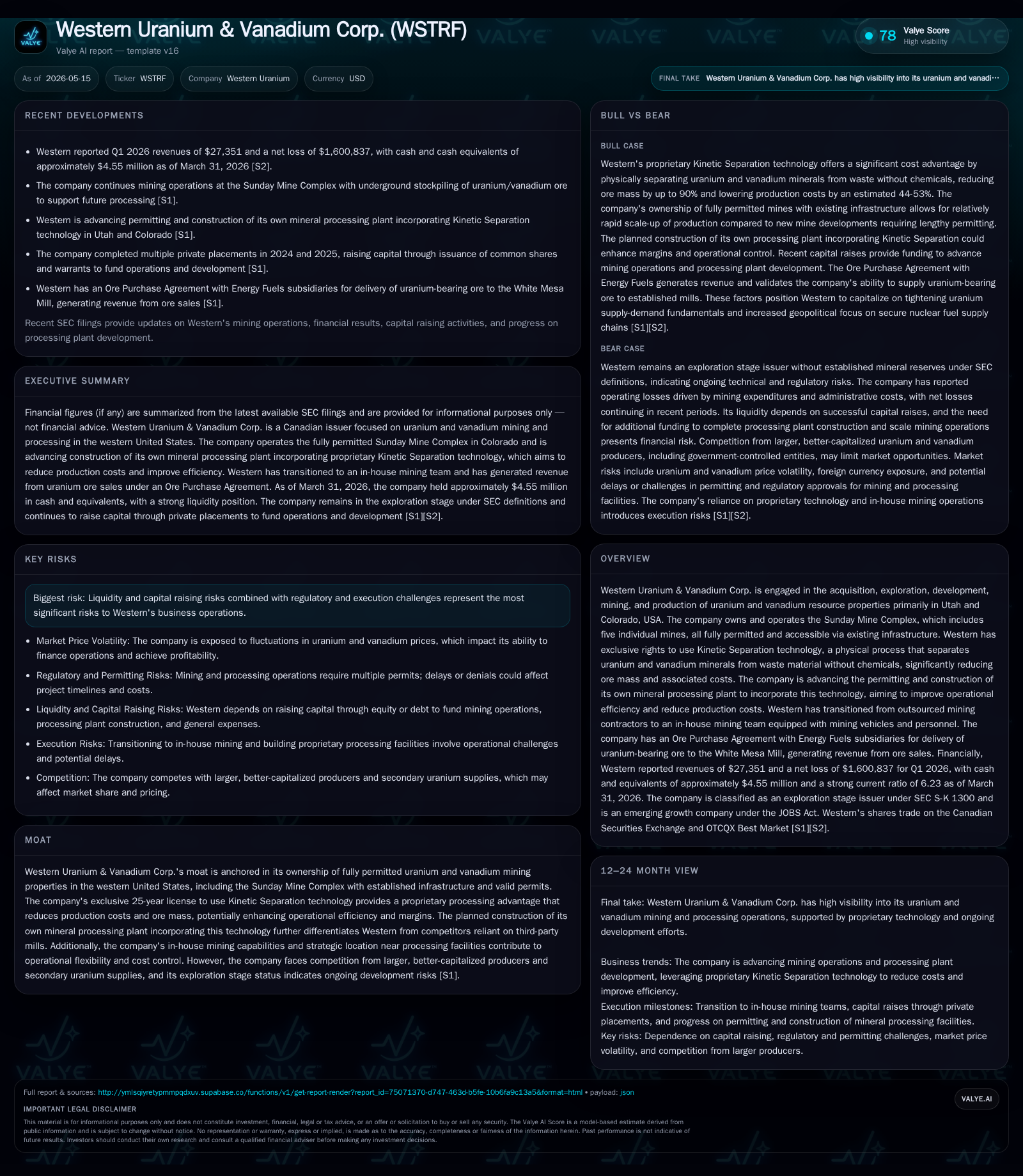
In its latest quarterly filing dated May 14, 2026, Western Uranium & Vanadium Corp. detailed substantial operational advancements, including permitting and construction progress on its proprietary Mustang Mineral Processing Plant that incorporates exclusive Kinetic Separation technology. The transition to an in-house mining team at the Sunday Mine Complex enhances cost control and operational flexibility. This development occurs in a market characterized by a structural multi-year uranium supply deficit, underpinning potential demand for near-term production ramp-up. However, capital raising and regulatory challenges remain key risks facing the company.
Latest Quarterly Operating Update Focuses on Processing Plant and Mining Operations
Western Uranium & Vanadium Corp.'s most recent quarterly report filing (10-Q) dated May 14, 2026 [S2] highlights continued progress in the company's strategic shift toward vertically integrated uranium and vanadium production via proprietary mineral processing capabilities. Notably, the company is advancing the permitting process for its Mustang Mineral Processing Plant, designed to incorporate its exclusive Kinetic Separation technology which physically separates uranium and vanadium minerals from waste material without chemical treatments. This technological integration is expected to reduce ore mass processed downstream dramatically, thereby cutting costs related to transport, power consumption, acid usage, and tailings disposal.
Concurrently, Western has substantially completed its transition from outsourced mining contractors to an in-house mining team operating at its Sunday Mine Complex (SMC). This team is equipped with newly acquired mining vehicles and personnel ready to deploy dual fully equipped mining teams. The direct operational control gained through this shift enhances flexibility in mining scheduling and cost management while supporting ore stockpiling underground to ensure steady feedstock supply to the planned mineral processing facilities.
These operational updates underscore Western's ambition to improve cost efficiency across the extraction-to-processing value chain at a time when uranium supply is tightening globally.
Business Model: Vertical Integration and Exclusive Processing Technology
Western Uranium & Vanadium’s business model centers on the acquisition, development, mining, and processing of uranium and vanadium resources primarily located in Utah and Colorado [S1]. The company’s largest asset suite is the Sunday Mine Complex — comprising five fully permitted mines with extensive existing infrastructure such as paved road access, electric power availability within underground declines, office buildings, storage facilities, and sophisticated haulage networks including vent shafts outfitted with exhaust fans.
A core differentiator lies in Western’s exclusive 25-year license to utilize Kinetic Separation technology [S1], a physical process that effectively separates high-grade uranium/vanadium mineralization from coarse barren sands early in the processing chain without chemical additives. By isolating approximately 85-90% of waste material before conventional milling steps, this technology reduces ore throughput by concentrating valuable minerals into roughly 10-20% of initial sample mass. This yields multiple benefits: substantial cuts in handling time and radiometric exposure risk during mining; reduced transportation volumes; diminished power/acid requirements at milling; decreased post-milling tailings volume; along with potential environmental benefits relating to legacy stockpile remediation.
The strategy prioritizes constructing Western’s own Mustang Mineral Processing Plant incorporating Kinetic Separation onsite over reliance on third-party mills — enabling tighter operational control and margin improvement.
Vertical integration further extends into complete in-house mining operations following years of outfitting vehicles and personnel transitioning away from contracts. This move is designed to reduce production costs while providing better responsiveness to logistical challenges underground.
Through this tightly controlled integrated model — from mine permits through proprietary processing — the company seeks competitive cost advantages particularly valuable amid an anticipated tightening uranium market.
Competitive Positioning Within the Uranium and Vanadium Market
The uranium industry is structured around large-cap established producers complemented by mid-tier companies like Western that leverage regional permits and niche technologies [S1]. Western differentiates itself with fully permitted assets concentrated on legacy deposits amenable to Kinetic Separation within the western U.S.—a region benefiting from accessible infrastructure mitigating typical remotewarehousing cost burdens common elsewhere.
Capacity constraints elsewhere come from limited mill availability—the U.S. domestic milling infrastructure is tightly regulated with few operational processors—making Western's plan for an independently operated plant key for securing feedstock throughput without third-party bottlenecks. This lowers execution risk linked to external contract mills’ capacities.
The company’s resource base rooted in historically mined deposits provides above-average project readiness compared with greenfield exploration juniors requiring extended development cycles.
While larger players benefit from scale and deeper financial reserves allowing aggressive production ramp-ups or hedging strategies, mid-tier companies like Western rely heavily on niche technologies (Kinetic Separation exclusivity) combined with geographic permits to carve out competitive cost positions.
Pricing power for uranium benefits broadly from a global supply deficit state established by utility inventory drawdowns amid shifting energy policies favoring nuclear fuel as a low-carbon baseline power source.
Growth Drivers in a Structural Uranium Supply Deficit
According to the latest annual disclosures [S1], the uranium market faces a profound multi-year structural supply deficit stemming mainly from depleted inventories alongside cautious supply-side responses after prolonged bear markets post-Fukushima. Rising nuclear reactor builds globally—especially in China—and restarting reactors notably in Japan stimulate accelerating utility demand for uranium fuel pellets.
Western’s near-term production readiness due to its Sunday Mine Complex active permits combined with anticipated completion of their Mustang processing plant incorporating Kinetic Separation places it strategically as one of few operators potentially able to increase output quickly once price thresholds justify full-scale operations [S1].
This creates growth potential if contracts or spot prices reach levels encouraging capital deployment beyond current developmental stages. Incremental milestones such as advancing plant construction permits or regulatory acceptance for expanded use of proprietary technology are critical catalysts.
In addition, environmentally focused demand drivers exist given Kinetic Separation technology’s capacity for remediating legacy stockpiles of uranium ore—potentially unlocking new material streams consistent with broader energy transition goals emphasizing emission reductions [S3].
Key Risks Including Capital Constraints and Regulatory Hurdles
Western faces clear risks primarily tied to capital requirements necessary for completing construction of its mineral processing plant along with expanding scaled-up operations at Sunday Mine Complex [S1][S2]. The capital-intensive nature of mill construction combined with uncertainties surrounding regulatory approvals for licensing full use of Kinetic Separation present execution timing risks that could delay operational ramp-ups.
Liquidity constraints are non-trivial given operating losses persist ($7.29 million loss reported year ending December 31, 2025) alongside ongoing investments [F1][S2]. The company depends heavily on continued access to equity or debt financing to fund these strategic initiatives without guaranteed timelines or pricing environments favorable enough to trigger full start-ups.
Regulatory compliance within both states of operation—and associated federal agencies—adds layers of oversight complexity especially considering novel technology deployments that require explicit permitting.
Competition for project funding among multiple uranium producers also pressures cost-of-capital dynamics which could hinder timely capital access during volatile commodity markets.
Strategic Insights: Next Milestones and Market Demand Signals
Near-term indicators that will validate Western's growth outlook include:
- Progress updates on Mustang Mineral Processing Plant permitting approvals leading toward commencement or acceleration of construction activities [S2].
- Receipt of regulatory green lights specific to expanded use licenses permitting unrestricted deployment of patented Kinetic Separation technology within processing operations.
- Utility contracting activity increases reflecting rising uranium procurement by nuclear power operators anticipating fuel restocking driven by global clean energy policies.
- Expansion signals within mining operations manifested by commissioning additional equipment or increased underground ore stockpiling volumes at SMC signaling readiness for plant feed throughput ramp-up.
- Execution milestones regarding successful financing rounds maintaining liquidity buffer sufficient for sustained development outlays [S1][S2].
Monitoring these points can help assess whether Western can capitalize effectively on nuclear fuel market tailwinds amidst supply constraints.
Financial Snapshot Reflecting Liquidity and Operating Performance
Latest financial snapshot
| Metric | Value | Period |
|---|---|---|
| Cash & equivalents | $4.55mm | |
| 2026-03-31 | ||
| Current assets | $5.05mm | |
| 2026-03-31 | ||
| Current liabilities | $0.81mm | |
| 2026-03-31 | ||
| Current ratio | 6.23x | |
| 2026-03-31 |
Source: SEC companyfacts cache [F1].
This snapshot underscores Western's adequate liquidity position entering Q2 2026 with cash buffers supporting planned capital expenditures despite ongoing operating losses reflecting investment stage [F1][S2].
Overall, while the financial footing appears stable short term, sustaining this momentum hinges critically on successful capital raises aligned with commercial milestones keyed toward bringing Mustang Mineral Processing Plant online at scale.
Disclaimer: This analysis is based solely on information available up to May 15, 2026, including SEC filings referenced herein. It reflects no investment advice or recommendation but aims only to provide an informed business analysis.
Disclaimer: This is research-only, informational analysis and not investment advice. It may include AI-generated interpretation and general industry context. Always verify important details using primary sources.

Comments