
Tempest Therapeutics Advances Dual-Targeting CAR-T Pipeline with Capital Efficiency Constraints
Latest quarterly filing spotlights clinical progress, capital limitations, and a strategic pivot to partnered development.
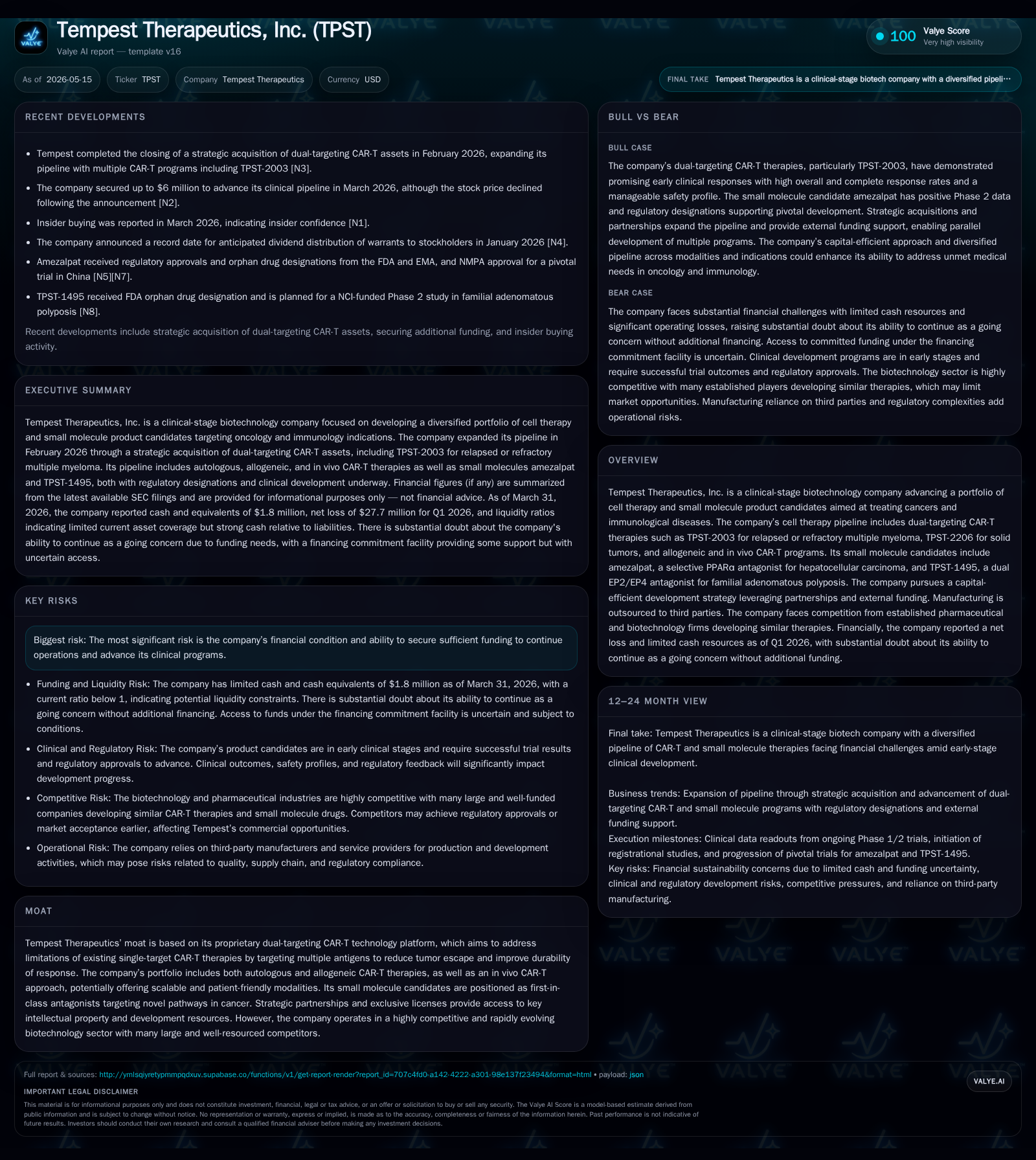
Tempest Therapeutics reported a significant step up in its clinical portfolio during Q1 2026, notably expanding its dual-targeting CAR-T therapy programs through an asset acquisition. The company pursues a capital-efficient strategy emphasizing partnerships and external funding to advance its diversified cell therapy and small molecule pipeline. Despite promising clinical milestones, the firm's fragile liquidity position raises continuing operational risks. Its competitive moat rests on novel dual-targeting CAR-T platforms addressing current therapy shortcomings, but financing uncertainty clouds near-term growth prospects.
Recent Operating Update
In the quarterly report filed May 14, 2026 ([S2], [S3]), Tempest Therapeutics detailed critical developments anchored by its February 2026 strategic acquisition of dual-targeting CAR-T assets from Erigen LLC and Factor Bioscience Inc. This transaction significantly broadened Tempest's cell therapy portfolio with candidates such as TPST-2003—an autologous CD19/BCMA dual-targeting CAR-T therapy currently engaged in Phase 1/2a trials for relapsed or refractory multiple myeloma (rrMM)—alongside programs like TPST-2206 targeting solid tumors and allogeneic therapies TPST-3003/3206 featuring gene editing at the TRAC locus for T-cell receptor disruption ([S2], [S5], [S13]).
Simultaneously, the company's financial disclosure highlights acute liquidity constraints: cash and equivalents stood at approximately $1.8 million as of March 31, 2026 with current assets of $2.45 million versus liabilities of $3.31 million, yielding a current ratio below one at 0.74 ([F1]). While Tempest secured an up-to-$20 million flexible credit line (FCL) from Factor Bioscience post-acquisition, only $13.8 million remains available under this facility with material uncertainty about access due to stringent conditions ([S2], [S11], [S16]). This financial backdrop imposes near-term risks on ongoing operations if additional financing cannot be reprised.
Business Model
Tempest operates as a clinical-stage biotech innovator focusing on a hybrid portfolio of advanced cell therapies (notably next-generation dual-targeted CAR-Ts) and small molecule oncology agents. Revenue generation is not yet established since the company is pre-commercial; operating losses continue while capital is deployed towards clinical trials and regulatory milestones ([F1], [S1]).
Its revenue mechanics will eventually rely on licensing deals, milestone payments, and eventual sales of approved therapies. Current model emphasizes capital efficiency by outsourcing manufacturing and leveraging partnerships to fund crucial late-stage development phases—evidenced by collaborations like Novatim Immune Therapeutics’ funding for TPST-2003 China trials and NCI support for TPST-1495’s Phase 2 FAP study ([S5], [S7], [S18]).
Margins and cash conversion remain untested but are expected to improve post-commercialization contingent on successful pivots from R&D spend to revenue recognition.
Industry Structure and Competitive Position
Dual-targeting CAR-T therapies represent an evolution within the broader immuno-oncology sector aiming to overcome issues like antigen escape that limit single antigen CAR-T durability. Tempest’s proprietary platform targets multiple antigens simultaneously—for example, CD19/BCMA in hematologic cancers or CD70 combinatorial targeting for solid tumors—with both autologous and allogeneic approaches allowing potential scale-up beyond personalized manufacturing constraints ([S1], [S10]).
Competitors include established large pharma groups developing single or multi-antigen CAR-T products alongside emergent biotechs innovating gene-edited or off-the-shelf solutions. Differentiation hinges on effective tumor targeting breadth, manufacturing scalability (allogeneic gene-edited cells), tolerability profiles, and clinical efficacy signals. Tempest’s addition of an in vivo CAR-T program further broadens modality options potentially improving patient convenience.
Small molecules like amezalpat compete in niche oncology segments with novel mechanisms such as selective PPARα antagonism combined with checkpoint inhibitors—a strategy designed to overcome resistance mechanisms. Similarly, TPST-1495 addresses unmet prevention needs in FAP through PGE2 receptor antagonism backed by NCI sponsorship.
Growth Drivers
Clinical Progression & Pipeline Expansion
TPST-2003: Near-term data expected from ongoing Phase 1/2a trials in China; registrational Phase 2b initiation anticipated end-2026 with interim readouts in 2027 funded via strategic partnership ([S18]). This candidate anchors Tempest's commercial hopes in hematologic oncology.
Allogeneic & In Vivo Modalities: TPST-3003 (allogeneic BCMA/CD19) and TPST-4003 (in vivo) are preclinical-stage programs slated for partner-funded investigator initiated trials soon—expanding scalable immunotherapy offerings ([S18]).
Small Molecule Development & External Funding Models
Amezalpat: Completed randomized Phase 2 for first-line hepatocellular carcinoma; poised for Phase 3 business development discussions leveraging positive regulatory designations including Fast Track and Orphan Drug Status from FDA as well as EMA orphan designation ([S7], [S19]).
TPST-1495: Novel dual EP2/EP4 prostaglandin receptor antagonist aimed at cancer prevention in familial adenomatous polyposis; Phase 2 trial expected to start within the year under NCI funding via CP-CTNet support allowing financial capital preservation ([S7], [S18]).
Capital-Efficient Strategic Framework
The company’s growth relies heavily on staged clinical advancement aligned with external funding sources—minimizing upfront R&D burden—and using milestone-driven licensing arrangements underpinning later-stage development investments (3031[S5], [S18]). This approach reflects industry trends where mid-tier biotech firms seek risk-sharing deals due to prohibitively high solo capital demands.
Risks / Watchpoints / Growth Constraints
Financial Viability: Cash runway covers less than one year at current burn rates requiring imminent access to external capital under uncertain terms ([F1], [S2]). Failure would precipitate project delays or cessation.
Clinical Execution: Outcome risks inherent in early-phase immuno-oncology development with dependency on trial data readouts that may impact partner willingness or subsequent funding ability.
Competitive Intensity: Larger players with deeper resources could eclipse Tempest through faster approvals or more efficacious product launches despite innovative dual-targeting technology ([S10]).
Regulatory Complexity: Both US and international approvals require extensive safety/efficacy evidence compounded by healthcare pricing reforms potentially limiting reimbursement environments ([S6], [S14]).
What to Watch Next
Investors should monitor:
- Initiation of registrational Phase 2b trial for TPST-2003 in China and interim efficacy updates expected circa 2027.
- Commencement of NCI-sponsored Phase 2 study of TPST-1495 in FAP as a key validation point.
- Business development activity concerning progression of amezalpat into late-stage pivotal trials that could unlock value inflection via partnerships or licensing.
- Financing developments related to utilization or replenishment under the Factor FCL given current liquidity distress.
- Regulatory milestone outcomes which may accelerate or delay time-to-market trajectories.
Financial Profile (Brief Context)
Latest financial snapshot
| Metric | Value | Period |
|---|---|---|
| Cash & equivalents | $1805000 | |
| 2026-03-31 | ||
| Current assets | $2mm | |
| 2026-03-31 | ||
| Current liabilities | $3mm | |
| 2026-03-31 | ||
| Current ratio | 0.74x | |
| 2026-03-31 |
Source: SEC companyfacts cache [F1].
Cash & equivalents stood at approximately $1.8 million as of March-end 2026 against current liabilities around $3.31 million implying short-term liquidity mismatch ([F1]). Total debt was recorded at circa $4.2 million (last annual view). The company’s operating losses remain substantial reflecting ongoing developmental status without product revenues. It relies primarily on equity issuances, asset transactions (notably share issuance for the February acquisition), license agreements entailing milestone payments, and third-party funding pathways to sustain operations ([F1], [S11], [S16]).
This analysis synthesizes public SEC disclosures through May 2026 contextualized within biotechnology industry dynamics relevant to emerging cell therapy companies managing capital-intensive development cycles amid competitive innovation pressures. It does not constitute investment advice but strives for factual clarity anchored on verified filings.
Disclaimer: This is research-only, informational analysis and not investment advice. It may include AI-generated interpretation and general industry context. Always verify important details using primary sources.

Comments