
Drugs Made In America Acquisition Corp. Advances Merger with Power Analytics Global Amid Leadership Changes
DMAA prepares to complete its de-SPAC merger targeting a $1 billion valuation amid executive transitions and capital structuring efforts.
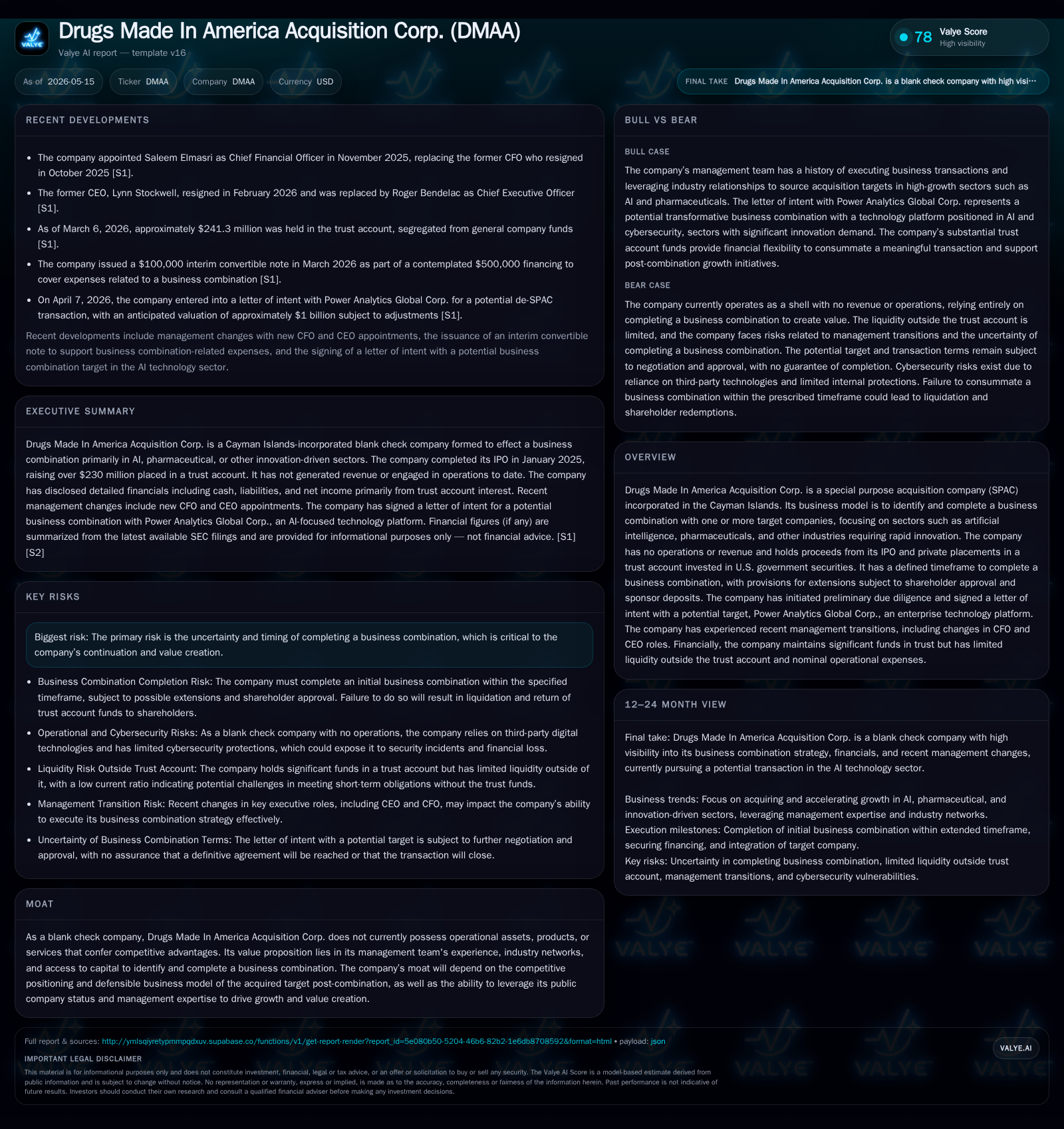
Drugs Made In America Acquisition Corp. (DMAA) remains focused on executing its initial business combination with Power Analytics Global Corp., a technology platform enterprise valued at approximately $1 billion. The company’s recent quarterly filing reveals leadership changes, including the resignation of its CEO and CFO transitions, alongside continued due diligence and capital commitments to support closing. As a SPAC with no operations or revenue, DMAA’s value hinges on the successful closing of this transaction and subsequent operational execution by the merged entity. The company’s financial position shows relatively limited cash compared to liabilities but holds significant funds in trust earmarked for the merger.
Recent Operating Update
The most consequential recent development for Drugs Made In America Acquisition Corp. (DMAA) came from its latest quarterly filing (Form 10-Q) on May 14, 2026 [S2], corroborated by an event filing (8-K) on May 5, 2026 [S3]. The filings disclose that DMAA is progressing toward completing its initial business combination (de-SPAC merger) with Power Analytics Global Corp. (PAGC), an enterprise technology platform valued near $1.0 billion subject to revenue contract verifications tied to valuation milestones.
This transaction remains subject to customary closing conditions: shareholder approval of the merger, SEC effectiveness of the Registration Statement on Form S-4, approval for listing of combined common stock on a national exchange, government clearances, and accuracy of merger representations [S3]. On closing, PAGC's outstanding shares will convert into common stock of the surviving entity per an agreed exchange ratio.
Parallel to these developments is significant management transition. Lynn Stockwell resigned as CEO and Executive Chair in February 2026 under circumstances related to sponsor withdrawals from affiliated accounts that raised governance concerns [S25][S26][S20]. Roger Bendelac has been appointed CEO effective immediately following Stockwell's departure [S25][S26], while Saleem Elmasri continued his CFO role since November 2025 through an external consulting arrangement [S23]. These shifts are crucial as they represent new stewardship aiming to steady corporate governance ahead of completing the merger.
Meanwhile, DMAA issued a convertible interim loan and engaged in sponsor transition financing totaling $100k initially with room for further proceeds up to $500k per agreements dated in March 2026 [S16]. This incremental capital supports working capital needs in advance of consummating the merger.
Business Model
As a special purpose acquisition company incorporated in the Cayman Islands since May 2024, DMAA's core proposition is not based on operations or product sales. It serves as a publicly-listed vehicle that raises capital via IPO and private placements — notably over $231 million placed into a trust account invested primarily in short-dated U.S. government securities — earmarked for acquiring an operating business within predefined deadlines [S1][S4][F1].
Revenue and operating profit are nonexistent at this stage; financial activity stems exclusively from interest income earned on trust-funds less administrative expenses needed to maintain regulatory compliance and execute acquisition due diligence [S1][F1]. Upon completing a business combination, DMAA transitions from an investment shell into an operationally active public company through reverse merger mechanics.
Their strategic focus prioritizes sectors requiring swift innovation such as artificial intelligence and pharmaceuticals — industries characterized by high R&D intensity, growing secular demand drivers, and technical complexity [S10][S14]. DMAA seeks proven industry leaders displaying sustainable competitive advantages and multiple expansion avenues that can leverage the public listing status for broader capital access and growth accelerations.
This model places great emphasis on management’s ability to source proprietary deals within its network and perform meticulous due diligence—including evaluation of commercial contracts, legal compliance, operational capabilities, and scalability potential—to ensure acquisition candidates align with strategic criteria [S1][S14].
Industry Structure and Competitive Position
SPACs targeting highly technical sectors such as AI platforms or pharmaceutical innovations face a dual challenge: identifying targets with credible defensible moats amid fast-evolving technologies while competing against other financial sponsors hungry for similarly high-growth assets. Because DMAA possesses no operational assets itself pre-transaction, its competitive position is fundamentally linked to the quality and defensibility of its eventual target post-merger plus post-merger management expertise.
Within this context, PAGC represents an influential player within enterprise technology platforms focused presumably on data analytics or AI-driven solutions—a space increasingly central to digital transformation initiatives across industries. The indicated $1 billion estimated valuation suggests PAGC operates at scale with validated contracts forming part of its backlog—a key measure distinguishing serious platform companies capable of sustained revenue generation.
However, competitive pressures exist due to sector fragmentation with multiple vendors offering overlapping technology stacks and innovation cycles continually shortening due to rapid software evolution. Hence post-merger performance will depend on effective scale-up strategies including market expansion, product enhancement cycles, integration of add-on acquisitions highlighted by DMAA management as part of growth plans [S17].
Growth Drivers
Several structural growth drivers underpin DMAA's rationale for pursuing a particular target like PAGC:
- Secular Demand in AI & Pharma: Both sectors exhibit robust secular tailwinds—AI driven by digital adoption across enterprises seeking optimization efficiencies; pharmaceuticals bolstered by ongoing healthcare needs heightened by demographic trends.
- Platform Scalability: PAGC's positioning as an enterprise technology platform suggests it can cross-sell additional services or software modules expanding customer lifetime value.
- Add-On Acquisition Potential: DMAA actively targets businesses capable of executing bolt-on acquisitions to accelerate market penetration post-combination leveraging their management team’s extensive contacts [S17].
- Public Market Access: Transitioning PAGC into a publicly traded entity opens new financing channels for organic R&D investments as well as inorganic deals.
- Experienced Management Partnership: By partnering with proven incumbent management teams alongside their sponsor group’s industry experience, DMAA aims to drive operational improvements beyond mere capital injection.
Risks / Watchpoints / Growth Constraints
While promising in theory, there are several critical risks worth noting:
- Merger Execution Uncertainty: Completion depends on satisfying regulatory approvals (SEC filings & exchange listings), shareholder voting outcomes, and conditions precedent which inherently carry timing risks [S3][S24].
- Sponsor Financial Issues: Past sponsor withdrawals from affiliated accounts led to leadership upheaval reflecting governance instability which could impact investor confidence or negotiation dynamics [S20][S25].
- Capital Adequacy: Direct cash holdings are minimal ($14.9k cash vs. $492k current liabilities) though major funding rests within segregated trust accounts; nonetheless managing working capital until close is delicate [F1].
- Valuation Sensitivity: PAGC valuation hinges partly on meeting revenue contract milestones which introduces execution risk if contracts fail validation or renegotiation occurs post-signing [S3].
- Post-Merger Integration Challenges: Combining corporate cultures, scaling operations efficiently while maintaining competitive product evolution amid swift tech change poses substantial obstacles.
- Limited Operating History: Absence of operating revenue limits historical performance analysis until merger is complete.
What To Watch Next
Key upcoming milestones include:
- Shareholder vote scheduling & outcome approving the proposed business combination disclosed in forthcoming proxy solicitation materials [S24].
- Filing & SEC review progress for Registration Statement/Form S-4 critical for enabling stockholder communications & final regulatory clearance.
- Listing approval status for combined stock on Nasdaq or other national exchanges enabling public trading post-close.
- PIPE financing execution if required at or near closing impacting available cash levels beyond trust account proceeds.
- Confirmation that PAGC meets revenue verification criteria stipulated in valuation adjustment schedule affecting final deal economics.
- Ongoing leadership stability under CEO Bendelac with formal compensation arrangements pending Board decisions which may influence future strategic direction [S16].
Financial Profile Summary
Latest financial snapshot
| Metric | Value | Period |
|---|---|---|
| Cash & equivalents | $14887 | |
| 2026-03-31 | ||
| Total debt | $100000 | |
| 2026-03-31 | ||
| Net debt | $85113 | |
| 2026-03-31 | ||
| Current assets | $14887 | |
| 2026-03-31 | ||
| Current liabilities | $492169 | |
| 2026-03-31 | ||
| Current ratio | 0.03x | |
| 2026-03-31 |
Source: SEC companyfacts cache [F1].
As of March 31, 2026 ([F1]), DMAA reported nominal direct cash and equivalents balance of approximately $14.9 thousand juxtaposed against current liabilities near $492 thousand producing a very low current ratio (~0.03). Total debt stood around $100 thousand resulting in net debt exceeding $85 thousand when offsetting cash holdings.
Importantly though these figures exclude trust account funds which hold over $241 million reserved exclusively for consummating the business combination transaction unaffected by other liabilities or sponsor default risks reported earlier [S16][F1]. Operating income remains negative as expected (-$2.82 million year-end Dec 31 2025) reflecting administrative costs outweighing solely interest income earned from trust assets prior to any revenues [F1]. Net income was positive mainly due to interest income fluctuations ($5.94 million net income year-end Dec 31 2025) which underscores no underlying operational profitability yet consistent with SPAC norms pre-merger completion.
Hence liquidity expressly supporting ongoing transaction costs seems adequate but tight working capital management remains essential leading up to close given minimal direct cash reserves outside trust assets [F1][S16].
Disclaimer
This analysis is provided for informational purposes only without any investment recommendation. Readers should conduct their own due diligence before considering any involvement related to Drugs Made In America Acquisition Corp. or its prospective business combination activities.
Disclaimer: This is research-only, informational analysis and not investment advice. It may include AI-generated interpretation and general industry context. Always verify important details using primary sources.

Comments