
Avidia Bancorp Strengthens Foundations with New Tax Credit Investments and Strategic Positioning
Latest quarterly filings reveal Avidia Bancorp’s strategic adoption of affordable housing tax credit investments and refined income tax disclosures, enhancing its financial and community engagement posture.
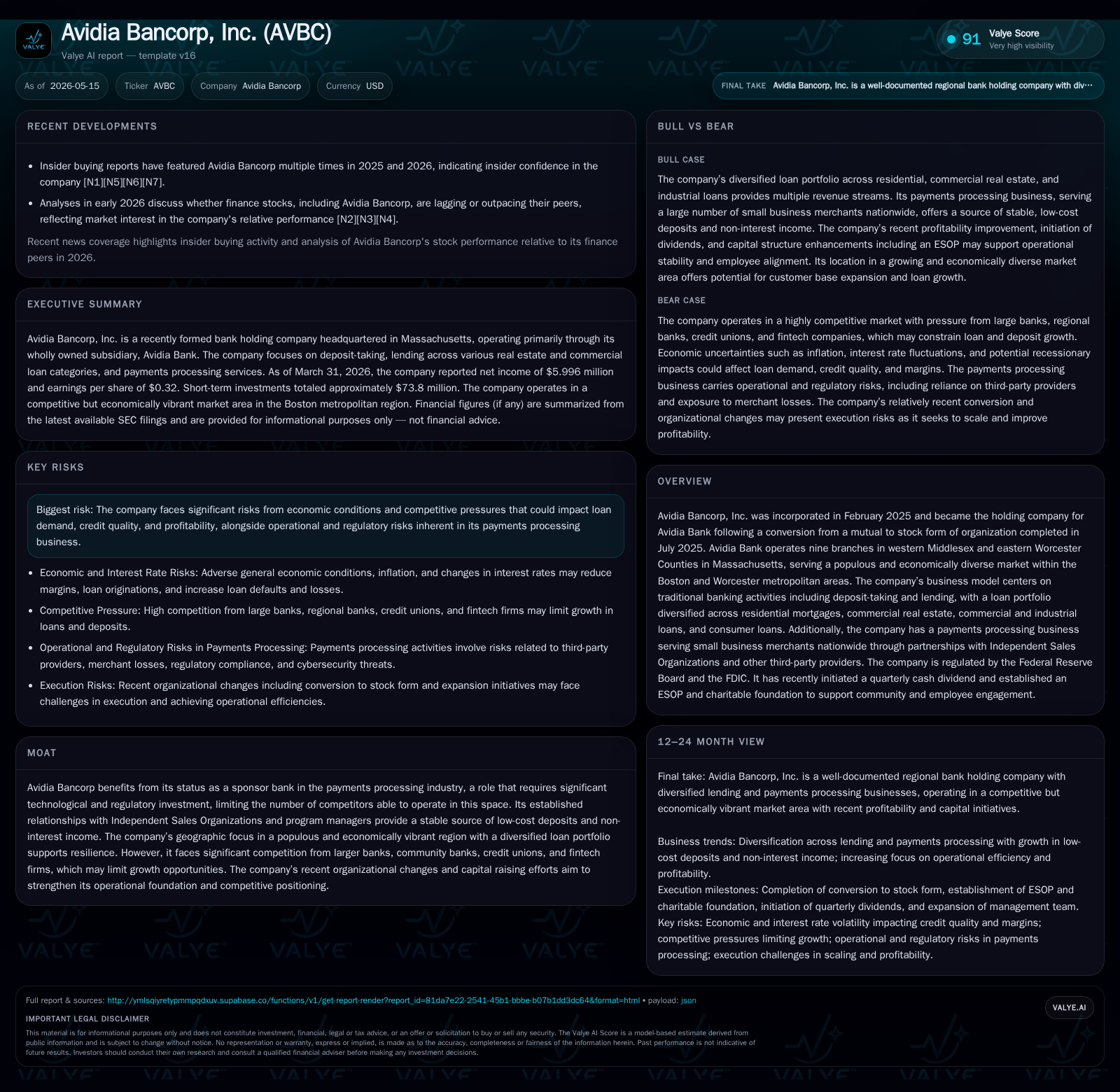
In its Q1 2026 filing, Avidia Bancorp unveiled a new approach investing in affordable housing projects via limited liability entities to harness tax benefits and deepen local ties. This move complements its dual banking and payments sponsorship model, anchored in diversified lending and stable deposit sources through ISO partnerships. Competitive pressures from regional banks and fintechs persist, but the company leverages its regulatory expertise and geographic focus for resilience. Key upcoming milestones include dividend payments and execution on tax credit investment pipelines.
Latest Quarterly Filing Update: Tax Credit Investments and Accounting Changes
Avidia Bancorp’s Q1 2026 10-Q filing marks a notable shift with the formal introduction of investments in qualified affordable housing projects structured through limited liability entities. This strategic allocation aims not only at generating income tax benefits via available credits but also underscores a commitment to community development within its Massachusetts footprint [S2]. The bank applies the proportional amortization method to these tax credit investments — whereby amortization expenses align with the annual utilization of tax credits — improving income tax expense transparency. This change is timely following the December 2023 Financial Accounting Standards Board update (ASU No. 2023-09) that requires enhanced disclosure on income taxes paid and rate reconciliations [S2].
This move reflects a thoughtful broadening of Avidia’s asset base beyond traditional loans and securities, potentially smoothing taxable earnings volatility while strengthening local stakeholder ties amid an increasingly competitive environment.
Core Business Model: Lending and Payments Ecosystem
Formed through converting from a mutual to stock entity in July 2025, Avidia Bancorp holds Avidia Bank which serves western Middlesex and eastern Worcester Counties with nine branches [S1]. The bank primarily offers classic deposit-taking services coupled with a diversified loan portfolio that includes residential mortgages (one- to four-family units), commercial real estate including multi-family properties, commercial & industrial (C&I) loans, with relatively modest consumer loans focused chiefly on automobile financing [S1].
Complementing lending activities is its payments processing business targeting small merchants nationwide. Acting as a sponsor bank within this industry entails stringent regulatory and technological responsibilities that underpin partnerships with Independent Sales Organizations (ISOs) and other third-party program managers. These relationships not only supply a cost-effective deposit base but also generate non-interest income through processing fees — a mix that supports financial stability amid lending margin pressures.
Revenue mechanics hinge on volume-driven lending margins modulated by interest rates plus fee income generated from payment transactions. The payments sponsorship role forms a moat due to high entry barriers related to compliance demands and required technology platforms.
Competitive Environment in Massachusetts Banking and Payments Sponsorship
Operating in a populous sub-region of Massachusetts that includes suburbs of Boston and Worcester positions Avidia within vibrant yet intensely competitive banking terrain. Larger regional banks pursue broad commercial relationships while many local community banks and credit unions emphasize personalized service at scale. Fintech entrants add pressure by offering digital-first lending or payment solutions often targeting niche customer segments.
Within the payments processing vertical, Avidia’s status as a sponsor bank offers structural advantages versus pure-play fintechs or smaller community banks by virtue of regulatory licensing that restricts competitors’ entry into bank-sponsored payment programs. Additionally, established ISO partnerships create switching costs given revenue-sharing frameworks and operational integration layers.
Yet geographic concentration potentially limits diversification benefits; while strong regional economic fundamentals endure, downturns could disproportionately impact loan demand or deposit growth [S1]. Furthermore, digital banking evolution may challenge traditional branch-based relationship growth even as payments infrastructure upgrades require ongoing capital outlays.
Drivers of Growth: Tax Credit Strategy, Deposit Base Stability, and Payments Relationships
The affordable housing tax credit investment strategy represents an incremental growth lever blending fiscal efficiency with socially responsible investing. By deploying capital through limited liability entities engaged in qualified developments, Avidia not only secures proportionate amortization-aligned tax savings but cements its role as a community financier supportive of local affordable housing needs [S2]. This initiative could also improve asset yield diversity amid rate environment fluctuations.
Payments sponsorship augments growth prospects by providing steady inflows of low-cost deposits leveraged from merchant accounts nationwide via ISOs. Maintaining strong ISO relations aids retention while helping navigate competitive fee structures inherent to merchant services.
On the lending front, diversified loan origination strategy balancing fixed-rate mortgages retained for interest management alongside adjustable-rate short-term commercial loans allows tailored portfolio risk management [S1]. Ongoing monitoring of construction loans — recognized for elevated risk due to project uncertainties — remains vital for managing underwriting quality.
Technological investments underpinning payments infrastructure remain necessary for compliance adherence under evolving regulations post FASB updates as well as merchant cybersecurity demands [S2]. Effective execution here supports reputation among ISOs and merchant customers alike.
Risks and Constraints: Economic Sensitivities, Competitive Pressures, and Regulatory Complexities
Despite strategic initiatives, several risk vectors remain pronounced. The regional loan book’s concentration in residential and commercial real estate exposes Avidia to cyclical market shifts impacting property values and borrower creditworthiness — risks amplified by inflationary pressures or employment fluctuations referenced in forward-looking statements [S1].
Competitive intensity from larger banks capable of financing broader product suites as well as aggressive fintech challengers applying digital innovation can erode pricing power both in lending spreads and payment fees. Moreover, customer expectations around convenience may compel capital-intensive platform upgrades beyond current budgeted levels.
Operational risk factors include dependency on third-party providers within the payments ecosystem where failure or breach could impose reputational damage or regulatory penalties [S1]. Regulatory complexity escalates particularly after implementation of ASU No. 2023-09 requiring granular income tax disclosures which increase compliance burdens [S2].
Finally, given its smaller reporting company status limits some disclosure granularity; consequently stakeholders face informational opacity on some contingency risks or prospective capital strategies [S1].
Upcoming Catalysts and Key Milestones to Monitor
Investor attention should center on several near-term execution points. The April 2026 dividend announcement scheduled for payout around May 28 confirms management confidence in liquidity stabilization post-conversion from mutual form [S3]. Tracking subsequent quarterly filings for detailed loan quality metrics such as delinquency rates or charge-offs will illuminate credit cycle navigation success.
Deployment pace of affordable housing tax credit investments represents another actionable indicator—the volume booked against pipeline projects will reveal scalability potential for this yield diversification strategy [S2]. Also critical is whether further technological enhancements enable broadened ISO partnerships or improved cost structures within payments operations.
Regulatory filings will additionally disclose adherence progress against expanded income tax disclosure standards introduced late last year which have knock-on effects on reported profitability measures [S2]. Finally, any announcements regarding expansion plans—whether physical branch growth or augmentation into adjacent financial products—would serve as direct evidence of growth ambition responsiveness.
This analysis synthesizes recent SEC disclosures up to Q1 2026 along with contextual evaluation grounded in industry knowledge without offering investment advice or financial forecasting. Readers should consider this report as an informative perspective on Avidia Bancorp’s operational landscape rather than a recommendation.
Disclaimer: This is research-only, informational analysis and not investment advice. It may include AI-generated interpretation and general industry context. Always verify important details using primary sources.

Comments