
SenesTech Advances Rodent Control Innovation Despite Short-Term Losses
SenesTech's Q1 2026 report shows persistent net losses but underscores progress in product registration and retail expansion for its Evolve rodent birth control solution.
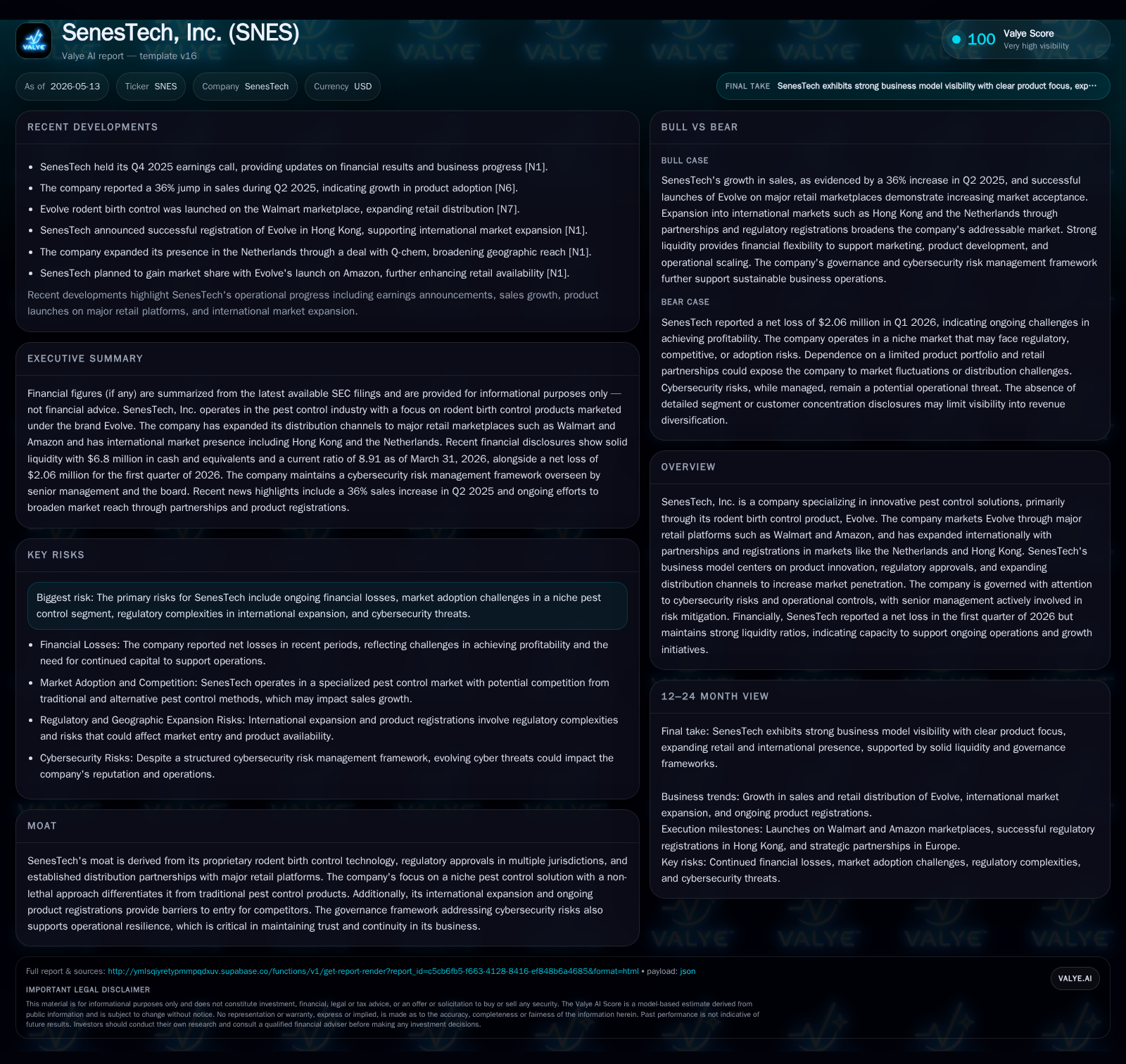
In its latest quarterly filing, SenesTech reported ongoing net losses reflecting its growth-stage operating profile but reinforced strategic advancements in distribution and international regulatory approvals. The company’s proprietary non-lethal rodent control product, Evolve, remains central to its business model, leveraging unique technology and expanding retail partnerships to penetrate niche markets domestically and abroad. While financial sustainability challenges persist, governance focused on cybersecurity risk management and operational control underpins resilience amid competitive and regulatory complexities.
Recent Operating Update: Q1 2026 Performance and Strategic Progress
SenesTech's Form 10-Q filed on May 13, 2026 [S2] reveals that the company continues to operate at a net loss, consistent with prior periods of investment in commercial execution. No material changes to existing risk factors were disclosed relative to the March 2026 10-K filing [S1], reflecting stable operational risks despite an evolving market environment. The May 12, 2026 8-K [S3] supplemented this disclosure by announcing first-quarter financials alongside reaffirming management’s focus on operational execution.
From a liquidity standpoint, SenesTech holds approximately $6.8 million in cash and equivalents as of March 31, 2026, supported by current assets totaling about $8.35 million against current liabilities near $0.94 million, yielding a robust current ratio of 8.91 [F1]. This solid liquidity position underscores capacity to fund ongoing R&D investments and marketing efforts crucial for scaling Evolve's market reach.
No changes to director or officer trading plans occurred during the quarter; governance emphasis remains on prudent risk management and maintaining continuity during CEO succession phases evidenced by recent executive leadership transitions detailed in earlier filings [S26], [S27].
Business Model and Product Differentiation
SenesTech’s core revenue derives from sales of Evolve—a proprietary rodent fertility control product that offers a humane alternative to conventional rodenticides. Marketed primarily through large retail platforms including Walmart and Amazon [S1], Evolve capitalizes on growing consumer preferences for environmentally responsible pest management solutions.
The company's revenue mechanics hinge on volume sales driven by expanded retail availability and geographic market penetration combined with price realizations set by unique product formulation backed by patent protection. Regulatory approval status forms a gating factor influencing addressable market scope; successful registrations in jurisdictions such as the Netherlands and Hong Kong signify important strategic milestones [S1].
Evolve’s innovative mechanism delivers differentiation through fertility suppression rather than lethal toxicity—an approach that appeals both to regulators wary of environmental impact and consumers seeking safer pest control methods. This innovation underpins durable pricing power amidst commoditized alternatives while contributing to SenesTech’s moat through complex regulatory pathways that competitors face entering similar markets.
Industry Dynamics and Competitive Position
Positioned within the niche segment of non-lethal rodent management solutions, SenesTech competes against traditional poison-based controls entrenched across agricultural, municipal, and consumer sectors. Conventional offerings benefit from long-established supply chains but face increasing scrutiny due to sustainability concerns.
The regulatory landscape presents both barriers to entry and opportunity: SenesTech’s ability to secure required registrations internationally constitutes a significant moat by limiting direct competition from newcomers lacking similar technological or legal qualifications [S1]. Retail channel partnerships augment distribution scale but require supply chain reliability—a factor governed internally with oversight from executives including the CFO and VP of Manufacturing who also lead cybersecurity risk initiatives [S1], ensuring protection against supply disruptions from cyber threats.
Customer behavior trends signal gradual adoption growing through awareness campaigns emphasizing humane pest management. However, given the product’s specificity as a fertility control agent addressing a distinct segment within pest eradication, growth rates may be more structural than cyclical but inherently limited in scale relative to broad-spectrum poisons.
Growth Catalysts: Distribution, Regulatory Expansion, and Innovation
Key growth drivers emerge from multi-pronged initiatives targeting expanded domestic retail footprint extension alongside international regulatory approvals enabling entry into European and Asian markets. Documented registrations in places like the Netherlands facilitate direct sales access under compliant frameworks; such geographic diversification mitigates risks associated with dependence on U.S.-centric demand [S1].
Continued innovation pipeline efforts focused on enhancing product efficacy while optimizing cost structures are critical for competitive positioning and margin improvement going forward. Management's supervision over manufacturing processes incorporates strict cybersecurity policies to manage operational vulnerabilities that could affect capacity or delivery timeliness—a notable priority conveyed at board level via regular reporting cycles [S1], [S26].
Metrics linked to these growth vectors include incremental unit sales volumes tracked through major retailer channel data reports, renewal rates for registration certifications abroad, and timelines for new market launches—the latter often heralded through SEC disclosures or press releases aligned with quarterly updates [S3], [S2].
Risks and Constraints: Adoption, Regulation, and Financial Sustainability
SenesTech faces persistent financial headwinds exemplified by ongoing net losses reflecting investments made ahead of sustainable revenue scale attainment [S2], underscoring the importance of capital efficiency.
Market adoption risks arise from the educational challenge inherent in convincing end-users conditioned toward traditional poisons to switch to a novel fertility-based approach within pest control—a niche with dedicated but limited customer bases.
Regulatory complexity imposes constraints as each international jurisdiction demands tailored compliance efforts delaying or restricting product rollout schedules. Moreover, geopolitical dynamics can introduce uncertainty impacting approval timelines or post-market surveillance requirements.
Operational risks tied to cybersecurity vulnerabilities form a non-trivial concern given reliance on digital supply chain systems; SenesTech addresses this proactively via governance structures led jointly by its CFO and VP Manufacturing with expert teams overseeing mitigation strategies reported periodically to the board [S1], [S26].
Key Milestones to Monitor Next
Stakeholders should track upcoming quarterly earnings releases slated around August 2026 which will offer updated visibility into revenue traction or margin evolution following current expansion campaigns [S3], [S2]. New product registration announcements or official entry into additional international markets serve as important barometers validating regulatory strategy execution.
Operational execution milestones including enhanced supply chain scalability or retailer onboarding success will provide tangible indicators regarding commercial strategy effectiveness.
Finally, guidance statements if provided during earnings calls will help clarify the pace at which SenesTech anticipates bridging current financial deficits towards break-even outcomes amidst competitive pressures.
Financial Snapshot: Q1 2026 Highlights
Latest financial snapshot
| Metric | Value | Period |
|---|---|---|
| Cash & equivalents | $7mm | |
| 2026-03-31 | ||
| Current assets | $8mm | |
| 2026-03-31 | ||
| Current liabilities | $938000 | |
| 2026-03-31 | ||
| Current ratio | 8.91x | |
| 2026-03-31 |
Source: SEC companyfacts cache [F1].
| Metric | Value | Period Ending |
|---|---|---|
| Cash & Equivalents | $6.8M | |
| 2026-03-31 | ||
| Current Assets | $8.35M | |
| 2026-03-31 | ||
| Current Liabilities | $0.94M | |
| 2026-03-31 | ||
| Current Ratio | 8.91 | |
| 2026-03-31 |
This liquidity profile provides operational runway allowing continued investment into key growth areas despite ongoing operating losses documented through late 2025 annual results showing a net deficit around $6.38 million [F1]. Capital discipline coupled with strategic expansion will determine medium-term viability as SenesTech pursues scaling opportunities.
Disclaimer: This analysis is based solely on publicly available SEC filings as of May 13, 2026, company factual data snapshots from F1 sources dated March 31, 2026 or earlier where cited, without any investment recommendation intended or implied.
Disclaimer: This is research-only, informational analysis and not investment advice. It may include AI-generated interpretation and general industry context. Always verify important details using primary sources.

Comments