
Skyline Bankshares Advances Through Regional Expansion and Conservative Credit Strategy
Skyline Bankshares leverages recent acquisitions and prudent underwriting to strengthen its foothold in the rural Southeast US banking market.
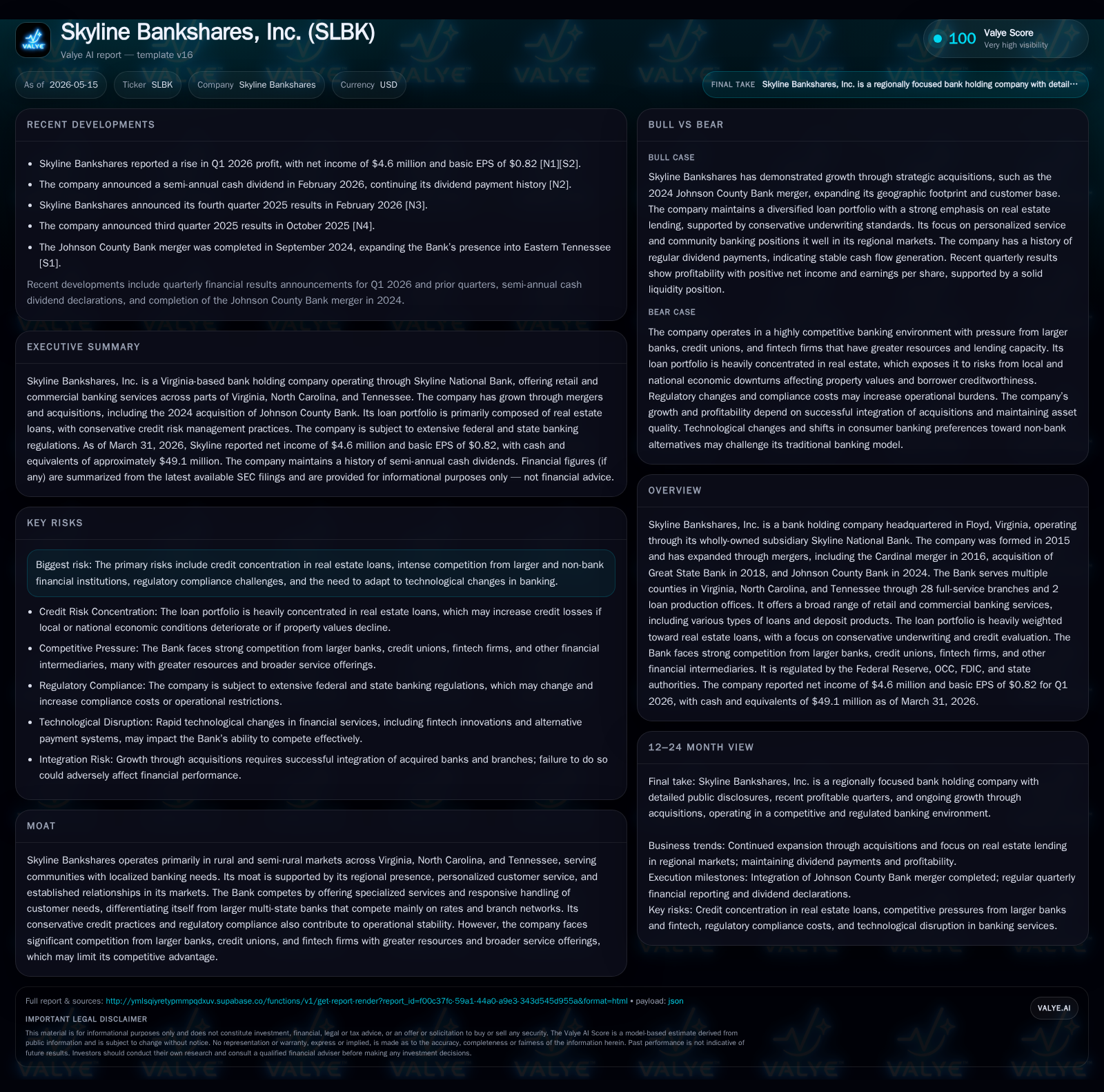
In its latest quarterly filing, Skyline Bankshares reported operational integration progress following its 2024 Johnson County Bank acquisition, which expanded its presence into Eastern Tennessee. The company's business model is anchored in conservative real estate lending and personalized service in rural markets. Despite strong competitive pressures from larger banks and fintech disruptors, Skyline’s localized approach and disciplined credit evaluation underpin its stability. Growth is primarily driven by strategic regional expansion and preserving loan portfolio quality, while risks center on economic vulnerabilities in declining local industries and evolving regulatory demands.
Latest Quarterly Update: Operational Highlights and Strategic Acquisitions
Skyline Bankshares’ most recent 10-Q filing dated May 15, 2026 [S2] confirms continued steady progress in integrating the September 2024 Johnson County Bank (JCB) transaction. This acquisition facilitated Skyline’s entry into the Eastern Tennessee market with approximately $87.2 million of acquired loans and $125.3 million of deposits assumed [S1]. As per filings around the recent earnings release [N1][S3], the combined entity has begun leveraging the JCB franchise to consolidate rural market share. While no material shifts were reported in loan quality or deposit behavior related to this merger through Q1 2026, the increased asset base supports longer-term growth traction.
The quarter showed no material changes to risk factors or operational constraints compared to the annual report disclosed two months prior [S1]. Decision-makers highlight that cautious credit policies remain intact even as they pursue cross-selling opportunities across their expanded footprint.
Skyline’s Business Model: Real Estate-Centric Lending and Customer-Centric Banking
Skyline National Bank operates as Skyline Bankshares’ sole banking subsidiary delivering a broad suite of retail and commercial banking products primarily within rural and semi-rural counties of Virginia, North Carolina, and Tennessee [S1]. The key revenue driver is net interest income generated predominantly from a real estate-weighted loan portfolio constituting over 93% of total loans at year-end 2025 [S1]. This includes single-family residential mortgages (56%+), non-farm/non-residential commercial real estate loans (29%), farm-related loans (2%), plus construction/development loans (~6%) [S5].
Credit underwriting is conservative by design — loan officers operate under Board-approved limits with Officers’ Loan Committee approvals required for loans above $2 million but less than $3 million, Directors’ Committee for loans up to $4.5 million, beyond which full board approval applies [S5]. The bank emphasizes low loan-to-value ratios supported by rigorous collateral appraisals to mitigate credit risk. Consumer loans remain a small portion (~1.3%) but continue to fulfill community needs without significant exposure.
Customer relationships emphasize personalized service tailored to localized economies often underserved by large national banks penetrating rural markets mainly on rate competition or digital reach. This approach fosters client retention via responsiveness rather than scale economies or fintech-enabled efficiencies.
Competitive Dynamics and Industry Environment in Rural-Southeastern US Markets
Skyline faces multifaceted competition spanning regional/national banks leveraging technology platforms for scale pricing advantages; well-established local credit unions deeply embedded within community networks; plus emerging fintech firms pushing digital-first solutions challenging traditional intermediaries across lending and deposit services [S1].
The company’s niche focus on localized banking relationships offers some moat protection but also caps scale benefits resulting in narrower margins relative to larger peers. Regulatory compliance forms a double-edged sword – enhancing safety/soundness yet increasing operational burdens particularly around cybersecurity mandates imposed by OCC/FDIC/Federal Reserve [S7][S8].
Economic headwinds persist given the reliance on historically declining furniture manufacturing/textile sectors intrinsic to parts of VA/NC/TN served by the bank. Such structural challenges affect local employment trends, borrowing demand quality, and collateral valuations in respective loan portfolios.
Growth Drivers: Geographical Expansion and Credit Portfolio Quality
Skyline’s strategic growth through mergers—highlighted by the Cardinal merger (2016), Great State acquisition (2018), culminating most recently with JCB (2024)—demonstrates its aim to deepen presence across contiguous southeastern states while scaling assets moderately [S1]. This build-out enables better product penetration into small-medium businesses typically underserved by larger institutions offering nationalized solutions.
Organic growth stems from expanding deposits within these communities paired with historically stable demand for real estate financing notwithstanding regional economic cyclicality. Management’s disciplined credit controls including conservative LTV thresholds and thorough borrower vetting act as critical levers reducing credit loss volatility over cycles [S5]. Such credit discipline has underpinned stable earnings through prior economic fluctuations.
Potential upside exists if modest recovery or diversification occurs away from vulnerable industries currently dominating local employment bases.
Key Risks and Industry Challenges: Credit Concentration, Competitive Pressures, Regulatory Oversight
Primary risk centers on real estate loan concentration exceeding 90%, exposing Skyline to downturns impacting collateral values or borrower service capability locally [S1]. Should regional economic performance deteriorate further due to declining manufacturing jobs or inflation-driven cost pressures raising defaults, loan loss provisions may rise impacting profitability.
At the same time heightened competition from larger banks offering broader products or fintech entrants providing user-friendly digital lending apps challenges retention of younger demographics or technologically savvy customers. Regulatory compliance requirements post-Dodd-Frank continue demanding significant resources especially concerning capital adequacy, cybersecurity protocols, data privacy safeguards mandated across several federal agencies [S8][S12].
No significant changes to risk factors were noted in Q1 filings maintaining continuity of disclosures from prior annual statements [S2][S1]. Technological adaptation remains an area requiring ongoing investment lest the bank lose competitiveness vs digitally agile peers.
Outlook and What to Watch: Execution of Integration, Loan Portfolio Trends, Technology Adaptation
The near term will be shaped largely by progress integrating Johnson County operations fully – including efficiency gains realization from fixed cost absorption across expanded footprint plus successful execution of targeted cross-selling initiatives leveraging existing client bases [N1][S2]. Monitoring delinquency trends particularly within commercial real estate exposures will be key leading indicators of portfolio health.
Net interest margins under shifting Federal Reserve interest policies will require close tracking given sensitivity of rural bank deposit pricing and variable rate loans.
Technology investments aimed at upgrading online/mobile platforms are expected to maintain relevancy against fintech threats but represent ongoing cost factors influencing operating leverage.
Regulatory developments especially any new capital or consumer protection rules could materially affect future compliance costs and strategic flexibility.
Financial Profile: Stability Supported by Strong Liquidity and Zero Debt
From a financial standpoint as noted in company facts data compiled through Q1 2026, Skyline holds no outstanding debt obligations [F1]. Recent net income figures exceeding $15 million annually attest to profitable operations sustained through disciplined underwriting practices [F1][N1].
Being well-capitalized per regulatory benchmarks provides additional cushion against unexpected losses or economic shocks while supporting dividend distributions observed in recent seasons.
Overall, this clean balance sheet affords management flexibility pursuing further strategic expansions or absorbing regulatory cost increases without excessive leverage risks.
Disclaimer: This analysis is based solely on publicly available SEC filings dated through May 15, 2026, company press releases referenced herein, and recognized financial data snapshots. It does not contain investment advice nor recommendations; readers should consult additional sources when forming opinions regarding Skyline Bankshares’ business outlook or financial standing.
Disclaimer: This is research-only, informational analysis and not investment advice. It may include AI-generated interpretation and general industry context. Always verify important details using primary sources.

Comments