
Leet INC. Confronts Steep Revenue Drop with Governance and Operational Shifts
Leet INC. faces acute financial distress following a drastic revenue collapse, triggering board-level audit committee leadership changes and operational recalibrations.
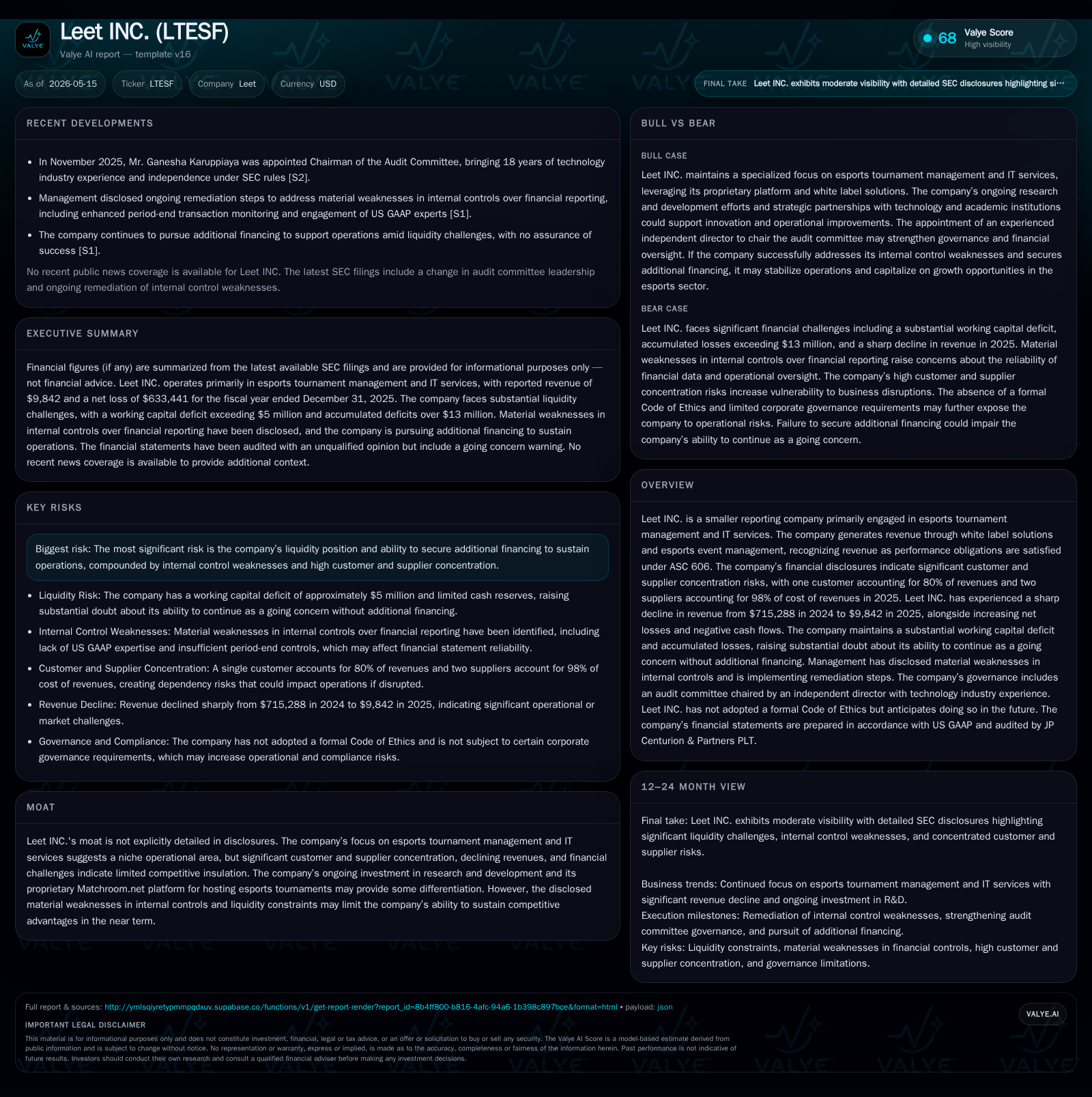
Leet INC. reported a staggering 98.6% revenue decline in 2025, driven primarily by the termination of its key white label contract. This precipitous drop has exacerbated net losses, amplified liquidity challenges, and highlighted internal control weaknesses. The recent appointment of Mr. Ganesha Karuppiaya as audit committee Chairman reflects an urgent push to strengthen governance amid these setbacks. With most revenue concentrated in Malaysia and supplier dependencies intensifying risk, Leet’s niche esports tournament management and IT service offerings face substantial headwinds. The company’s path forward hinges on securing financing, adapting its Matchroom.net platform, and diversifying its client base to restore stability.
Recent Operating Developments and Governance Changes
Leet INC., a smaller reporting company focusing on esports tournament management and IT services, faces a dire near-term operating outlook as documented in its November 2025 Form 6-K and May 2026 annual report (20-F). The latest publicly disclosed development was the appointment of Mr. Ganesha Karuppiaya as Chairman of the Audit Committee effective November 3, 2025, replacing Mr. Dai Song who remains a member [S2]. This move signals enhanced board-level effort to address governance gaps amid substantial operational challenges.
Mr. Karuppiaya’s background includes nearly two decades in the technology sector and a Bachelor’s degree in Computer Science from Coventry University, UK, positioning him with relevant industry expertise to oversee strengthened financial controls under Sarbanes-Oxley mandates applicable to the company ([S2]). This leadership shift directly follows public acknowledgment of material weaknesses in Leet’s internal controls over financial reporting as disclosed in their year-end annual filing for fiscal 2025 ([S1]).
Business Model and Core Offerings in Esports and IT Services
Leet INC.'s revenue derives principally from esports tournament management facilitated by its proprietary online platform Matchroom.net alongside ancillary IT services [S1]. Revenue recognition follows ASC Topic 606 standards where amounts are recognized upon satisfaction of performance obligations tied to contractual milestones.
The company provides white label solutions tailored for telecommunications clients primarily in Southeast Asia. However, customer concentration is acute: one major entity accounts for approximately 80% of Leet's revenues as per fiscal year 2025 disclosures ([S1]). This heavy dependence intensified vulnerability when the key white label project with Smart Communications Inc., a large Philippine telecom provider, ceased at the end of 2024 leading to dramatic revenue fallout.
Cost components include platform server rentals, network bandwidth expenses, direct labor costs for operations and development teams—all areas targeted for cost reduction as volumes shrank ([S1]). Notably, research and development expenses nearly halved from just under $36K in 2024 to about $18.5K in 2025 reflecting curtailed innovation spending which could impact long-term competitiveness.
Competitive Dynamics and Industry Positioning
Within the esports event management niche where Leet operates, competition involves both global platforms and localized service providers offering tournament hosting infrastructure coupled with marketing or engagement tools. The company's proprietary Matchroom.net platform aims to carve differentiation but lacks scale compared to major industry players.
High customer concentration creates pricing risk; switching costs may be moderate given esports market fluidity and alternative platform options available. Supplier concentration is also acute—with two suppliers responsible for about 98% of cost of goods sold—exacerbating potential supply chain disruptions or price increases ([S1]).
Moreover, management has disclosed ongoing deficiencies in internal controls which may impair execution effectiveness relative to more established competitors who boast robust governance frameworks (). This structural fragility weakens Leet’s moat amidst an industry that prizes scalability, platform resilience, user engagement metrics, and stable vendor partnerships.
Key Growth Drivers for Recovery or Expansion
Despite setbacks, several avenues could underpin recovery if effectively pursued:
- Esports market growth: Globally expanding consumer adoption offers latent demand potential for tournament hosting services.
- Monetization enhancement: Deepening adoption and utilization of mini-app tools on Matchroom.net could generate incremental revenue streams.
- Geographic diversification: Current concentration risks may be mitigated by expanding client base beyond Malaysia/Philippines into other Southeast Asian or global markets.
- Operational efficiencies: Reductions in server rental fees and bandwidth usage indicate potential flexibility in cost structure adjustment aligned with volume changes ([S1]).
However, R&D expense cuts may slow innovation cadence risking platform stagnation ([S1]). Stronger capital reserves would be necessary to fund product enhancements essential for competitive positioning.
Risks and Constraints Impacting Viability
Leet faces significant existential risks:
- Liquidity crisis: Cash balances stood at a precarious $3,994 at fiscal year-end against current liabilities exceeding $5 million resulting in a near-zero current ratio ([F1]).
- Customer/supplier concentration: Heavy reliance on one customer for most revenue (~80%) and two suppliers controlling nearly all input costs (98%) dramatically elevates operational risk ([S1]).
- Persistently negative profitability: Net loss ballooned from around $21K in FY24 to $633K FY25 amidst collapsing revenues ([F1]), compounding accumulated deficits now exceeding $13 million ([S1]).
- Material control weaknesses: Unaddressed deficiencies hinder accurate financial reporting increasing regulatory compliance risks ([S1]).
- Going concern uncertainty: Management explicitly states substantial doubt regarding continuing operations without new financing secured within twelve months ([S1]).
These vulnerabilities highlight constrained strategic maneuverability requiring urgent capital infusion alongside operational reengineering.
Near-Term Milestones and Monitoring Points
Key upcoming markers indicative of possible stabilization or further deterioration include:
- Financing success: Ability to secure additional funding through shareholders or new investors critical for survival ([S1][S2]).
- Contract renewals/new client wins: Post-termination of Smart Communications contract in late 2024 forces dependency on establishing new agreements especially within Southeast Asia markets.
- Audit committee effectiveness: Impact of Mr. Karuppiaya’s chairmanship on remediating internal control weaknesses will be closely monitored ([S2]).
- Interim disclosures: Any updates released via interim filings or press releases shedding light on operational progress or fatigue will be pivotal cues.
Absent clear improvements across these dimensions could presage further liquidity stress or impair ongoing viability.
Financial Condition and Performance Overview
Leet's fiscal year ended December 31, 2025 paints a stark financial deterioration:
All financial indicators coalesce into a portrait of an entity grappling with steep top-line contractions while burdened by fixed overheads amid liquidity starvation requiring swift strategic action.
This analysis is based exclusively on publicly available disclosures from Leet INC.’s SEC filings up through May 15, 2026. It avoids speculative assertions beyond cited data.
Disclaimer: This is research-only, informational analysis and not investment advice. It may include AI-generated interpretation and general industry context. Always verify important details using primary sources.

Comments