
MasterBeef Group Expands Into Beverage Sector with Thai Tea Franchise Push
MasterBeef's announcement of a franchise agreement to introduce premium Thai tea and dessert outlets in Hong Kong and Macau signals strategic diversification beyond its core Taiwanese cuisine portfolio.
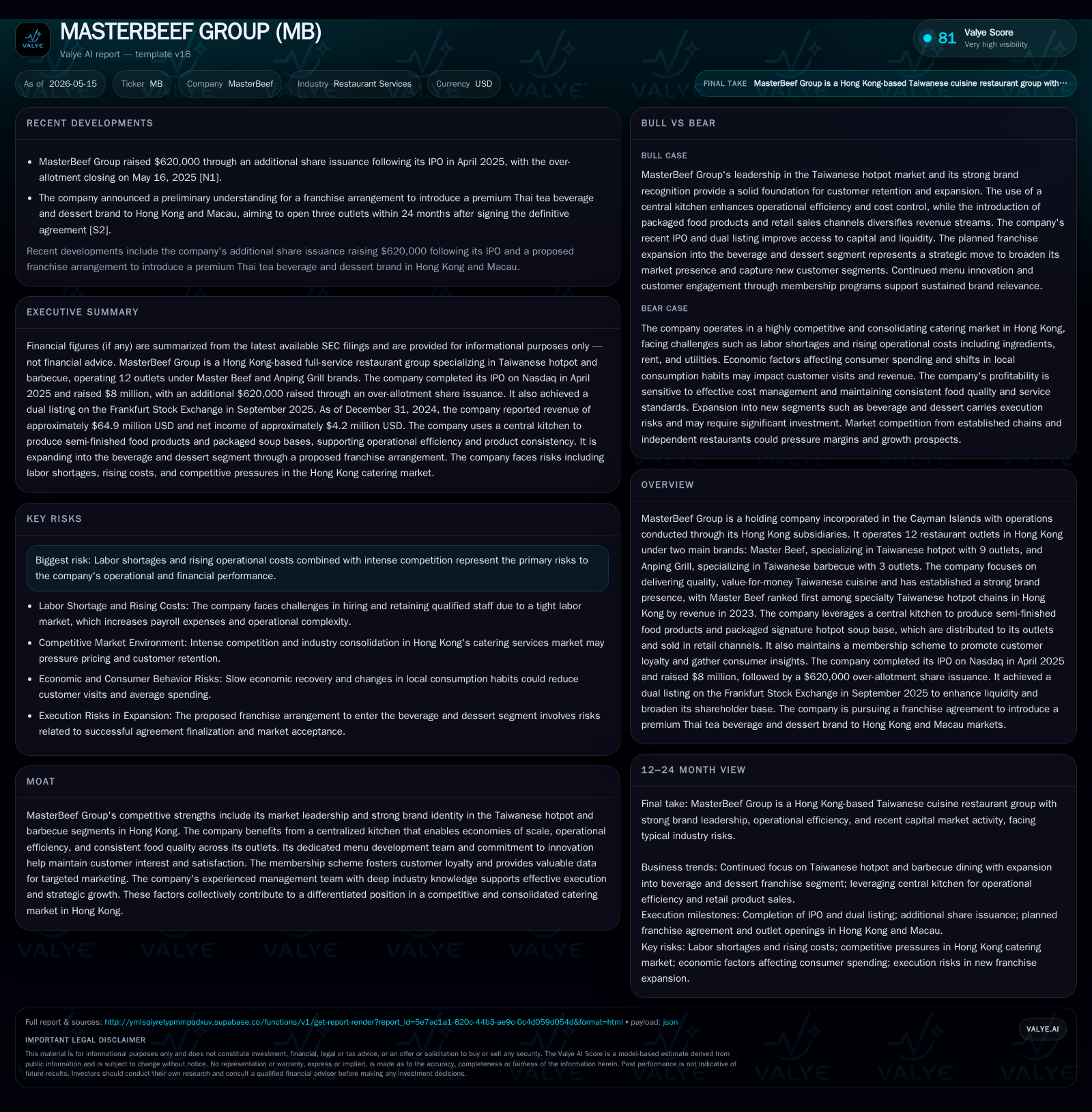
In May 2026, MasterBeef Group disclosed a preliminary franchise agreement to bring a Thai tea and dessert brand from Thailand into the Hong Kong and Macau markets, marking a deliberate entry into the beverage segment alongside its established restaurant base. The company operates 12 outlets with two main Taiwanese cuisine brands and leverages a central kitchen model for efficient food production. Despite recent revenue pressures linked to Hong Kong's economic environment and rising operational costs, MasterBeef aims to stabilize growth through innovation, franchising, and data-driven customer engagement. Key risks include intense regional competition and inflation-driven margin pressures. Upcoming milestones include finalizing the franchise agreement and rolling out three new beverage outlets within two years.
Recent Quarter Highlights: New Franchise Partnership Sets Growth Tone
In its latest quarterly filing (May 14, 2026) [S2], MasterBeef Group announced reaching a preliminary understanding on a strategic franchise partnership to introduce a premium Thai tea beverage and dessert brand from Thailand into the Hong Kong and Macau markets. This initiative marks the company's first significant foray beyond its core Taiwanese hotpot and barbecue restaurant operations into the beverage and dessert segment—a move likely intended to diversify revenue streams amid evolving consumer preferences. The definitive franchise agreement remains subject to final documentation, but the company has targeted opening three new outlets across these two regions within 24 months post-agreement finalization.
This franchise push signals an evolution in MasterBeef's growth strategy, moving from solely expanding their own restaurants toward leveraging franchising models to diversify both offerings and geographic reach. It also reflects an attempt to capture the growing demand for premium beverages in Hong Kong, where tea culture enjoys strong popularity but competition remains fierce.
Company Business Model: Authentic Taiwanese Cuisine Anchored by Operational Efficiency
MasterBeef Group operates as a holding company incorporated in the Cayman Islands with substantive operations run through Hong Kong subsidiaries [S1]. Its primary business involves managing two main Taiwanese cuisine brands—Master Beef (hotpot) with nine outlets, and Anping Grill (barbecue) with three outlets—totaling twelve restaurants in Hong Kong as of the latest filings.
Central to its operational model is a centralized kitchen producing semi-finished food products as well as packaged signature hotpot soup bases distributed internally across outlets and sold through retail channels. This centralized production enables economies of scale, consistency in food quality across locations, and streamlined cost controls—all essential for maintaining its value proposition of "quality yet affordable" Taiwanese dining experiences.
Revenue primarily derives from sales at these restaurant outlets (approximately 94% of revenue), augmented by sales of packaged goods in retail channels and revenues linked to membership schemes designed to boost customer loyalty while providing actionable insights for targeted marketing campaigns [S1], [F1].
The company's semi-self-service hotpot format reduces labor intensity compared to full-service models while enhancing table turnover rates—a critical factor given space constraints typical of Hong Kong dining venues. Average spending per customer hovered near HK$300 (~US$38), reflecting mid-market positioning aimed at budget-conscious but quality-seeking consumers [S14].
Market Positioning and Competitive Environment in Hong Kong Dining
Hong Kong's restaurant industry is highly fragmented with many local operators specializing in Taiwanese cuisine competing intensely alongside multinational chains [S1]. Within this landscape, MasterBeef has established itself as the leading specialty Taiwanese hotpot chain by revenue as of 2023, commanding approximately 9.7% revenue market share in overall Taiwanese cuisine [S1]. While competitors often possess larger scale or broader geographic footprints, MasterBeef boasts strong brand recognition locally anchored by consistent food quality, competitive pricing, and distinctive menu innovation through dedicated culinary teams.
Key competitive factors include location accessibility—MasterBeef's presence in Mong Kok affords exposure to high foot traffic zones—and ambiance aligned with casual dining expectations. Its blend of hotpot all-you-can-eat and barbecue concepts caters effectively to different consumer occasions but faces pressure from similarly positioned mid-range chains employing aggressive promotions.
Service quality consistency supported by centralized kitchens helps reduce variability seen commonly among smaller chains reliant on individual kitchen teams. However, cost inflation compounded by labor shortages presents ongoing challenges driving up operating expenses amid limited ability to pass through price increases fully without affecting patronage.
Growth Drivers: Innovation, Franchising, and Loyalty Programs
While historical growth relied heavily on opening additional outlets during expansion phases—particularly throughout the pandemic period when competitors contracted—the firm's current approach emphasizes measured expansion complemented by diversification outside pure restaurant operations [S1], [S2].
The new Thai tea franchise represents a strategic shift leveraging an established brand within beverages/desserts appealing to younger demographics seeking premium tea experiences—a vibrant sector growing beyond traditional meal-centric dining.
Continued menu innovation supported by culinary R&D aims to maintain customer interest within its core Taiwanese hotpot/barbecue formats while also exploring product extensions potentially compatible with central kitchen capabilities.
MasterBeef’s loyalty membership scheme remains a vital tool fostering repeat visits. Membership data enhances marketing precision enabling personalized offers that can improve average spend per visit and frequency without broadly raising prices—thus protecting margin integrity amid inflationary environments.
Technological upgrades focusing on automation within service flows are being pursued to raise staff productivity—a key priority given wage inflation’s downward pressure on profitability margins [S1].
Risks and Constraints: Rising Costs and Market Competition
Labor shortages remain prevalent across Hong Kong’s foodservice sector, inflating payroll costs significantly—the largest single expense after raw materials—and constraining margin recovery despite some offsetting operational efficiencies [S1].
Inflationary pressures affecting ingredient prices further compound cost challenges in maintaining attractive price points for largely price-sensitive customers typical of mid-range casual dining segments.
Competitive intensity risks arising from numerous Taiwanese cuisine providers pose threats if MasterBeef fails to continuously innovate or adapt its offering. Larger rivals with greater financial resources may undertake sustained marketing or expansion campaigns potentially eroding market share.
Limited pricing power constrains ability to transfer increased costs fully onto consumers without triggering demand elasticity impacts such as lower visit frequency or reduced spend per transaction.
Brand reputation risks related to food safety or service lapses could disproportionately harm consumer trust given the importance of brand recognition stressed in filings [S1]. Maintaining consistent quality across all outlets through stringent centralized kitchen controls mitigates this but requires continuous vigilance.
Upcoming Catalysts to Monitor
Key near-term milestones hinge on finalizing the definitive franchise agreement for the Thai tea brand—completion would signal operational readiness for rollout.
Subsequent openings of three beverage/dessert outlets across Hong Kong and Macau over the next two years will serve as early proofs-of-concept for success beyond core cuisines.
Operational KPIs such as outlet count trends for both existing restaurant formats alongside new franchises will shed light on network scaling efficiency.
Margin developments should be tracked closely given ongoing cost pressures; success here may depend on effectiveness of technology-driven productivity gains and supply chain negotiations enabled by scale.
Membership subscriptions growth rates plus average spending metrics will reflect progress on customer engagement strategy leveraging data insights for targeted promotions without undermining traffic.
Any incremental product launches or geographic expansion announcements could further indicate evolving growth vectors deserving attention.
Financial Profile Overview
According to companyfacts data ending December 31, 2024 [F1], MasterBeef reported revenues near US$64.9 million alongside net income around US$4.2 million despite recorded losses at earlier fiscal years due primarily to disposal gains no longer recurring [S1].
Cash & equivalents stood above US$15 million with total current assets slightly below US$23 million against current liabilities tallying approximately US$27 million—yielding a current ratio near 0.83 indicative of tight working capital positioning but manageable liquidity under expected cash flows [F1].
Operating losses reported recently are attributed mostly to decreased customer visits impacted by slow local economic recovery coupled with higher wage and raw material costs that erode margins despite strict expense controls implemented by management [S1].
Capital expenditures pivot primarily around leasehold improvements and kitchen equipment investments designed to enhance operational capacity without excessive spending escalation observed in prior years [S10].
Overall financial posture reflects balancing act between funding measured growth initiatives including franchising schemes versus navigating cost headwinds characteristic of mid-tier restaurant operators operating within dense urban centers such as Hong Kong.
This analysis synthesizes SEC filings through May 2026 combined with companyfacts data last updated December 31, 2024. It aims solely at elucidating MasterBeef Group's business dynamics, recent developments, market positioning, growth prospects, risks, and financial context without offering investment recommendations or price guidance.
Disclaimer: This is research-only, informational analysis and not investment advice. It may include AI-generated interpretation and general industry context. Always verify important details using primary sources.

Comments