
URSB Bancorp Drives Growth Through Localized Lending and IPO-Fueled Capital Expansion
URSB Bancorp’s initial public offering and loan portfolio evolution signal strategic momentum in its New Jersey regional banking niche.
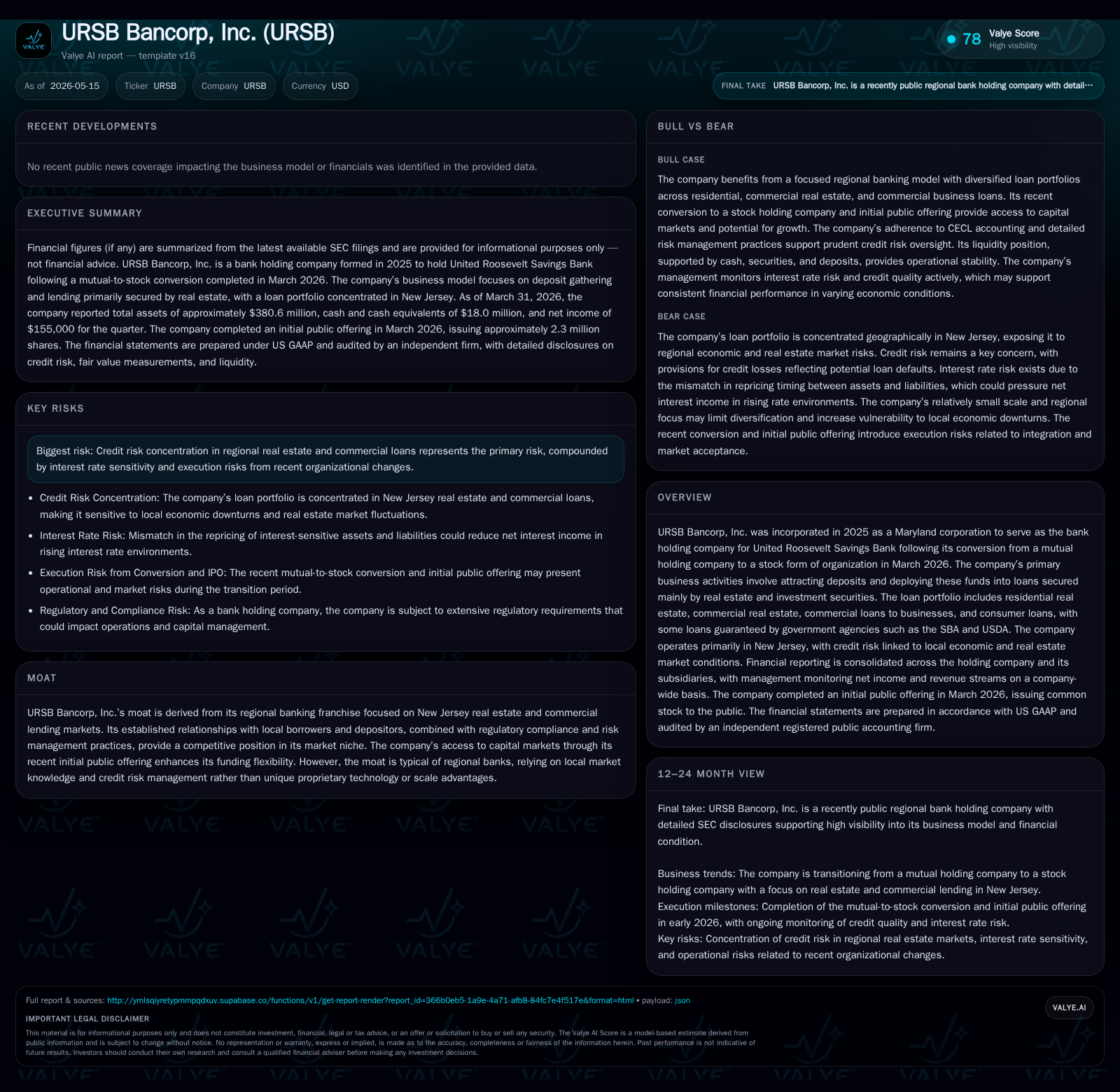
In Q1 2026, URSB Bancorp increased its allowance for loan losses reflecting loan growth and adjusted credit risk factors, coinciding with its March IPO which expanded capital resources. The company’s business model centers on deposit gathering and loan origination primarily secured by New Jersey real estate and commercial assets, supported by government-backed loans that mitigate risk. Its competitive moat is anchored in strong local relationships and disciplined risk management, positioning it to capitalize on market penetration opportunities enabled by fresh capital infusion. However, credit concentration in regional real estate markets and execution risks from organizational changes warrant close monitoring.
Q1 2026 Operating Update: Credit and Capital Dynamics Post-IPO
URSB Bancorp reported a notable increase in the allowance for loan losses during the first quarter ended March 31, 2026. This rise was principally driven by organic loan portfolio expansion coupled with adjustments to qualitative factors that influence credit risk assessments [S2]. This movement signals active portfolio management amid growing exposure. Concurrently, URSB conducted its initial public offering at the end of March 2026 following its conversion from a mutual holding company to a stock corporation [S3]. This pivotal transition injected fresh equity capital into the bank holding company structure.
The infusion of IPO proceeds bolsters URSB’s capital base, underpinning enhanced lending capacity. As of quarter-end, cash and cash equivalents stood at approximately $18 million [F1], providing solid liquidity cushion to support ongoing operations. The weighted-average shares outstanding for the period reflect post-IPO dilution impact but are not indicative for future earnings comparisons due to mid-period issuance [S2].
URSB Bancorp’s Business Model: Product Mix and Revenue Drivers
Incorporated in late 2025 as part of United Roosevelt Savings Bank's reorganization, URSB Bancorp acts primarily as the bank holding company managing deposit gathering and loan deployment activities [S1]. The core revenue engine involves attracting deposits predominantly from New Jersey-based customers, then leveraging these funds into a diversified lending book secured largely by residential and commercial real estate collateral within the state [S1].
The loan mix extends beyond real estate to include commercial loans issued directly to local businesses. A segment of these commercial credits benefits from federal agency guarantees—principally via SBA and USDA programs—which reduce credit reserve requirements given explicit government backing [S1][S2]. This dynamic enhances net interest margins by enabling attractive pricing on lower-risk exposures.
Investment securities complement the asset base with holdings focused on mortgage-backed securities and U.S. government agency obligations that align with conservative liquidity management practices [S1]. The bank employs a rigorous internal credit grading framework consisting of eight categories for commercial real estate and construction lending. Loans rated between one to five are classified as “pass” with low to average risk profiles; those rated six fall under “watch,” signifying minor concerns without evidence of imminent deterioration but warranting closer surveillance [S2].
Managing Credit Risk within Regional Real Estate Exposure
Credit concentration emerges as the defining feature of URSB’s risk profile. The extensive focus on New Jersey real estate markets—both residential and commercial—means that credit performance is tightly linked to local economic conditions and property valuation trends [S1]. While geographic concentration inherently elevates cyclical vulnerability, URSB offsets this through disciplined underwriting standards reflected in its internal grading system.
Loans categorized as watch-rated require ongoing tracking to promptly identify any early signs of deterioration [S2]. This proactive stance facilitates measured adjustments in allowance levels aligned with evolving risk signals. Government guarantees embedded in select SBA/USDA loans provide a built-in buffer against losses on that portion of credits, aiding overall portfolio resilience.
The integration of qualitative factors into allowance calculations during Q1 indicates management’s attentiveness to emerging market nuances possibly induced by shifting interest rates or local economic shifts that could affect borrower repayment capacity.
Competitive Landscape: Positioning in the New Jersey Banking Market
URSB Bancorp’s moat reflects characteristics typical of a regional community bank rather than large-scale banking institutions. Its competitive edge lies predominantly in long-established relationships with area borrowers and depositors who benefit from localized service models attuned to specific market conditions. Regulatory compliance efforts coupled with internal controls on credit risk lend further credibility among stakeholders.
The shift from mutual holding company status to a publicly traded stock company broadens access to external capital markets, enhancing financial flexibility—a relative advantage over smaller peers reliant solely on retained earnings or deposit growth for balance sheet expansion [S3].
However, the lack of proprietary technology platforms or significant scale economies limits differentiation beyond the traditional values of local banking expertise and tailored customer engagement. This situates URSB squarely within the competitive bandwidth where emphasis remains on prudent risk management and deepening local market penetration.
Growth Catalysts: Loan Expansion, Local Market Penetration, and Capital Flexibility
The IPO proceeds realized in March 2026 materially strengthen URSB’s ability to scale its lending portfolio without compromising regulatory capital thresholds [S2][S3]. This financial boost supports targeted growth initiatives across multiple credit segments:
- Residential Real Estate: Continued demand within select New Jersey neighborhoods provides steady volumes for mortgage origination.
- Commercial Real Estate: Underserved local sectors offer opportunities for specialized financing solutions leveraging intimate market knowledge.
- Consumer Loans: Government-guaranteed programs reduce loss potential while enabling attractive offerings that diversify income streams.
These avenues collectively underpin near-to-medium term volume growth prospects accompanied by stable pricing power embedded in mortgage spreads. URSB's internal loan grading system facilitates dynamic allocation of allowance reserves alongside measured portfolio risk expansion ensuring sustainable net interest margins remain intact.
Potential Risks: Concentration, Economic Sensitivity, and Execution Challenges
Key vulnerabilities revolve around geographic concentration chiefly centered on New Jersey real estate markets [S2]. Any downturns impacting property values or business cash flows could amplify nonperforming loans beyond current watch-level gradings necessitating heightened provisioning.
Interest rate fluctuations also present headwinds particularly affecting mortgage-related assets where repricing lag or refinancing activity can compress earning yields temporarily.
Moreover, transitional execution risks stem from the recent organizational conversion—from a mutual holding entity to fully public stock ownership—that may strain operational integration efforts including compliance adaptations or investor relations initiatives.
Hence ongoing vigilance around emerging portfolio stress indicators as well as smooth assimilation of new corporate governance structures is critical for maintaining strategic momentum.
Key Upcoming Milestones and Market Signals to Watch
Market participants should monitor subsequent quarterly filings for clarifying signals regarding credit impairment trends reflected through:
- Changes in allowance for loan losses versus incremental loan originations,
- Shifts within internal loan grade categories especially movements toward watch or substandard statuses,
- Commentary from management addressing deployment pace of IPO capital,
- Evolution of consumer versus commercial portfolio performance,
- Regulatory communications potentially altering capital adequacy frameworks or risk weighting parameters.
These data points will illuminate whether URSB’s post-IPO strategy translates into durable growth accompanied by sound credit discipline within its regional footprint.
Disclaimer: This analysis is based exclusively on publicly available SEC filings and company disclosures without any investment recommendation or opinion offered herein. Readers should conduct their own due diligence before making any financial or strategic decisions related to URSB Bancorp, Inc.
Disclaimer: This is research-only, informational analysis and not investment advice. It may include AI-generated interpretation and general industry context. Always verify important details using primary sources.

Comments