
PGIM Private Credit Fund Updates Governance and Co-Investment Strategy in Q1
Latest quarterly filings reveal refined governance controls, fee alignment, and expanded co-investment policies shaping PGIM Private Credit Fund’s operational posture.
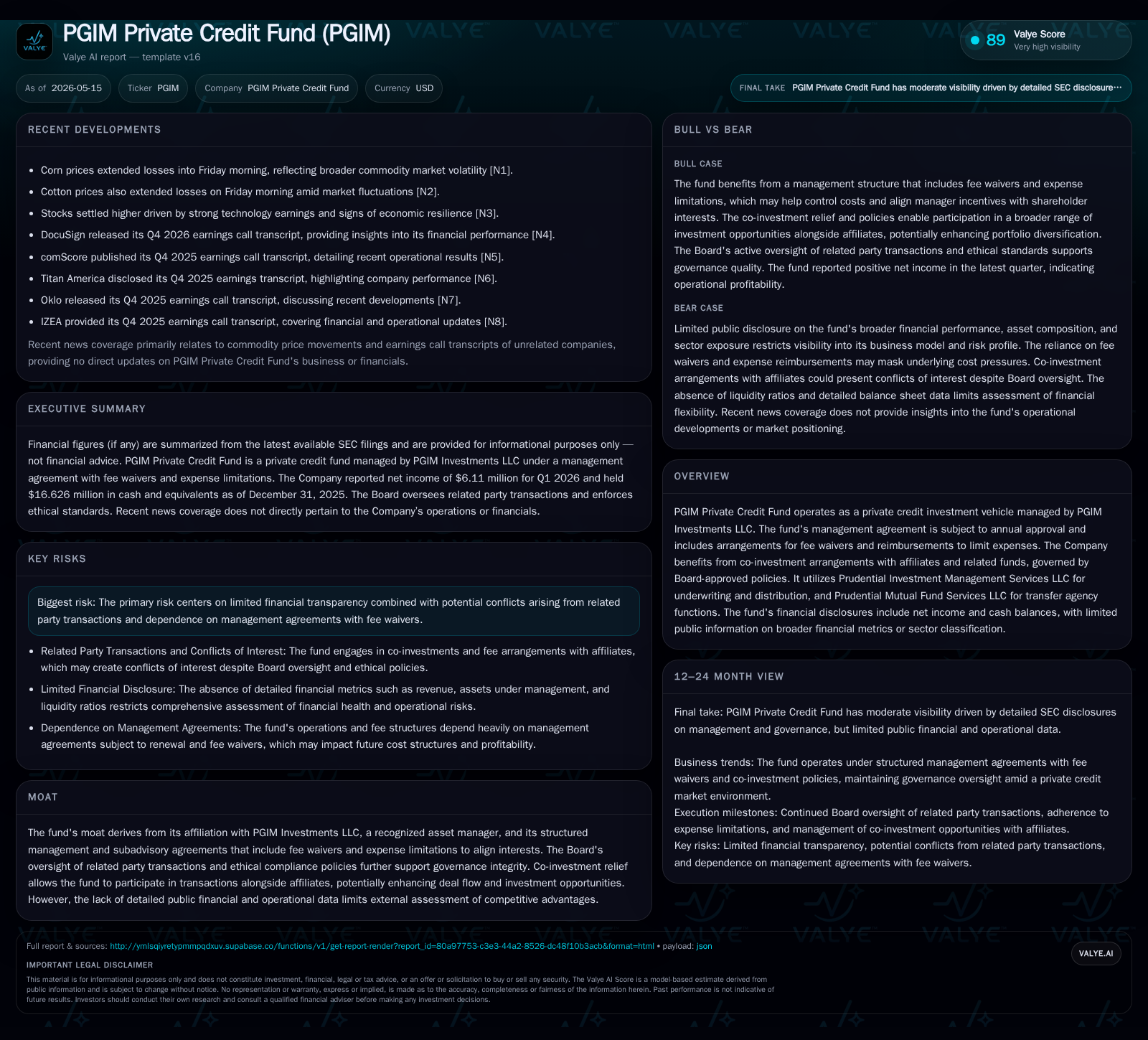
In its latest 10-Q filing dated May 15, 2026, PGIM Private Credit Fund disclosed the establishment of a new credit facility alongside sustained management fee waivers aimed at preserving investor alignment. The Fund operates through a tightly governed framework involving annual Board approvals of management agreements and carefully structured co-investment relief to participate alongside affiliates. These developments underscore an evolution in operational flexibility amid a competitive private credit landscape focused on middle market direct lending in the US and select global regions.
Latest Quarterly Developments and Their Implications
PGIM Private Credit Fund's most recent quarterly filing (Form 10-Q dated May 15, 2026) highlights key operational evolutions including the formation of a new loan financing and servicing agreement executed on May 5, 2026. This facility with Deutsche Bank AG acts as an additional capital source secured by substantially all assets of the fund’s wholly owned special purpose vehicle (SPV), signaling enhanced flexibility in funding private credit investments under favorable terms [S2][S3]. Concurrently, the managerial structure remains supported by continued contractual fee waivers through December 31, 2025, maintaining alignment between the fund’s earnings profile and management incentives by limiting expense burdens on shareholders during this waiver period [S1][S2]. These features collectively reflect deliberate calibration of operating levers to navigate regulatory constraints and competitive market conditions inherent to private credit closed-end funds.
The maintenance of these management fee arrangements amidst evolving capital strategies underscores a commitment to safeguarding shareholder value while expanding access to diversified deal flow via affiliated co-investment channels established through exemptive relief orders. This operating posture sets an immediate tone for disciplined portfolio scaling amidst governance rigor.
Business Model and Product Offering Framework
PGIM Private Credit Fund functions as a non-diversified closed-end BDC externally managed by PGIM Investments LLC. The core revenue mechanism is interest income derived from privately originated floating rate loans primarily first lien senior secured debt to U.S. middle market companies—with up to 30% allocated globally in Canada, Europe, Australia, and Latin America—augmented by capital gains or dividends from equity stakes in portfolio companies where applicable [S1]. The fund employs multiple classes of Common Shares (Class I, S, D) that differ mainly in shareholder servicing fees but maintain economic parity otherwise. Monthly Net Asset Value (NAV) calculations per share class drive shareholder servicing fees in adherence to transparent stewardship practices aligned with fair value measurement protocols governed under ASC 820 [S1].
Strategically, the fund’s investment focus prioritizes downside risk mitigation through contractual protections such as seniority in capital structure, covenants enhancing cash flow predictability, and collateral coverage for a majority exposure—capping subordinated debt at no more than 20% of invested capital. This conservative structuring is designed to preserve principal while generating current income streams [S9][S25]. Operationally, PGIM Investments LLC subcontracts underwriting responsibilities to Prudential Investment Management Services LLC and partner subadvisers who also follow detailed co-investment policies accommodating investments alongside affiliated funds when aligned with the fund’s Core Mandates [S1]. The transfer agency function is outsourced to Prudential Mutual Fund Services LLC ensuring efficient shareholder servicing.
Governance Structure and Related-Party Dynamics
Governance quality stands out as a fundamental moat element for the fund despite its opaque external disclosure profile. Its governance framework entrusts the Board with annual approvals of management agreements—including fee waivers—and oversight of related-party arrangements including co-investments permitted under SEC exemptive relief orders. This serves both transparency and ethical compliance objectives against potential conflicts arising within affiliate-dense structures common in asset management ecosystems [S1][S2]. The Board routinely receives evaluations of cybersecurity risks overseen by Prudential’s interim Chief Information Security Officer (CISO) alongside information security officers tasked with real-time incident detection and remediation monitoring—a critical consideration given the sensitivity of proprietary data governing private credit deals [S1].
The co-investment relief policy mandates that subadvisers present investment opportunities consistent with the fund’s strategy to permit proportional participation vis-à-vis other PGIM-related entities sharing similar asset-class targets. Importantly, discretion rests with subadvisers to decline investments deemed inappropriate for the fund’s objectives, helping preserve alignment across capital allocation decisions. This nuanced governance architecture mitigates transaction conflicts via structured reviews covering investment suitability, expense limitations capped contractually with reimbursement provisions limiting shareholder burden, plus continuous ethical oversight powered by formal codes governing executive behavior [S1][S18].
Position within the Private Credit Industry
Within the broader private credit ecosystem dominated by middle market direct lending specialists, PGIM Private Credit Fund carves out an affiliation-based niche leveraging PGIM Investments LLC’s scale advantages in underwriting effectiveness and distribution reach. Its mandate targeting below-investment-grade floating rate debt helps fill appetite gaps among institutional investors seeking yield alternatives that maintain relatively defensive credit profiles through senior secured loan prominence. Brand association to PGIM enhances deal origination quality and access relative to smaller or standalone private credit vehicles lacking integrated origination-distribution platforms [S1].
The industry value chain contextually involves prudential underwriting standards exercised by PRIIMS LLC on behalf of the fund combined with network effects achieved via Prudential Mutual Fund Services facilitating investor servicing efficiencies—a synergy increasingly critical to compete on cost basis amid rising compliance expectations imposed by SEC registered reporting regimes applicable since its May 2023 BDC election [S1][S4]. Competitive differentiation is supported by a capacity approach balancing liquidity needs via revolving credit facilities while managing concentration risks through diversified geography allocation capped exposure tiers.
Drivers of Growth: Co-Investments and Fee Arrangements
Growth prospects are structurally linked to expanding co-investment opportunities allowed under exemptive relief frameworks which enable the fund to piggyback on proprietary deal flow sourced by affiliates within PGIM’s extensive platform. This arrangement not only increases deal pipeline volume but enhances selection agility allowing dynamic fit assessment aligned with core investment mandates [S1][S3]. Such strategic participation can help drive scale benefits reducing unit costs over time.
Furthermore, annual Board approvals maintaining current management agreements provide recurring discipline over incentive structures ensuring ongoing alignment between manager remuneration—currently influenced by temporary fee waivers—and execution performance metrics. Anticipated expiration of these waivers post-2025 presents margin expansion potential assuming portfolio growth stability aligned with interest income accrual patterns [S1][S2]. Maintaining monthly NAV transparency bolsters investor confidence supporting stable capitalization inflows necessary for sustained origination capacity.
Risk Factors Including Transparency and Transaction Conflicts
Significant risks stem from limited public financial disclosure restricting third-party assessment precision relative to performance benchmarking peers; valuations rely heavily on managerial estimates constrained by illiquidity characteristic inherent in private credit portfolios—raising fair value determination subjectivity acknowledged under ASC 820 rules governing Level III inputs [S8][S23]. Related-party transaction complexity introduces potential conflict zones despite Board-mandated procedural safeguards around co-investments—necessitating vigilance over allocation fairness.
Cybersecurity risk remains salient due to dependency on integrated technology systems overseen remotely by subsidiaries within Prudential Financial Inc., bearing operational disruption consequences if controls fail or incidents escalate. While mitigation frameworks exist including CISO-led incident response protocols presented regularly to trustees, residual threat exposure persists given evolving cyberattack sophistication posing potential reputational damage or regulatory probing risk scenarios [S1]. Regulatory scrutiny extrapolated from ongoing BDC status creates compliance overhead influencing cost structures.
Near-Term Milestones and Monitoring Points
Key upcoming milestones encompass scheduled annual Board votes expected later in 2026 reaffirming management agreement renewals including any adjustments tied to emerging market or operational dynamics documented through periodic SEC reporting cycles such as quarterly NAV disclosures which reflect portfolio mark-to-market trajectories indicative of underlying asset health. Shareholder communications around repurchase program activity will also serve as liquidity demand barometers essential for assessing market appetite for offer redemptions capped at 5% quarterly thresholds potentially impacting capitalization dynamics.
Monitoring future event filings will clarify incremental changes in co-investment participation levels offering tangible insight into evolving operational partnerships alongside affiliates potentially correlating with shifts in deal origination velocity. Observers should also track distributions declared per share class as proximate indicators of cash flow generation sustainability tied directly to earnings mix weighted toward interest income streams [S2][S3][S14].
Financial Overview: Supporting Context
The latest financial snapshot reveals net income totaling approximately $21.8 million for year-end 2025 paired with a cash & equivalents balance near $16.6 million providing liquidity buffer supporting general corporate purposes including investment activities underwritten through newly arranged credit facilities [F1]. This liquid position complements disclosed revolving credit commitments ranging upward due to accordion features permitting scalability up to $350 million augmenting funding flexibility beyond initial $175 million commitment increments seen earlier in fiscal periods [S20].
Operating cash flows historically have been deployed heavily toward portfolio acquisitions dominated by first lien debt instruments consistent with stated investment priorities while financing cash inflows derive principally from equity issuances within Class S and D shares as well as borrowings secured against portfolio assets ensuring multi-source capital scaffold continuity vital for growth execution pacing.
This analysis synthesizes verified SEC disclosures alongside companyfacts data points without offering investment advice or speculative conclusions beyond documented evidence provided by official filings dated up to May 15, 2026.
Disclaimer: This is research-only, informational analysis and not investment advice. It may include AI-generated interpretation and general industry context. Always verify important details using primary sources.

Comments