
Safe Pro Group Executes Strategic Advances in Defense Tech with AI-Driven Solutions
Q1 2026 filings highlight Safe Pro Group’s growth in AI-enhanced defense technology alongside leadership and operational enhancements.
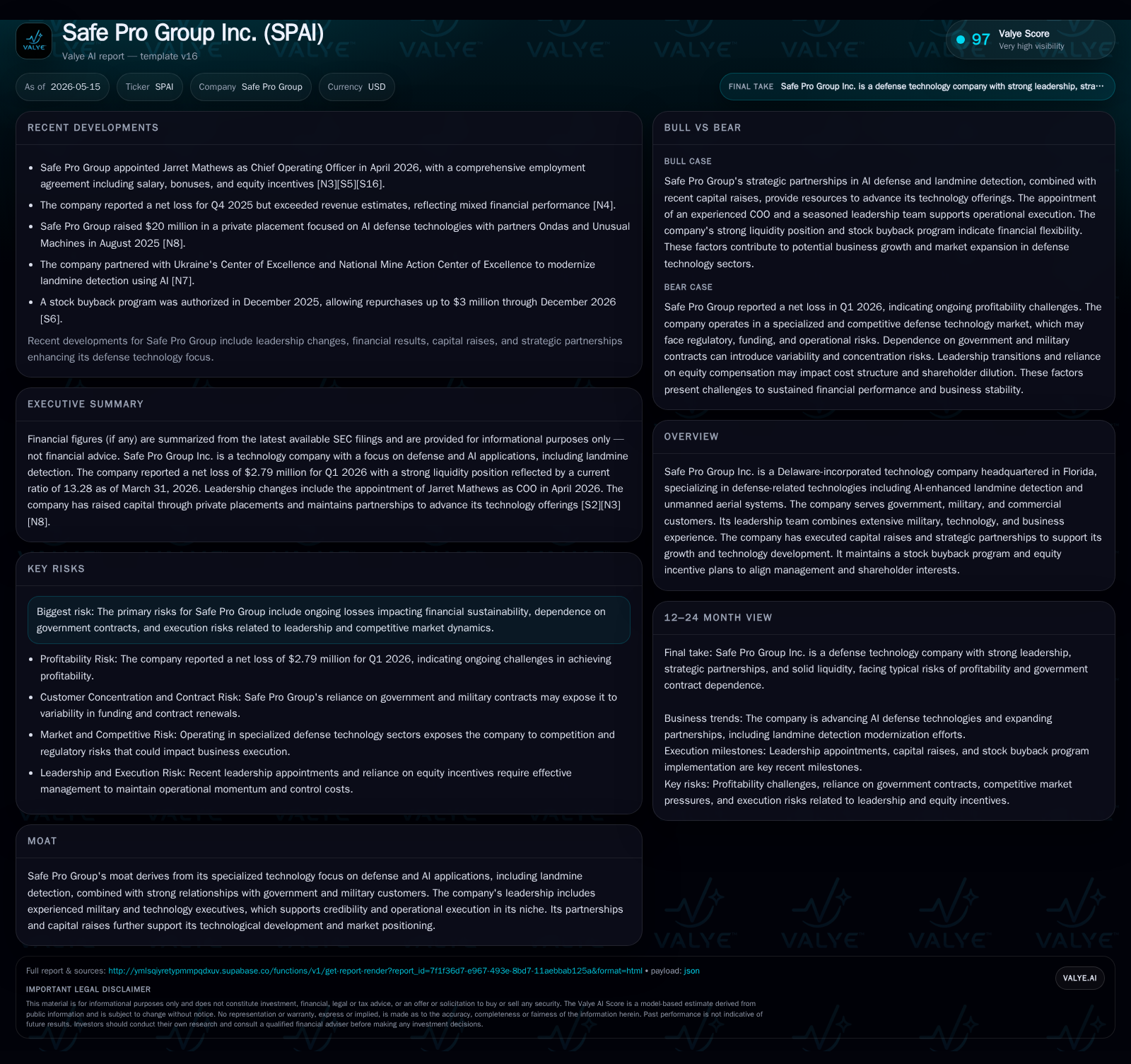
Safe Pro Group Inc. reported its Q1 2026 results on May 15, emphasizing continued development of its AI-driven landmine detection systems and unmanned aerial systems. The company strengthened its leadership by appointing a new COO with military acquisition expertise, supporting expanded government partnerships. Despite ongoing net losses, the firm maintains a robust liquidity position enabling sustained investment in R&D and contract expansion. Key growth drivers include deepening government contracts, proprietary AI technology, and strategic capital raises, while risks center on financial sustainability and execution in a competitive defense-market environment.
Latest Quarterly Operating Update: Key Developments and Impact
Safe Pro Group's Q1 2026 results filed on May 15 underpin a phase of strategic advances powered by increased government demand for advanced AI-enabled defense technologies [S2][S3]. The company highlighted revenue progress driven by expanding contracts within defense markets targeting landmine detection and unmanned aerial system (UAS) applications. Notably, the appointment of Jarret Mathews as Chief Operating Officer in April added significant operational depth given his background directing U.S. Army acquisitions programs [S11][N4].
This leadership shift aligns with Safe Pro's focus on scaling contract execution capabilities and deepening military engagement channels. The company's latest disclosures confirm ongoing investment in product development, with AI algorithm enhancements embedded into their detection platforms enhancing performance. However, operating losses persist as the company balances R&D expenditure against nascent commercial traction [S2].
Business Model and Core Technologies: Specialized Defense Focus
Safe Pro generates revenue primarily through government and military contracts focused on defense technologies, chiefly AI-driven landmine detection systems and unmanned aerial vehicles designed for reconnaissance and payload delivery [S1]. These offerings cater to defense agencies requiring high accuracy, reliability, and rapid deployment capability in hazardous environments.
The business model emphasizes long-term contracts that encompass system development, integration, testing, and support services. Government clients pay for bespoke solutions that leverage Safe Pro's proprietary AI software combined with rugged hardware platforms. Commercial customers form a secondary market segment but rely on similar usage models.
Crucially, Safe Pro's technology moat is established via its fusion of AI enhancement with domain-specific engineering know-how, making switching costly for customers due to embedded software complexity and certification hurdles typical in defense procurement [S1][F1]. This specialization supports recurring revenues linked to maintenance contracts and software updates.
Competitive Positioning within the Defense Technology Sector
Safe Pro operates within a crowded but fragmented landscape of specialized defense technology providers ranging from large prime contractors down to agile niche innovators [S1]. Its competitive advantage derives from focused expertise at the intersection of AI applications for landmine detection combined with scalable UAS platforms.
Government relationships serve as a gatekeeping moat because contract awards often hinge on past performance credibility, security clearances, and regulatory compliance rigor—barriers where Safe Pro's management team's military connections add tangible value [S1][N4].
Nevertheless, pricing pressure exists as public budgets tighten and alternative solutions emerge globally. Capacity constraints are manageable currently but require careful balancing to meet scaling demand while controlling costs.
Growth Drivers: Government Contracts, AI Innovation, and Strategic Partnerships
Growth at Safe Pro is unfolding along several vectors:
- Government Contract Expansion: The firm continues building backlog through targeted wins in landmine detection upgrades across allied nations’ militaries. Contracts incorporate staged deliveries linking revenue recognition to milestone completions [S2][S3].
- AI-Enabled Product Advances: Investment in machine learning algorithms embedded within sensor suites enhances detection rates under diverse environmental conditions, distinguishing Safe Pro’s offerings [S1][N2].
- Strategic Partnerships: Collaborations facilitate access to additional R&D resources and potential new customer channels while capital raises underpin technology scale-up initiatives [S3].
KPIs such as contract wins pipeline size, adoption rate of updated AI modules, and successful field deployment milestones serve as proxies validating these drivers.
Risks and Constraints: Financial Sustainability and Execution Challenges
While Safe Pro’s technical positioning is strong, persistent net losses near $14.3 million reinforce concerns about cash burn rates relative to operating inflows [F1]. Reliance on government funding introduces volatility risks tied to geopolitical shifts or budget austerity.
Execution risks also loom due to competitive intensity requiring accelerated innovation cycles alongside complex project management inherent in defense procurements [S2][S1]. Leadership transitions must maintain cohesion amid scaling pressures.
The emerging growth company status offers some regulatory relief but places emphasis on meeting near-term milestones to sustain investor confidence.
Upcoming Milestones: What Investors Should Monitor Next
Key forthcoming indicators include:
- Q2 2026 earnings release providing updated revenue figures and gross margin insights,
- Announcements related to new contract awards or renewals,
- Developments concerning commercialization phases for enhanced AI landmine detection platforms,
- Updates on integration progress following COO appointment supporting operational efficiency [S3][N2].
Tracking these events will elucidate whether Safe Pro can convert its technological promise into scalable financial returns.
Latest Financial Snapshot Supporting Operational Context
Latest financial snapshot
| Metric | Value | Period |
|---|---|---|
| Total debt | $146,000 | |
| 2026-03-31 | ||
| Net debt | $146,000 | |
| 2026-03-31 | ||
| Current assets | $15,566,806 | |
| 2026-03-31 | ||
| Current liabilities | $1,172,631 | |
| 2026-03-31 | ||
| Current ratio | 13.28x | |
| 2026-03-31 |
Source: SEC companyfacts cache [F1].
Safe Pro Group's balance sheet as of March 31, 2026 shows total debt at $146,000 against current assets of approximately $15.6 million yielding an exceptionally strong current ratio of around 13.28—indicative of ample liquidity coverage over short-term obligations [F1]. Current liabilities stand at $1.17 million reflecting manageable operating payables.
Nevertheless, the net income loss tracked near $14.3 million underscores challenges transitioning from development-stage investment toward achieving profitable contract scale [F1].
| Metric | Value |
|---|---|
| Total Debt | $146,000 |
| Current Assets | $15,566,806 |
| Current Liabilities | $1,172,631 |
| Current Ratio | 13.28 |
| Net Income (Loss) | -$14,322,779 |
This analysis is based solely on public filings and news up to May 15, 2026. It does not constitute investment advice but provides a detailed operational perspective grounded in recent disclosures.
Disclaimer: This is research-only, informational analysis and not investment advice. It may include AI-generated interpretation and general industry context. Always verify important details using primary sources.

Comments