
Genie Energy’s Retail and Renewables Segments Weigh Growth Amid Regulatory and Market Volatility
Latest quarterly results highlight operational resilience but underscore challenges from deregulated retail energy competition and evolving renewable projects.
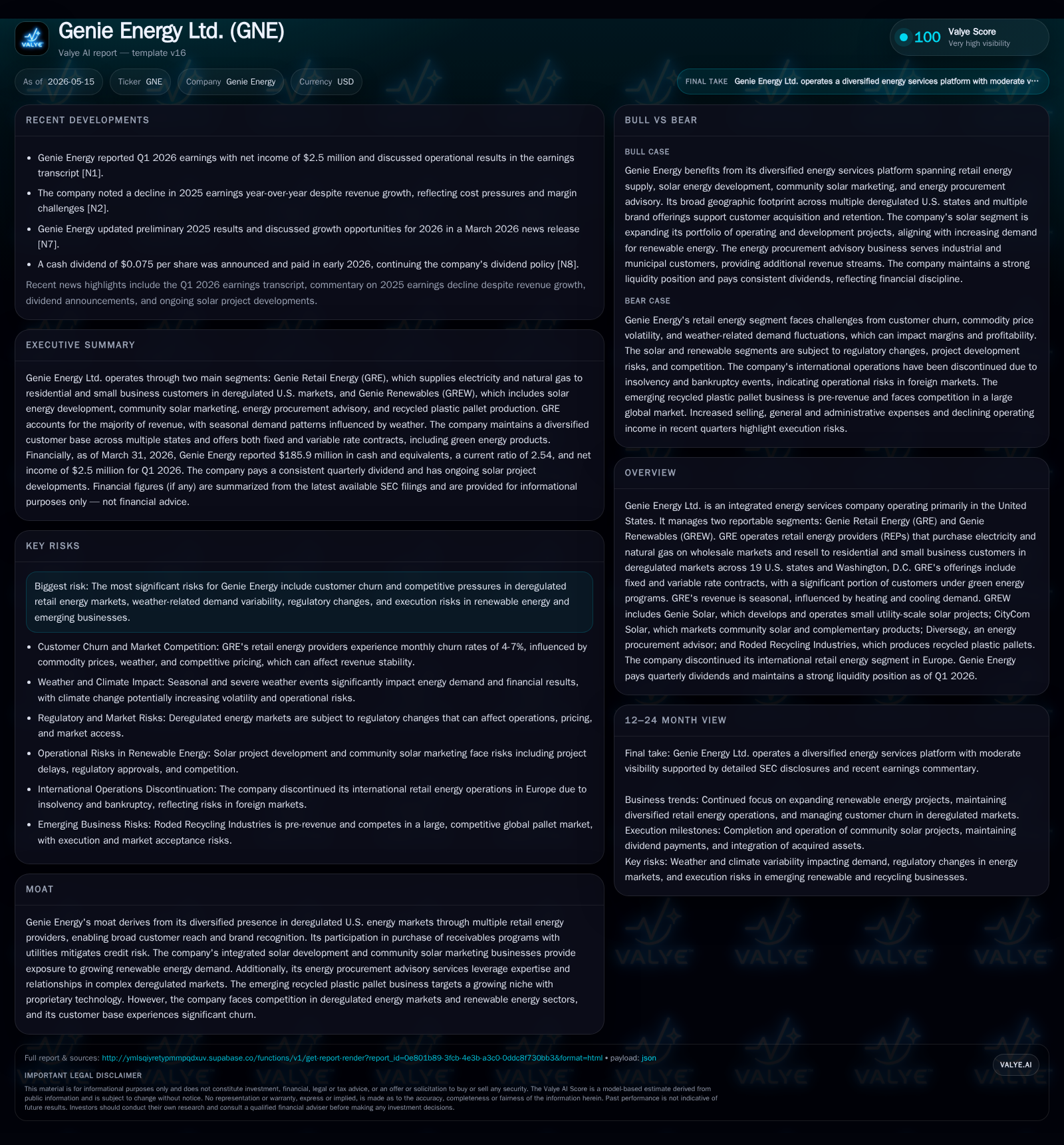
Genie Energy Ltd. reported its Q1 2026 operating results emphasizing continued exposure to weather-driven demand cycles and regulatory shifts in its retail energy businesses, alongside advancing renewable solar projects and early-stage recycling initiatives. The company’s two main segments, Genie Retail Energy (GRE) and Genie Renewables (GREW), offer diverse exposures from wholesale energy resale in deregulated U.S. markets to utility-scale solar development, community solar marketing, and an emerging recycled plastics pallet business. While GRE benefits from broad market presence and purchase-of-receivables programs that mitigate credit risks, it faces intense competition, customer churn, and growing regulatory complexities. Meanwhile, GREW’s growth is driven by expanding solar capacity and community solar initiatives, though execution remains critical amid pricing pressures in the renewables sector. Financially, Genie maintains strong liquidity with a robust current ratio and negligible net debt as of Q1 2026.
Recent Operating Update
Genie Energy’s latest quarterly filing on May 15, 2026 ([S2]) and concurrent earnings release ([S3]) provide a grounded picture of the company’s performance through Q1 2026. The report stresses the direct influence of climate-related factors—including weather volatility—and regulations on demand for retail energy offerings in deregulated U.S. states.
A key operational highlight is that required renewable energy credit (REC) compliance fluctuates regionally with customer mix and consumption profiles. The company indicates these credits are generally accounted for during either the first calendar quarter or late second to early third quarter depending on state compliance periods ([S2]).
Additionally, company disclosures reflect that while the Retail Energy Providers (REPs) continue to face competitive pricing pressure from incumbent utilities and other REPs, GRE sustains its participation in purchase of receivables programs, which insulate its cash flow from bad debt risks posed by customers or utilities ([S2],[S1]).
Business Model
Genie Energy operates principally through two reportable segments:
Genie Retail Energy (GRE): This segment runs multiple REPs across 19 deregulated U.S. states plus Washington D.C., reselling electricity and natural gas primarily to residential and small commercial customers. GRE derives revenue from energy resale margins on wholesale purchases hedged via fixed or variable contracts. Its offering includes environmental products such as green energy plans that contain renewable content to meet regulatory requirements or customer preferences.
Genie Renewables (GREW): Comprising several subsidiaries—most notably Genie Solar (solar project development & operations), CityCom Solar (community solar marketing), Diversegy LLC (energy procurement advisory for commercial/municipal customers), and Roded Recycling (plastic pallets producer). GREW focuses on capitalizing on the expanding renewable infrastructure buildout and sustainability trends.
The GRE model relies heavily on volume-driven sales to end customers who pay fixed or indexed rates linked to wholesale commodity prices. Pricing margins can fluctuate with market dynamics; therefore margin management often depends on hedging efficiency and minimizing customer churn—both significant challenges given competitive landscapes ([S1]). Customer acquisition requires substantial marketing investment due to brand competition with entrenched utilities.
Meanwhile, the GREW segment aims to capture secular growth from renewable adoption through building utility-scale solar assets which gradually contribute operational revenues once online. CityCom Solar leverages customer acquisition expertise for community solar products tailored to customers seeking off-site renewable solutions. Diversegy extends value by advising large customers navigating complex deregulated markets.
Roded Recycling is currently pre-revenue but represents a strategic diversification leveraging proprietary technology that converts agricultural/industrial plastic waste into high-grade pallets potentially benefiting from plastic waste reduction credits ([S1]). This product could gain cost competitiveness against traditional pallets due to low feedstock cost.
Industry Structure and Competitive Position
In the deregulated retail energy sector where GRE operates, competition arises both from incumbent utilities who retain strong name recognition and integrated infrastructure ownership, as well as numerous smaller REPs racing for market share ([S1]). Regulatory conditions vary by state with some subjecting retail suppliers to stringent marketing registration and disclosure protocols—as seen recently in New York—which may suppress customer acquisition efficiency.
The ability to participate in POR programs allows GRE’s REPs to receive payments for billed amounts directly from utilities, mitigating credit risk substantially compared to direct customer collections. However, regulatory shifts such as Maryland's elimination of POR for residential customers led Genie to exit some residential markets there—highlighting vulnerability to legislative changes ([S1]).
In renewables, the competitive landscape is shaped by rapidly declining solar installation costs globally making utility-scale projects increasingly viable economically ([S1]). Genie Solar competes with established developers but gains edge by owning operational small-scale plants while also pursuing permitting for newer projects primarily in core states like New York and Ohio.
Community solar via CityCom taps into a growing market segment demanding cleaner energy access without onsite panels but faces competitive pressure from other aggregators or local utilities offering similar programs.
Energy procurement advisory services provided by Diversegy act at a higher B2B layer where expertise around contract negotiation provides stickiness but also exposes it to competition from consulting firms or in-house corporate teams.
Roded Recycling enters a niche with environmental product differentiation potentially commanding advantages if scaling oil supply chain disruption accelerates interest in plastic waste alternatives.
Growth Drivers
The company’s growth trajectory rests on several vectors:
Expanding Customer Base in Deregulated States: Genie continues marketing efforts aiming at net positive customer additions despite churn typical of residential retail electricity markets [S1]. Performance hinges on ability to adapt offerings amid shifting state rules.
Renewable Energy Project Pipeline: Completion of newly constructed community solar projects—like the Lansing Community Solar array brought online November 2025—and ongoing permitting pipeline in New York support mid-term revenue ramp within GREW ([S23]). Acquisition of operational projects adds near-term cash flow.
Green Product Demand: Increased consumer preference for green energy options underpins potential uplift in fixed-rate green plans within GRE’s portfolio aiding retention.
Emerging Circular Economy Solutions: Launching Roded Recycling’s recycled plastic pallets targets new revenue streams exploiting growing regulatory emphasis on plastic waste reduction incentives ([S1]).
Energy Procurement Consulting Expansion: Diversegy's advisory role benefits from industrial client interest in optimizing energy spend amid volatile markets.
Risks / Watchpoints / Growth Constraints
The principal risks highlighted include:
High Customer Churn & Competition: Residential REP businesses suffer significant attrition requiring continuous costly marketing campaigns; incumbents have entrenched advantages limiting pricing power [S1].
Regulatory Uncertainty: Changes varying by state could impose marketing constraints or eliminate POR benefits adversely affecting revenue streams—e.g., Maryland losing POR led Genie to return impacted customers [S1].
Weather & Climate Impact: Weather extremes directly affect heating/cooling demand creating seasonal revenue swings coupled with commodity price volatility [S2].
Renewables Execution Risk: Scaling solar projects depends on timely permitting approvals and construction efficiency; delays or cost overruns could hamper growth prospects [S23].
Early Stage Status of Roded: As a pre-revenue start-up initiative, success depends on commercialization execution within competitive recycled materials markets which remain nascent [S1].
What To Watch Next
Key upcoming milestones include:
- Ongoing regulatory developments particularly in states like New York affecting REP marketing practices where Genie holds material share (~12% meters served) [S1].
- Completion status of community solar projects under construction in New York or pipeline expansions across other states [S23].
- Initial commercial releases from Roded Recycling pilots expected during 2026 [S1].
- Quarterly updates detailing customer count trends within GRE indicating traction against churn.
- Further commentary on pricing strategies vis-à-vis wholesale commodity fluctuations impacting margins within retail supply contracts.
- Progression on internal control improvements following previous audit restatements will be relevant for financial reporting reliability [S15].
Financial Profile Summary
Latest financial snapshot
| Metric | Value | Period |
|---|---|---|
| Cash & equivalents | $186mm | |
| 2026-03-31 | ||
| Current assets | $311mm | |
| 2026-03-31 | ||
| Current liabilities | $122mm | |
| 2026-03-31 | ||
| Current ratio | 2.54x | |
| 2026-03-31 |
Source: SEC companyfacts cache [F1].
While the detailed income statement metrics post-Q1 2026 remain embedded primarily within SEC text filings ([S2],[S3]), the company’s balance sheet snapshot as of March 31, 2026 shows a healthy liquidity position:
*Total debt figure not refreshed since late 2021 filings but likely remains nominal given no contradictory disclosures [F1],[S2]. The strong surplus cash position implies low leverage risk giving financial flexibility for growth investments particularly into renewable capital expenditures ([F1],[S2]).
Margins remain pressured by competitive retail pricing dynamics but operating income was reported at $4.57 million at year-end December 31, 2025 with net income approximating $4.8 million over same period signifying modest profitability despite headwinds ([F1]). Seasonal impacts related to demand intensity carry forward into quarterly variations.[N7]
Conclusion
Genie Energy continues maneuvering through a multifaceted energy landscape balancing legacy retail provider operations exposed to cyclical demand fluctuations, intense marketplace competition, evolving regulation alongside growth bets within renewables convergence including community solar development and innovative recycling solutions. The diversified yet interrelated portfolio offers some insulation against sector-specific downturns but execution discipline remains crucial especially as regulatory environments shift unpredictably across states. Maintaining purchase-of-receivables participation helps stabilize cash flows amid high churn risks while expanding operated renewable generation assets underscores alignment with structural decarbonization trends.
The firm’s sizable liquidity reserve provides cushioning backed by low leverage though profitability metrics point toward cautious optimism given challenging retail segment economics amid ongoing investment needs elsewhere in renewables scaling stages.
Investors tracking Genie Energy should prioritize monitoring operational customer metrics within deregulated REP territories alongside progress toward commercial scale at Roded Recycling as well as incremental contributions from new solar arrays coming online throughout the year.
This analysis is based solely on public SEC filings dated through May 15th, 2026 as well as recent news transcripts cited herein. It does not constitute investment advice or recommendations but aims to provide an informed industry perspective grounded in verifiable data sources.
Disclaimer: This is research-only, informational analysis and not investment advice. It may include AI-generated interpretation and general industry context. Always verify important details using primary sources.

Comments