
Telkom Indonesia Accelerates Strategic Holding Transformation to Unlock Telecommunications Value
Latest quarterly disclosures reveal Telkom Indonesia’s active push toward a streamlined holding company structure, driving operational efficiency and asset monetization amidst industry headwinds.
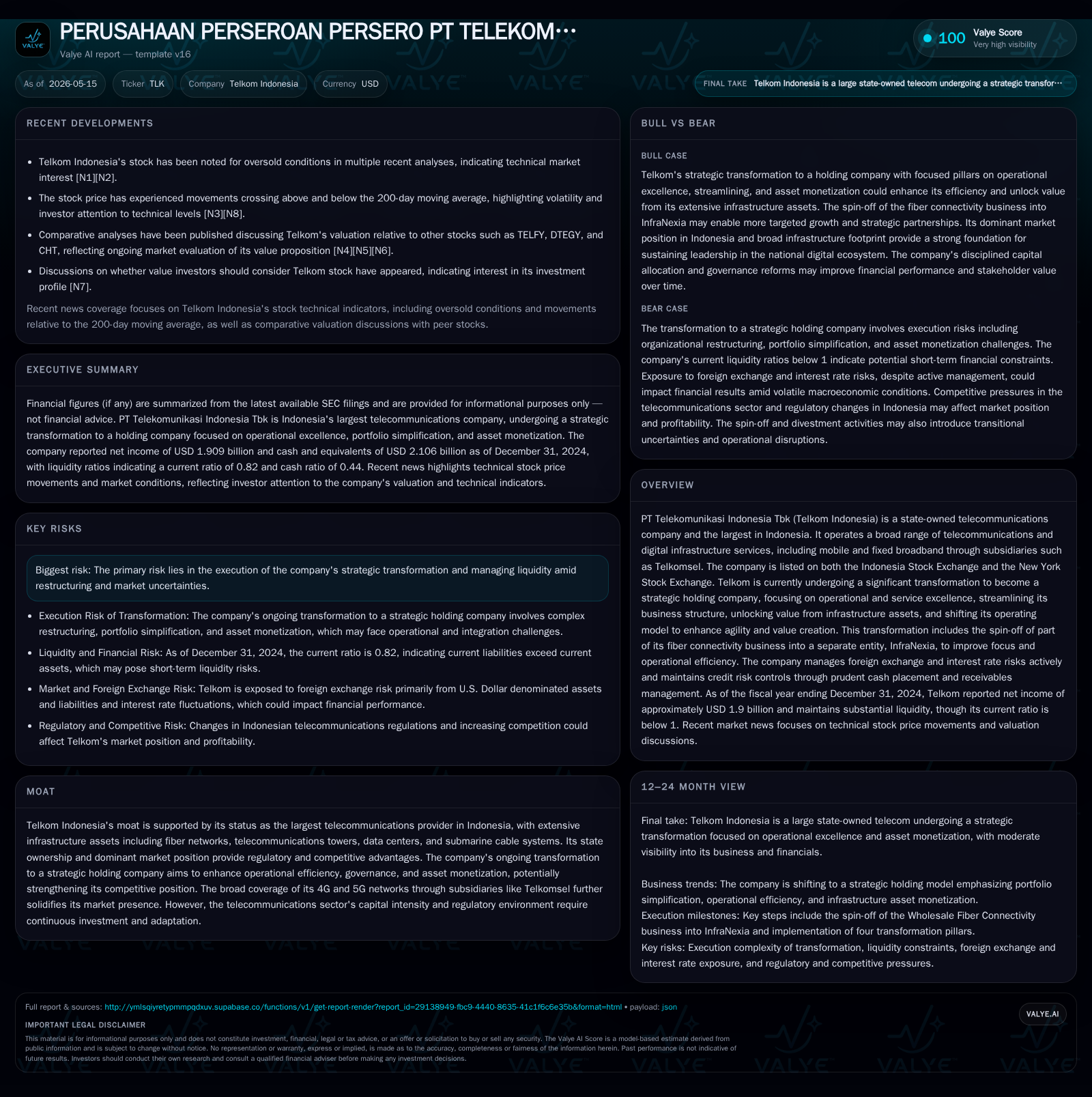
PT Telekomunikasi Indonesia Tbk (Telkom Indonesia) reported continued progress in its Five Bold Moves transformation during the latest quarter, focusing on rationalizing its subsidiary portfolio and sharpening operational performance. The company maintains its leadership in Indonesia’s telecommunications market through broad 4G/5G coverage and digital infrastructure expansion, leveraging scale while navigating capital intensity and regulatory complexities. Key growth drivers include digital infrastructure spin-offs and enterprise ICT services, balanced against execution risks related to transformation and legal investigations. Financially, liquidity remains adequate with manageable leverage, though tight current ratios necessitate careful working capital management.
Latest Quarterly Operating Update: Transformation Progress and Market Realities
The latest quarterly filing as of May 15, 2026 [S2], complemented by a prior 6-K on May 13 [S3], sheds light on Telkom Indonesia’s accelerated strategic repositioning under the “Five Bold Moves” framework. The company is actively evolving from an integrated incumbent operator toward a streamlined strategic holding entity focused on enhanced operational rigor and unlocking value from existing infrastructure assets. This includes rationalizing the subsidiary portfolio—most notably through the spin-off of the fiber connectivity business unit into InfraNexia—to concentrate management effort more sharply and improve capital allocation efficiency.
Management’s commentary underscores the challenging macro backdrop characterized by sluggish global growth and subdued consumer purchasing power pressing the Indonesian telecom sector in 2025–26. Despite these headwinds, Telkom signals resilience in completing organizational streamlining initiatives aimed at mid-term sustainable growth. This enhances control over capital-intensive digital infrastructure investments while sustaining quality service delivery across mobile cellular and fixed broadband segments.
Business Model Architecture: Core Pillars and Service Quality
Telkom’s revenue generation rests primarily on four pillars anchored by diverse yet complementary service lines optimistic towards future digital consumption trends [S1][S14]:
B2C Mobile Services: Operated principally via majority-owned subsidiary Telkomsel, offering extensive 4G/5G coverage to approximately 156 million subscribers backed by a robust base transceiver station (BTS) footprint.
Fixed Broadband Services: IndiHome branded fixed broadband reflects growth potential with over 10 million residential subscribers benefiting from fiber-optic connectivity.
Digital Infrastructure: The InfraNexia initiative formalizes the separation of fiber backbone assets to foster dedicated focus on wholesale infrastructure services.
B2B ICT & International Ventures: Comprehensive ICT solutions for enterprise customers plus international business platforms engaging cross-border data flows provide revenue diversification.
Telkom maintains pricing rationalization policies balancing profitability against broad customer affordability constraints amid Indonesia’s middle-income demographic segment. Investments in network quality and large-scale infrastructure underpin product relevance while affording significant switching costs internationally difficult for competitors without government backing or extensive asset bases.
Competitive Positioning in Indonesia’s Telecommunications Ecosystem
Telkom commands a dominant position as Indonesia’s largest telecom operator, leveraging state ownership that provides both implicit government backing and preferential access within regulatory frameworks [S1][S5]. Its extensive tangible asset base—comprising nationwide fiber networks, tens of thousands of telecommunications towers (BTS count aligned with market leadership), multiple hyperscale data centers including Batam and Cikarang sites, plus international submarine cable consortium memberships such as TOPAZ, BIFROST, SJC2—raises formidable barriers to entry in this capital-intensive industry.
Regulatory oversight by the Ministry of Communication and Information Technology (MoCD) governs licensing fees, universal service obligations (USO), frequency usage charges, and tariff structures that directly impact operational costs and pricing flexibility [S5]. While state ownership ensures regulatory alignment in part, it also introduces governance complexity regarding minority shareholders’ interests vis-à-vis governmental priorities.
Growth Catalysts: Digital Infrastructure Expansion and Portfolio Rationalization
Key drivers propelling Telkom’s growth trajectory encompass:
InfraNexia Fiber Spin-Off: Transitioning fiber assets into a dedicated entity streamlines capital investment decisions focused on wholesale market opportunities with improved efficiency expected from concentrated management oversight [S3].
Mobile Data Network Rollout: Ongoing investment in expanding Telkomsel’s next-generation network footprint with emphasis on densification of both 4G LTE and emerging 5G capabilities caters to surging demand for high-speed data consumption.
Enterprise Digital Service Adoption: Increasing digitization across Indonesian corporates fuels uptake of cloud services, cybersecurity solutions, managed services under the B2B ICT pillar.
International Business Expansion: Platforms enabling cross-border telecommunications traffic provide incremental revenue scope beyond domestic confines.
Over 60% of total revenues now derive from data-related services substantiating a structural industry pivot away from declining legacy voice/SMS products toward Internet-of-Things (IoT), Over-The-Top (OTT) content engagement, e-commerce ecosystems integration—hallmarks of an evolving digital economy landscape [S1].
Risks and Constraints: Execution Challenges and Regulatory Environment
Transformation execution risk forms a critical watchpoint given ongoing internal reorganizations paired with past compliance lapses highlighted by U.S. SEC/DOJ investigations related to revenue recognition irregularities dated mainly between 2016–2019 affecting historical financials [S7][S20]. While internal investigation phases are concluded with remedial actions underway—including strengthening accounting controls and management layers—the ultimate resolution timelines remain uncertain.
Operating cost pressures arise partly from obligatory concession fees paid to government bodies (approximately Rp2 trillion annually) alongside radio frequency charges constituting around 7% of total expenses—significant recurring cost lines that constrain gross margin expansion prospects [S1][S5]. Additionally, Indonesia’s competitive telecom sector mandates continuous heavy capex commitments for network modernization amid price-sensitive end markets constraining immediate pricing power despite premium service offerings.
Governance tension between public shareholder minority interests versus state owner directives may influence strategic decision-making processes with attendant risk implications requiring diligent monitoring.
Key Monitorables: Upcoming Milestones, Capital Deployment, KPI Trends
Investors should closely track several operational milestones:
The progress of InfraNexia spin-off execution per transformation roadmap with clarity on standalone operational metrics affecting consolidated financials going forward [S3].
Subscriber trends at IndiHome fixed broadband along with Telkomsel mobile subscriber dynamics which serve as leading indicators for top-line momentum [S1].
Capital expenditure patterns reflecting prioritization toward fiber backhaul scale-up and accelerated BTS rollout aligned with growing 5G adoption highlighted in capex disclosures roughly totaling Rp24.6 trillion (~US$1.475 billion) in 2025 across parent & subsidiaries consistent with stated funding capacity [S9].
Refinancing activities or changes in credit facility utilization impacting leverage ratios alongside working capital management effectiveness which currently registers a modest current ratio near 0.82 flagged as tight but manageable liquidity [F1][S4].
Resolution progress regarding ongoing legal/regulatory probes will materially affect risk assessment frameworks going forward.
Supporting Financial Commentary: Liquidity, Debt Profile, and Profitability Snapshot
Telkom closed calendar year-end December 31, 2025 maintaining cash & equivalents around US$2.1 billion complemented by current assets slightly below current liabilities yielding a current ratio close to 0.83—a tight but monitored liquidity position necessitating efficient working capital control [F1][S12]. External liquidity is supported by extensive undrawn credit lines aggregating more than Rp40 trillion ($~2.4 billion) from diversified banking partners providing ample dry powder for growth capex or refinancing needs [S4][S6].
Total debt stood at approximately Rp75 trillion (~US$4.5 billion) characterized by a mix that includes long-dated Rupiah denominated bonds bearing coupon rates between ~10.6% (maturing June 2030) to ~11% (maturing June 2045), supplemented by lease liabilities and bank loans; near equal split between fixed/floating rates exposes some sensitivity to interest rate fluctuations managed via portfolio structuring strategies [S3][S13][S15].
Despite intensifying expense pressures related to depreciation/amortization arising from network buildout & concession fees alongside slower revenue growth dampening operating profit margins—from nearly 28% in prior year down toward low twenties percent—the company maintained positive profitability levels surpassing US$1.8 billion net income estimates alongside incremental finance income reflective of rising interest environments offsetting higher costs [S11][S17].
In summary: Telkom demonstrates disciplined capital management balancing aggressive network investment needs amid complex regulatory interactions while undergoing profound organizational change positioning it for longer-term value capture within the Indonesian digital transformation theme.
Disclaimer: This analysis is based solely on publicly filed SEC documents dated through May 2026 combined with companyfacts financial data as specified. It does not constitute investment advice or recommendations but aims to deliver an informed business assessment grounded exclusively in cited official disclosures.
Disclaimer: This is research-only, informational analysis and not investment advice. It may include AI-generated interpretation and general industry context. Always verify important details using primary sources.

Comments