
Community Bancorp's Regional Banking Model Leverages Deposit Stability and Credit Risk Controls
Strong loan growth combined with disciplined capital and liquidity management underscores Community Bancorp's steady approach within Vermont’s regional banking landscape.
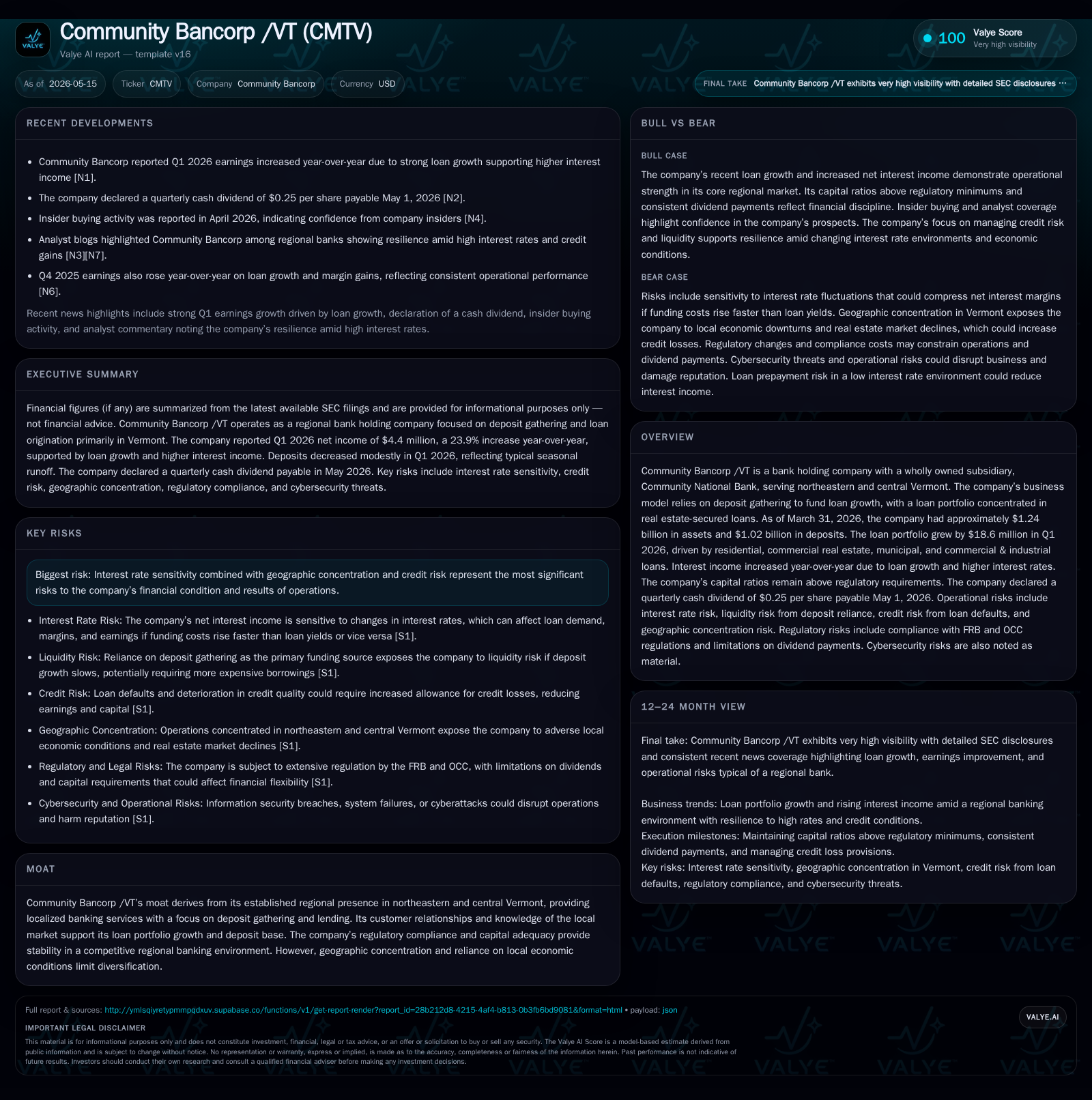
Community Bancorp reported a $18.6 million increase in its loan portfolio during Q1 2026, driven by residential, commercial real estate, municipal, and commercial & industrial loans, supporting higher interest income despite a decline in deposits. The bank’s funding strategy remains grounded in core deposits complemented by alternative funding sources like reciprocal CDARS/ICS programs. Its capital position strengthened with equity rising to $116.8 million—well above regulatory requirements—while the company continues to manage interest rate risk and credit exposures through independent loan reviews and prudent underwriting practices. Growth momentum is balanced with risks linked to geographic concentration and deposit fluctuations in a challenging rate environment.
Q1 2026 Operating Highlights and Near-Term Developments
Community Bancorp released its Form 10-Q on May 15, 2026, covering the quarter ended March 31, revealing notable operational progress alongside manageable challenges inherent in regional banking. The company expanded its loan portfolio by approximately $18.6 million during the quarter—a continuation of solid lending momentum—primarily propelled by increases across residential mortgage (first and junior lien), commercial real estate (CRE), municipal loans, and commercial & industrial (C&I) segments [S2][S24]. Importantly, residential mortgage loans remained steady at about 29.2% of total loans, underscoring the bank's continued emphasis on traditionally underwritten mortgages backed by protected Loan-to-Value ratios.
Despite this growth in earning assets, total deposits contracted by roughly $52.9 million (4.9%), primarily due to anticipated first-quarter runoff typical in government agency accounts and non-arbitrage purposes [S24]. This contraction necessitated tactical liquidity maneuvering as the company balanced asset growth with liability-side dynamics.
Interest income rose by $1.5 million year-over-year thanks to both volume expansion and higher interest rates applied to new originations as well as repricing adjustable-rate loans [S24]. Conversely, total interest expense edged down slightly due to modest declines in interest paid on deposits and junior subordinated debentures carrying floating rates [S24]. The company declared a steady quarterly dividend of $0.25 per share payable May 1, reflecting consistent shareholder returns policy amidst ongoing operational development [S13][N2].
Capital strength improved with shareholders’ equity climbing to $116.8 million at quarter-end from $113.7 million at December 31, 2025; book value per share rose accordingly to $20.88 from $20.36 [S2][S28]. Liquidity remains supported by management's assessment of high levels of potentially liquid assets, unencumbered securities, cash flows from operations, and additional borrowing capacity sufficient to meet the company’s liquidity and capital needs [S2].
Business Model and Product Offering Overview
Community Bancorp operates principally as a bank holding company controlling Community National Bank serving northeastern and central Vermont communities—a geographically concentrated yet relationship-dense market [S1]. Its business model hinges on core deposit gathering as the foundation for funding a loan portfolio skewed heavily toward real estate-secured loans including residential mortgages (~29% of loans) and CRE lending.
Revenue is generated primarily from net interest income (NII) derived from the spread between interest earned on loans/investments versus interest paid on deposits/borrowings. The company supplements income via fees but this remains secondary [S1][S2]. Loan growth directly lifts interest income through volume expansion while pricing reflects prevailing market rates plus risk-based adjustments ingrained within underwriting norms.
Customer relationships hinge on local presence enabling tailored lending products meeting community needs ranging from home purchases/refinances to business financing backed by tangible collateral. The absence of high-risk mortgage products like option ARMs or subprime exposures mitigates credit volatility [S22]. Deposit products cover demand accounts, savings accounts, money market funds and time deposits segmented carefully for price competitiveness aligned with liability management strategy [S21].
Alternative funding routes such as reciprocal CDARS/ICS deposits grant deposit insurance coverage for larger client balances exceeding standard FDIC limits via reciprocal exchanges with participating banks—a valuable retention tool [S21]. Brokered time deposits also supplement retail deposits when required providing flexible but more expensive funding alternatives during mismatch periods.
Competitive Position within Regional Banking
Community Bancorp’s moat largely rests on its deep Vermont regional footprint characterized by strong local relationships supported by legacy knowledge of economic cycles unique to northeastern Vermont towns [S1]. As an entrenched player without broad geographic diversification, it leverages localized customer insight capturing small business lending opportunities while maintaining conservative real estate collateral standards.
Regulatory adherence is rigorous reflected in capital adequacy comfortably exceeding minimums—critical for smaller institutions facing heightened scrutiny post-pandemic banking sector volatility [S1][S28]. This conservatism benefits reputational trust among depositors who seek stability alongside ongoing product customization.
However, the bank faces competitive pressure from other New England regional institutions as well as larger national players encroaching into community banking spaces via digital channels or specialized loan offerings. Price competition can intensify especially around core deposits impacting net interest margin if deposit costs escalate faster than asset yields [S1][N1].
Residential mortgage growth benefits from Vermont’s stable housing market with conservative underwriting practices preserving asset quality while expanding footprint incrementally through origination of first lien mortgages plus junior lien home equity products underpinned predominantly by PMI or strict credit eligibility requirements [S22]. Commercial real estate loans rose notably contributing over one third of new originations—reflecting moderate but persistent demand aligned with local business expansions or refinancing activity summarized in Q1 data showing multiple segments growing simultaneously including municipal loans supporting public infrastructure projects [S24].
On the liability side, the emphasis remains on growing core deposits that provide low-cost reliable funding—a vital competitive advantage limiting dependence on costly brokered funds or volatile wholesale borrowings during stress scenarios [S21]. Enhanced deposit retention through FDIC-insured reciprocal CDARS/ICS networks supports accumulation of larger client balances effectively stabilizing funding cost structure even amid broader industry challenges around deposit attrition [S21]. Time deposits have shown modest increases recently reflecting tactical pricing adjustments balancing customer preferences for yield against liquidity demands.
Risks and Constraints: Interest Rate, Credit, and Liquidity Factors
Key sensitivities reside primarily within manageable but material categories:
Interest Rate Risk: The differential repricing speed between assets (loans) which often reset faster versus liabilities (deposits) which reprice more slowly creates exposure potentially compressing net interest margins if deposit rates rise suddenly beyond projected levels or competitor pricing forces accelerated repricing before asset yields follow suit [S1][S27]. The Asset Liability Committee monitors this carefully leveraging both internal models plus external consultant rate shock simulations across parallel/non-parallel yield curve scenarios ensuring exposure stays within tolerable limits.
Credit Risk: Concentrated exposure to Vermont real estate markets necessitates active monitoring given potential economic perturbations impacting borrower cash flows or collateral valuations particularly within CRE portfolios whose geographic distribution reflects local economic health [S22]. Independent periodic loan reviews validate internal risk grades while maintaining dynamic Loan Loss Allowance provisioning adjusted for emerging adverse trends reducing likelihood of surprise losses except under severe macro downturns inconsistent with current outlooks.
Liquidity Risk: Heavy reliance on deposit gathering exposes vulnerability should depositor behavior shift unexpectedly causing outflows; mitigating strategies include diversified product offerings enhancing customer stickiness plus ready access to secured borrowing facilities like FHLB advances plus brokerage relationships for short-term time deposits acting as fallback options during tighter market environments without excessive cost burdens at current scales [S2][S21].
Geographic concentration inherently limits diversification benefits common in broader multi-state banks but this also supports superior localized decision-making—trading breadth for depth—but risks amplification during regional economic stress events requiring vigilant scenario testing.
Upcoming Catalysts and Monitoring Points
Attention should be directed toward several forward-looking operational signposts:
- Loan Portfolio Trends: Sustained quarterly increments tracking residential vs commercial split will indicate whether momentum persists amid evolving rate cycles or softening local demand pressures emerge.
- Deposit Flow Dynamics: Monitoring sequential changes separating retail core balances from reciprocal/funded elements clarifies funding stability—the slope between outflows vs inflows will reveal any emerging liquidity tension points.
- Credit Quality Migration: Early warning signs derived from delinquencies or criticized assets particularly concentrated in CRE sectors will inform risk adjustments essential amid tightening underwriting criteria underway regionally.
- Monetary Policy Impact: Fed rate decisions influencing wholesale funding costs directly affect borrowing economics especially given floating rate debt instruments present requiring assessment on hedging effectiveness.
- Capital Allocation Plans: Implementation pace against buyback authorizations (~90k shares repurchased since inception) signals management confidence while ensuring capital retention sufficiently supports future organic growth targets maintaining regulatory buffers steadfastly intact.[S28][N3]
- Dividend Sustainability: Quarterly payout consistency coupled with earnings strength will clarify shareholder value continuity despite market fluctuations.[N2]
Synopsis of Capital Structure and Financial Condition
As of March 31, 2026 Community Bancorp reported an equity capital base totaling $116.8 million up from $113.7 million at prior quarter end supporting a book value per share increase to $20.88 from $20.36 demonstrating incremental value accretion largely driven by net income generation partially offset by dividends declared/hints of modest treasury stock retirements under buyback programs approved earlier.[S2][S28]
The long-term capital structure includes approximately $12.9 million principal amount of Junior Subordinated Debentures indexed to SOFR plus spread yielding ~6.8% quarterly floating rate cost effective Q1.[S8] Additional long-term unsecured credit lines complement liquidity alongside Federal Home Loan Bank advances totaling ~$36 million secured primarily against eligible mortgage/commercial loan assets providing accessible contingent leverage capacity at minimal utilization currently.[S4][S11]
The balance sheet composition reflects judicious capital planning balancing adequate retention supporting organic growth without compromising regulatory thresholds while aiming to sustain attractive shareholder returns vis-à-vis dividends plus opportunistic share repurchase reflecting prudent use of excess capital underlined by management commentary emphasizing ongoing dialogue with regulators ensuring alignment.[S28]
This analysis is based exclusively on publicly filed SEC documents as cited without speculative forecasts or non-disclosed projections. It aims solely to provide an informed operational understanding anchored on the latest reported facts.
Disclaimer: This is research-only, informational analysis and not investment advice. It may include AI-generated interpretation and general industry context. Always verify important details using primary sources.

Comments