
SportsQuest's Engagement Shift and Strategic Expansion in Franchise Consulting
Latest quarterly results highlight zero revenue amidst strategic moves to grow franchise consulting through partnerships and digital offerings.
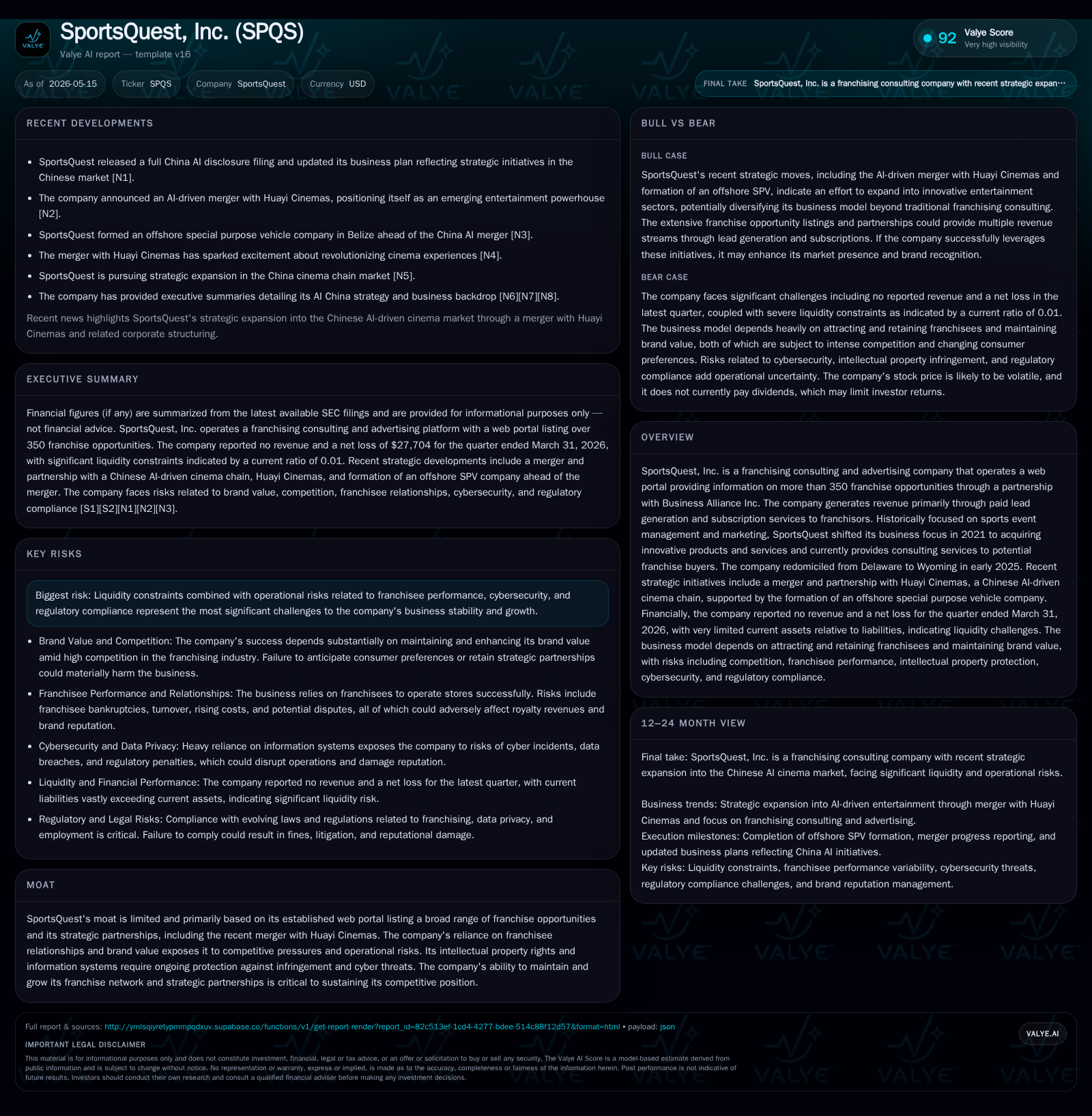
SportsQuest, Inc. continues its transition from sports event management to a franchise consulting and advertising platform, maintaining zero revenue in the latest quarter but advancing strategic partnerships, including a merger with Huayi Cinemas. The company's business model revolves around paid lead generation and franchisor subscriptions via an extensive web portal listing over 350 franchise opportunities. While growth drivers include leveraging strategic alliances and expanding franchisee development, significant risks remain due to liquidity constraints, cybersecurity vulnerabilities, and franchisee operational challenges. Monitoring progress on partnership integration and franchisor subscription metrics will be critical to assessing SportsQuest's path to sustainable growth.
Latest Quarterly Operating Update: Highlights and Implications
The May 15, 2026 10-Q filing reveals that SportsQuest continues to generate no revenue in the recent quarter ending March 31, 2026 while reporting sustained net losses consistent with prior periods [S2; F1]. Despite this, the company pursued strategic expansion activities including a significant merger with Huayi Cinemas—a Chinese cinema chain employing AI-driven innovations—and has formally established an offshore special purpose vehicle in connection with this partnership [S2; Valye Report Excerpt]. Furthermore, SportsQuest completed an administrative redomicile from Delaware to Wyoming in early 2025 reflecting a strategy shift aimed at corporate agility [S1].
The absence of revenue amidst these maneuvers highlights ongoing operational challenges despite management's efforts to pivot and expand its footprint beyond legacy sports event marketing lines. The persistent net loss underscores continued burn without cash inflows from primary operations so far.
Business Model Evolution and Service Offering Analysis
Originally originating as a sports event manager controlling entities such as the US Pro Golf Tour, SportsQuest transitioned in 2021 to focus on acquiring innovative products/services within franchising consulting and advertising [S1]. Currently the core offering rests on a web portal (www.iefranchise.com), providing information on over 350 franchise opportunities via partnership with Business Alliance Inc. (BAI) [S1; Valye Report Excerpt].
Revenue arises primarily from two streams: paid lead generation fees charged per successful transaction or inquiry delivered to franchisors, and subscription fees paid by franchisors for listing and marketing access on the platform [S1]. This dual-pricing approach targets both transactional volume (lead quantity/quality) and recurring subscription stability.
The value proposition emphasizes match-making between prospective franchise buyers—typically business-educated individuals seeking vetted opportunities—and franchisors desiring efficient digital outreach across multiple industry sectors. However, realization depends heavily on sustained user engagement on the portal, effectiveness of lead conversion processes, data accuracy across listings, and competitive differentiation against other franchise directories or consultants.
Despite a broad listing portfolio enabled by BAI's sector diversification (mostly focusing on clusters of 1–3 industry verticals per group), monetization remains limited by low brand equity relative to larger platforms. The shift away from direct event operations constrains organic network effects traditionally derived from high-profile sporting brand recognition.
Competitive Environment and Industry Positioning
SportsQuest operates in an intensely competitive space encompassing franchise consulting platforms, business advisory services, accounting firms advising franchises, business brokers, specialized attorneys, and digital marketing companies focused on lead generation. The low switching costs for both franchisors seeking marketing channels and prospective buyers searching franchise options intensify pressure on pricing power [Valye Report Excerpt; S2; S14].
Information systems resilience is crucial given dependency on email marketing campaigns, social media presence, CRM platforms managing client contacts, and data analytic tools. Vulnerabilities here expose SportsQuest not only to cyberattack or technical outages but also reputation damage from perceived security mishandling [S24; S27]. Intellectual property rights encompassing trademarks and copyrights face infringement risk domestically and internationally due to uneven protection regimes [S13; Valye Report Excerpt].
Historically rooted in sports marketing—a niche now deemphasized—the company must contend with competitors holding stronger brand presence or deeper capital resources in franchising markets. The recent integration with Huayi Cinemas reflects an attempt to differentiate via access to AI-enhanced product lines potentially attractive to tech-savvy franchisees or ancillary service categories.
Regulatory intricacies impose additional burden as compliance with FTC Franchise Rule requirements, state registration laws across about 14 states in the US, international franchise sales statutes (Canada, Mexico, Australia), labor standards governing wage laws for store-level employees, environmental zoning regulations related to physical storefronts—all affect both SportsQuest’s advisory service content quality and operational viability of affiliated franchises [S5-S7; S12].
Growth Drivers: Strategic Partnerships and Market Penetration Potential
Key growth enablers for SportsQuest pivot around scaling paid lead volumes through increased engagement on www.iefranchise.com supported by targeted advertising campaigns designed to convert browsers into franchise commitments or subscription sign-ups.
The merger with Huayi Cinemas provides a novel axis for expansion leveraging AI-driven cinema technology offerings alongside traditional franchising niches—potentially unlocking new industry verticals or international market exposure underpinned by cross-border collaboration frameworks in their special purpose vehicle structure [S2; Valye Report Excerpt].
Additionally, the company aims to stimulate regional franchise development through existing franchisor networks backed by renewed marketing partnerships. Subscription services offer a recurrent revenue backbone if client churn can be managed effectively through service innovation.
Digital marketing improvements including SEO optimization of franchise listings, enhanced lead qualification filters reducing acquisition costs for franchisors, improved data analytics for buyer profiling represent addressable levers for increased monetization.
Measurable KPIs underpinning these growth levers include number of active paying franchisors on subscription plans, monthly qualified lead counts delivered via portal channels, conversion rates of leads into signed franchises or consultation contracts. Increased diversification across sectors listed enhances revenue mix resilience versus concentration risk inherent in sector-specific groups serviced previously by BAI partnerships.
Risks and Constraints: Brand Dependence, Cybersecurity, and Franchisee Dynamics
SportsQuest faces acute liquidity constraints as evidenced by its current financial snapshot showing $3K in current assets against nearly $491K current liabilities resulting in an extremely low current ratio (~0.01) as of March 31, 2026 [F1]. This fragile financial position limits operative flexibility until revenue streams become tangible or external capital infusion occurs.
Operational risks compound from dependence on third-party franchisees who operate under separate contractual arrangements yet critically influence royalty income flows tied to their store performance [S22–S26]. Elevated probability of franchisee bankruptcies or failures disrupts revenue continuity while regulatory compliance variability poses litigation exposure.
Cybersecurity threats constitute a material vulnerability given reliance on sensitive personally identifiable information held within corporate-controlled systems alongside those maintained by franchisees or vendors [S17–S18; S24–S25]. Breaches could cause operational downtime plus reputational damage harming brand trust needed for client attraction/retention.
Brand value is highly contingent upon maintaining high-profile strategic partnerships along with positive consumer sentiment influenced by company-wide adherence to ethical standards—any breach here can affect future growth potential significantly [S15; Valye Report Excerpt]. Challenges include evolving consumer preferences away from traditional brick-and-mortar franchises toward digital alternatives.
Human capital risk exists as difficulty attracting or retaining qualified personnel may hinder execution of complex growth strategies or IT infrastructure upgrades recommended by strategic plans.
Future Watchpoints: Strategic Milestones and Operational Execution Indicators
Market watchers should focus on several near-to-mid term milestones indicating sportsquest’s successful transformation:
- Evidence of integration progress with Huayi Cinemas partnership including launch or commercialization of AI-enabled service products within the advisory framework.
- Tangible improvements in franchisor subscription acquisition numbers coupled with demonstrably higher lead generation conversion ratios stemming from web portal enhancements.
- Announcements related to new geographic expansions especially leveraging offshore entity structures facilitating cross-border franchise sales or regional rollouts.
- Any updates that reflect improved balance sheet health such as liquidity injections or debt restructuring detailed in subsequent quarterly filings.
- Progress in cybersecurity infrastructure upgrade disclosures which mitigate operational risk exposure poised against escalating threat environments. Monitoring these factors will help clarify if SportsQuest can penetrate market ceilings imposed by brand weakness presently reflected in zero reported revenues.
Current Financial Snapshot: Liquidity and Capital Structure
Latest financial snapshot
| Metric | Value | Period |
|---|---|---|
| Current assets | $3001 | |
| 2026-03-31 | ||
| Current liabilities | $490710 | |
| 2026-03-31 | ||
| Current ratio | 0.01x | |
| 2026-03-31 |
Source: SEC companyfacts cache [F1].
| Metric | Value | Period End |
|---|---|---|
| Current Assets | $3,001 | |
| 2026-03-31 | ||
| Current Liabilities | $490,710 | |
| 2026-03-31 | ||
| Current Ratio | 0.01 | |
| 2026-03-31 |
This snapshot portrays a strained short-term liquidity profile posing significant operational risk absent near-term capital inflows or dramatic reduction in liabilities [F1]. Ongoing net losses exacerbate cash burn concerns while revenue remains elusive at this stage preventing self-sustaining cash flow generation.
Consequently finance serves mainly as constraining evidence reinforcing the urgency behind execution shifts articulated earlier rather than a source of optionality driving acceleration at present.
Disclaimer: This analysis is based strictly on publicly available SEC filings as referenced. It does not provide investment advice or price forecasts but seeks only to analyze the company's disclosed operating context as of May 15th, 2026.
Disclaimer: This is research-only, informational analysis and not investment advice. It may include AI-generated interpretation and general industry context. Always verify important details using primary sources.

Comments