
Superstar Platforms Accelerates PawnTrust Development While Managing Liquidity Challenges
The company advances its digital pawn marketplace and lending initiatives amid significant financial constraints and early-stage operational hurdles.
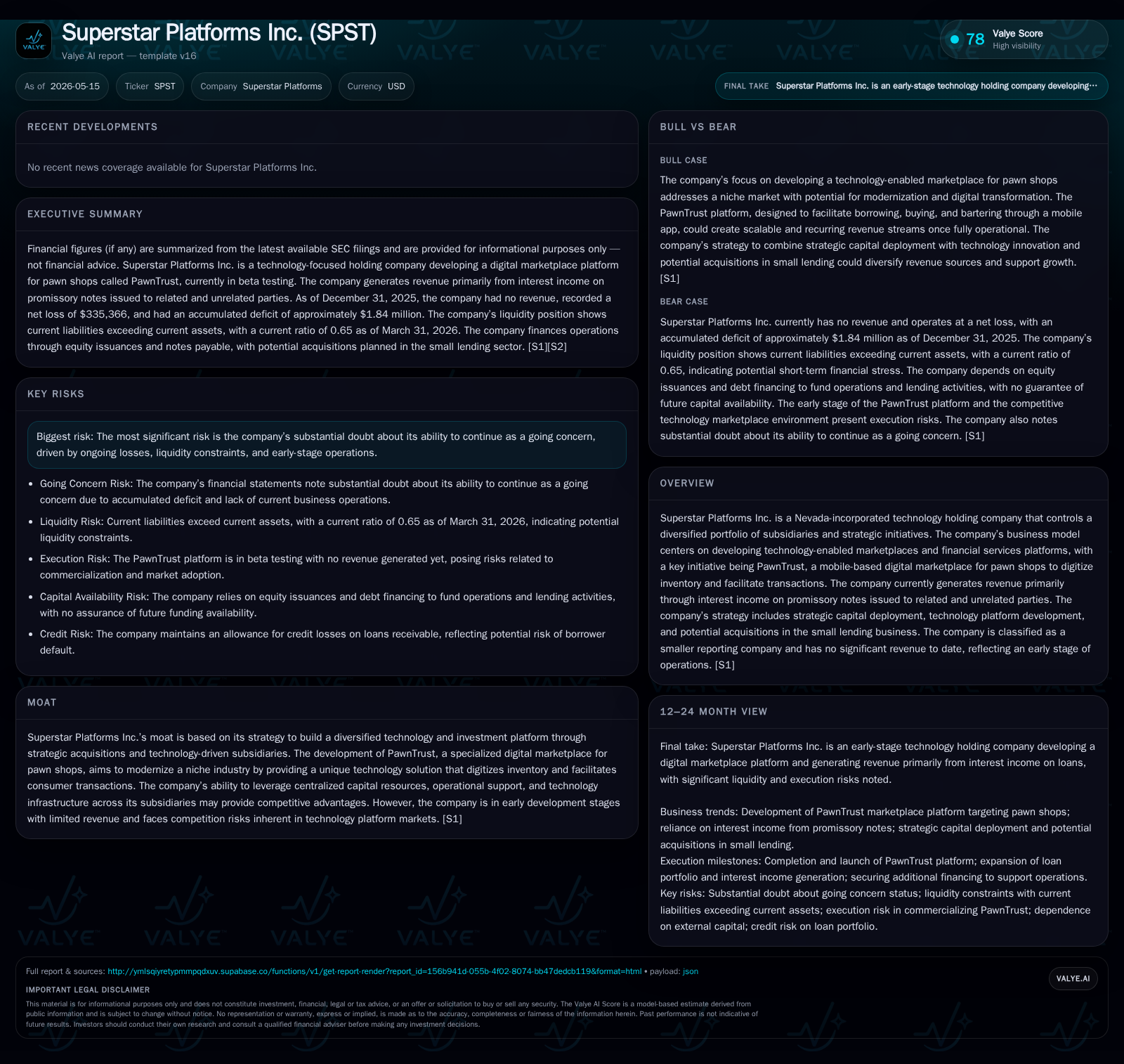
Superstar Platforms Inc. remains in an early operational stage, focusing on building PawnTrust, a mobile-first digital marketplace for pawn shops, while relying primarily on interest income from promissory loans. The latest quarterly filing confirms a sharp increase in operating expenses driven by platform development and supporting loan portfolios, resulting in a widened net loss and liquidity pressures. Strategic growth depends on expanding PawnTrust’s adoption and scaling lending assets through acquisitions, but substantial doubt about continuing as a going concern persists due to the company’s working capital deficiency. Monitoring loan performance metrics, capital raise progress, and platform launch updates will be critical for assessing future viability.
Latest Quarterly Operating Update: Key Developments and Implications
Superstar Platforms Inc.’s 10-Q for Q1 2026 reveals a sharp escalation in operating expenses to $541K, marking a nearly 230% increase compared to the prior period despite zero recorded revenue [S2], [S3]. This cost escalation reflects intensified investment in the PawnTrust digital marketplace as well as augmented lending operations. Correspondingly, net losses widened to approximately $335K, more than double previous periods [F1]. The company’s business model presently generates revenue chiefly through interest income on promissory notes rather than marketplace transactional fees, which remain nascent.
However, current assets ($2.79M) fall short of current liabilities ($4.28M), producing a suboptimal current ratio near 0.65 [F1]. This signals pronounced working capital constraints that heighten the company’s reliance on external financing sources such as equity issuances or related-party borrowing to sustain operations [S3]. These factors underpin the repeated disclosure of substantial doubt concerning the company's ability to continue as a going concern [S4], [S21].
Business Model Overview: Technology-Enabled Marketplaces and Lending
Operating as a technology holding entity structured around subsidiaries and strategic initiatives, Superstar Platforms centers its strategy on developing technology platforms alongside strategic capital deployment within fintech-adjacent categories [S1], [S22]. A cornerstone initiative is PawnTrust: a mobile-based digital marketplace exclusively geared toward pawn shops seeking to modernize inventory management and enable consumer-facing borrowing, buying, and bartering functionalities via an app.
Currently in beta testing with a commercial launch slated for Q2 2026 [S12], PawnTrust aims to address inefficiencies in traditional pawn operations by facilitating digitized transactions that can unlock broader market accessibility.
Alongside platform development, the company generates recurring revenue almost entirely through interest earned on promissory notes issued to related and unrelated borrowers at annual rates around 24% [S6]. These loans support affiliated businesses or third parties strategically aligned with its growth prospects. The interest spread between borrowing costs (via notes payable) and loan yields forms the crux of Superstar’s immediate economic engine.
Despite these structural components, the company remains in an embryonic revenue phase without meaningful transaction fees from PawnTrust yet recorded [F1]. Capital consumption to fund technology development and build out the loan portfolio dominates near-term operations.
Competitive and Industry Context: Niche Digital Pawn Platforms and Small Lending Dynamics
The pawn industry historically operates through fragmented local storefronts with limited technological integration. PawnTrust enters this legacy sector attempting to bridge significant digitization gaps by offering specialized inventory management coupled with consumer lending capabilities embedded in one mobile interface [S1]. This specialization could create switching costs if it gains scale; however, network effects depend heavily on merchant adoption in this niche market.
On the lending front, Superstar operates within small-dollar personal lending markets where credit risk management is paramount. Management maintains allowance for credit losses aligned with ASC 326 guidance at approximately 3% of outstanding loans [S19], reflecting conservative provisioning assumptions given economic uncertainties. Notably, all loans were reported current without delinquencies at year-end 2025 [S19], supporting underwriting discipline despite early-stage scale.
Competitive risks stem from established fintech lenders with broader platforms or incumbents pursuing digital extensions. Regulatory environments affecting lending terms or marketplace compliance also pose ongoing oversight complexities.
Growth Drivers: PawnTrust Expansion, Strategic Acquisitions, and Interest Income Potential
Key growth drivers pivot on accelerating PawnTrust adoption post-beta launch to build transactional volume that can diversify revenue beyond interest income [S12]. Market penetration among pawnshops — traditionally underserved by digitized marketplaces — offers potential structural growth if conversion hurdles are effectively managed.
Simultaneously, strategic acquisitions within the small lending sector present avenues for scaling loan asset pools swiftly. Management signals intent to pursue such deals leveraging existing capital structures including notes payable facilities totaling over $2.6 million used for loan funding purposes [S3], [S6].
Risks and Watchpoints: Liquidity Constraints, Going Concern Doubts, and Revenue Generation Challenges
Superstar Platforms’ most critical risk revolves around its acute cash burn profile coupled with constrained liquidity evidenced by a current ratio below one (0.65) [F1]. The company acknowledges recurring substantial doubt regarding its ability to continue as a going concern absent access to timely additional equity or debt funding from shareholders or third parties [S4], [S8], [S21]. Dependence on related party financings further accentuates potential governance scrutiny.
The absence of meaningful revenues outside interest income indicates revenue generation challenges inherent in early-stage platform launches; PawnTrust must overcome execution risks including merchant onboarding speed and regulatory compliance hurdles adjacent to consumer financial services [S12]. Loan portfolio credit quality requires constant monitoring given macroeconomic headwinds impacting borrower repayment capacity plus competition from fintech incumbents with larger scale risk analytics engines.
Dilution risks loom if repeated equity raises ensue amid weak cash flow breakeven outlooks. Finally, failure to secure prudent borrowings could stall growth investments exacerbating fixed cost absorption pressures due to scaling inefficiencies at low volumes.
Near-Term Milestones and What Investors Should Monitor
Critical upcoming milestones include observing quarterly updates detailing loan portfolio performance metrics such as receivables growth rates alongside interest collections trends validating lending model sustainability [S2], [S3]. Equally pivotal is monitoring progression towards commercial launch of PawnTrust given its status in closed beta during recent reporting with management targeting full rollout in Q2/2026.
Expense trajectory will require scrutiny given operating cost inflation noted year-over-year illustrating steep ramp-up phases during platform development stages.
Tracking evolving allowance for credit losses relative to loan book health will signal underlying portfolio resilience amidst shifting economic conditions.
Financial Snapshot: Capital Structure, Liquidity, and Burn Analysis
Superstar’s financial snapshot underscores notable leverage amid constrained liquidity profiles typical of early-stage platform plays supported by debt financing totaling roughly $2.7 million utilized for both operational needs and loan financing [F1]. Persistent net losses highlight ongoing cash burn dynamics exacerbated by increased payroll expenses and bad debt provisions accounting for most cost escalations in recent quarters [S3]. The imbalance between current liabilities exceeding assets prompts caution regarding near-term solvency absent incremental capital infusion or positive cash flow improvements.
This analysis is based exclusively on publicly filed SEC documents as of Q1 2026 inclusive of the amended annual report dated May 7, 2026 ([S1]-[S28]) supplemented by companyfacts data snapshots ([F1]). It does not include non-public information or projections beyond these filings. The assessment refrains from offering investment advice or recommendations.
Disclaimer: This is research-only, informational analysis and not investment advice. It may include AI-generated interpretation and general industry context. Always verify important details using primary sources.

Comments