
Marathon Bancorp Strengthens Capital Strategy with Stock Repurchases and Solid Local Banking Footprint
The recent adoption of a stock repurchase program alongside steady earnings growth underscores Marathon Bancorp's evolving capital management within its regional Wisconsin franchise.
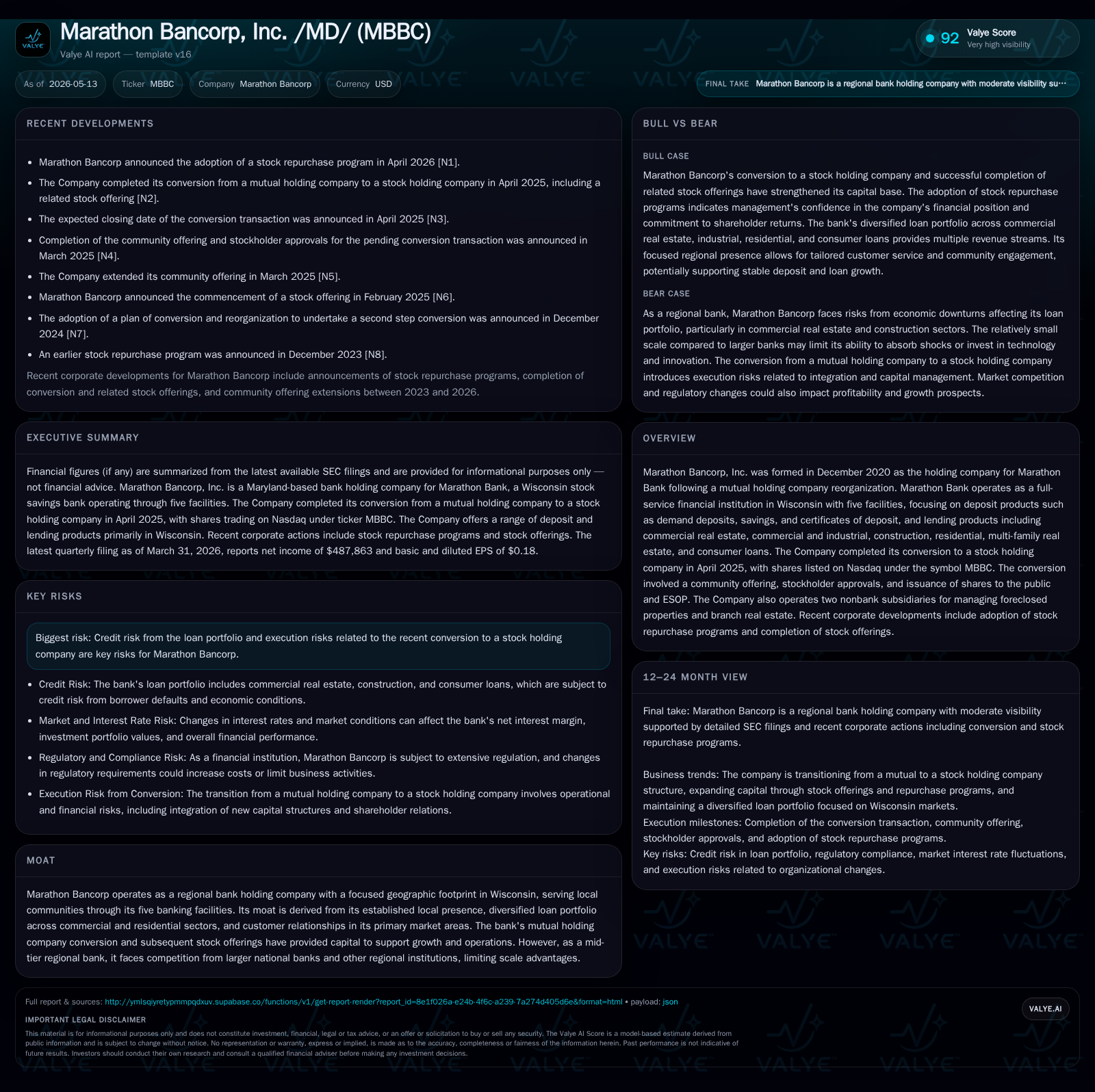
Marathon Bancorp, a regional Wisconsin bank holding company, recently initiated a stock repurchase program representing about 5% of its shares, signaling a strategic shift towards capital return post its April 2025 conversion to a stock holding company. The first quarter of fiscal 2026 saw net income more than triple year-over-year, supporting increased shareholder returns. Marathon operates with a community banking model centered on deposit and diversified loan products across commercial and residential sectors, maintaining strong local ties but facing scale limitations against larger banks. Key growth drivers include capital deployment efficiency, local market penetration, and loan portfolio diversification, while risks center on credit quality and execution challenges following organizational changes. Financially, the company shows robust liquidity with no debt outstanding as of the latest quarter.
Recent Quarterly Operating Update: Buybacks and Performance
Marathon Bancorp disclosed in its May 13, 2026 10-Q filing that it had adopted a formal stock repurchase program permitting the buyback of up to roughly 146,931 shares – around 5% of its current public float. These repurchases were slated to begin immediately after releasing Q1 fiscal 2026 results [S2][S3]. This move marks an important strategic transition from capital accumulation towards disciplined capital return following the company's conversion to a stock holding company in April 2025.
Operationally, the bank demonstrated robust earnings expansion: net income for the nine months ended March 31, 2026 eclipsed $1.43 million compared to $374k in the prior year period. Such earnings momentum provides foundational support for executing buybacks without compromising balance sheet stability or liquidity.
Additionally, unrealized gains on available-for-sale securities remained modestly positive in the current quarter reflecting prudent management of debt investments amid fluctuating interest rates [S2]. The combination of improved profitability and enhanced capital flexibility positions Marathon to manage shareholder value actively.
Marathon Bancorp’s Community Banking Model and Product Suite
Marathon Bancorp was formed as a mid-tier regional bank holding company headquartered in Maryland but operating fully through its subsidiary Marathon Bank with five branches across Wisconsin counties including Marathon County and Waukesha County. The institution offers traditional community banking services:
- Deposit products encompass demand deposits (checking), savings accounts, and certificates of deposit (CDs).
- Lending portfolios are diversified across commercial real estate loans; commercial & industrial loans; construction loans; residential one-to-four-family mortgages; multi-family real estate financing; as well as consumer loans.
- The bank also holds two nonbank subsidiaries tasked with management of foreclosed properties and real estate assets tied to branch operations.
This product breadth helps mitigate concentration risk across loan types while rooting revenue generation firmly within local economic activity. However, scale limitations inherent in a medium-sized regional bank constrain leverage over national pricing power or technology adoption advantages common among larger peers [S1].
The conversion from a mutual holding structure to fully public status in April 2025 involved issuance of shares via community offerings supported by stockholder approvals alongside ESOP offerings funded by internal term loans. This transition has materially enhanced access to permanent equity capital fueling strategic flexibility [S1].
Competitive Landscape: Mid-Tier Regional Bank Dynamics
Marathon occupies a competitive niche typical for regional community banks that anchor themselves in specific geographic markets – here focused deeply in Wisconsin counties with meaningful roles serving personal customers and small/medium businesses. Its moat largely stems from longstanding local relationships, tailored customer service models, and understanding of regional economic drivers.
However, this localized focus confers only modest scale economies relative to larger regionals or national institutions that can command greater fee income diversification or pricing advantages on deposit costs. Furthermore, national competitors benefit from broader digital banking platforms impacting customer retention dynamics [S1].
Regulatory compliance also plays a role; as a state-chartered savings bank subsidiary housed within a publicly traded holding company structure under Nasdaq rules (ticker MBBC), governance requirements have intensified post-conversion adding complexity without large-scale institutional support.
Geographic concentration amplifies credit portfolio sensitivity: uneven economic cycles affecting construction or multifamily residential development impact risk-weighted asset quality requiring ongoing vigilance [S1].
Growth Drivers: Capital Deployment, Local Market Penetration, and Loan Diversification
Strategic growth at Marathon centers on three intertwined pillars:
- Capital management: The recently launched buyback initiative functions as both confidence signal and mechanism for enhancing earnings per share metrics without dilutive equity issuance pressure. Efficient deployment supports shareholder returns alongside organic balance sheet expansion.
- Deepening local banking relationships: Leveraging community-centered brand recognition enables deposit base enhancement crucial for funding loan originations cost-effectively while fostering stickiness via personalized service models.
- Loan portfolio diversification: Continued origination activity spanning commercial real estate segments including construction and multifamily projects taps into localized economic trends while residential lending maintains retail footprint relevance.
This multi-front approach aligns with conservative underwriting practices denoted by stable provisioning for credit losses (-$2k recovery noted) combined with cautious balance sheet growth accommodating macroeconomic fluctuations [S2][S3][S1].
Regional economic tailwinds such as steady housing demand in Wisconsin locales underpin volume support particularly for construction and multifamily real estate exposures believed to be less cyclically volatile than pure commercial industrial segments.
Risks and Constraints: Credit Quality and Execution Post-Conversion
Foremost among risks is credit quality volatility given concentration in real estate-related lending sensitive to interest rates and local market conditions. Adverse shifts could necessitate additional provisioning impacting earnings sustainability.[S1][S2]
Executional challenges persist following the organizational transformation from mutual to stock holding company completed recently (April 2025). New governance frameworks including ESOP dynamics introduce complexity around incentive alignment while converting erstwhile members’ interests into publicly traded equity risks operational disruptions during transitional phases.[S3]
Interest rate fluctuations also weigh on debt securities valuations where unrealized gains/losses fluctuate with market rates though management’s intent not to sell mitigates realization risk currently.[S2]
Competition for deposits constrains ability to raise low-cost funding amid larger regional bank competitors offering scale pricing benefits.[S1]
Outlook: Key Milestones and Monitoring Points Ahead
Upcoming quarters will be critical for observing trends including:
- Progression of allowance for credit losses adjustments reflecting evolving borrower performance across commercial real estate sub-segments.
- Trajectory of net income reflecting operational efficiency gains or margin compression due to funding cost pressures.
- Uptake of the share repurchase program indicating management’s confidence appetite alongside actual cash deployment impact on equity base.
- Deposit growth dynamics at branch level which underpin core funding stability versus trend shifts toward digital channels posing structural headwinds.
- Further disclosures or announcements regarding capital raises or additional corporate structural refinements post-conversion phase.[S2][S3]
These factors collectively will signal whether Marathon can sustain earnings momentum while managing risk prudently amid an industry environment marked by consolidation tendencies among mid-tier regionals.
Financial Snapshot: Latest Quarter Highlights
As of March 31, 2026, total assets reached approximately $249 million supported by strong liquidity evidenced by cash & equivalents exceeding $13.6 million with no outstanding long-term debt liabilities reported — underscoring balance sheet health favorable for setting discretionary capital policies such as share buybacks [S2][F1].
Net income for Q1 alone was $487k compared with $148k in the same quarter one year prior — more than tripling illustrating effective margin management and credit stabilization efforts.[S2]
Cash flows from operating activities were robust at $2 million over nine months supporting reinvestment capacity coupled with cautious investing activity consistent with loan portfolio growth ambitions.[S2]
Unrealized gains on available-for-sale securities remained moderate positive factors adding modest augmentation to shareholders’ equity.[S2]
In summary, financial metrics reinforce narrative themes emphasizing growing profitability strength leveraged by sound liquidity enabling active capital return initiatives without material leverage risk distortion.
Disclaimer: This is research-only, informational analysis and not investment advice. It may include AI-generated interpretation and general industry context. Always verify important details using primary sources.

Comments