
RenovoRx Advances Commercial Device Strategy While Pivotal Trial Nears Enrollment Completion
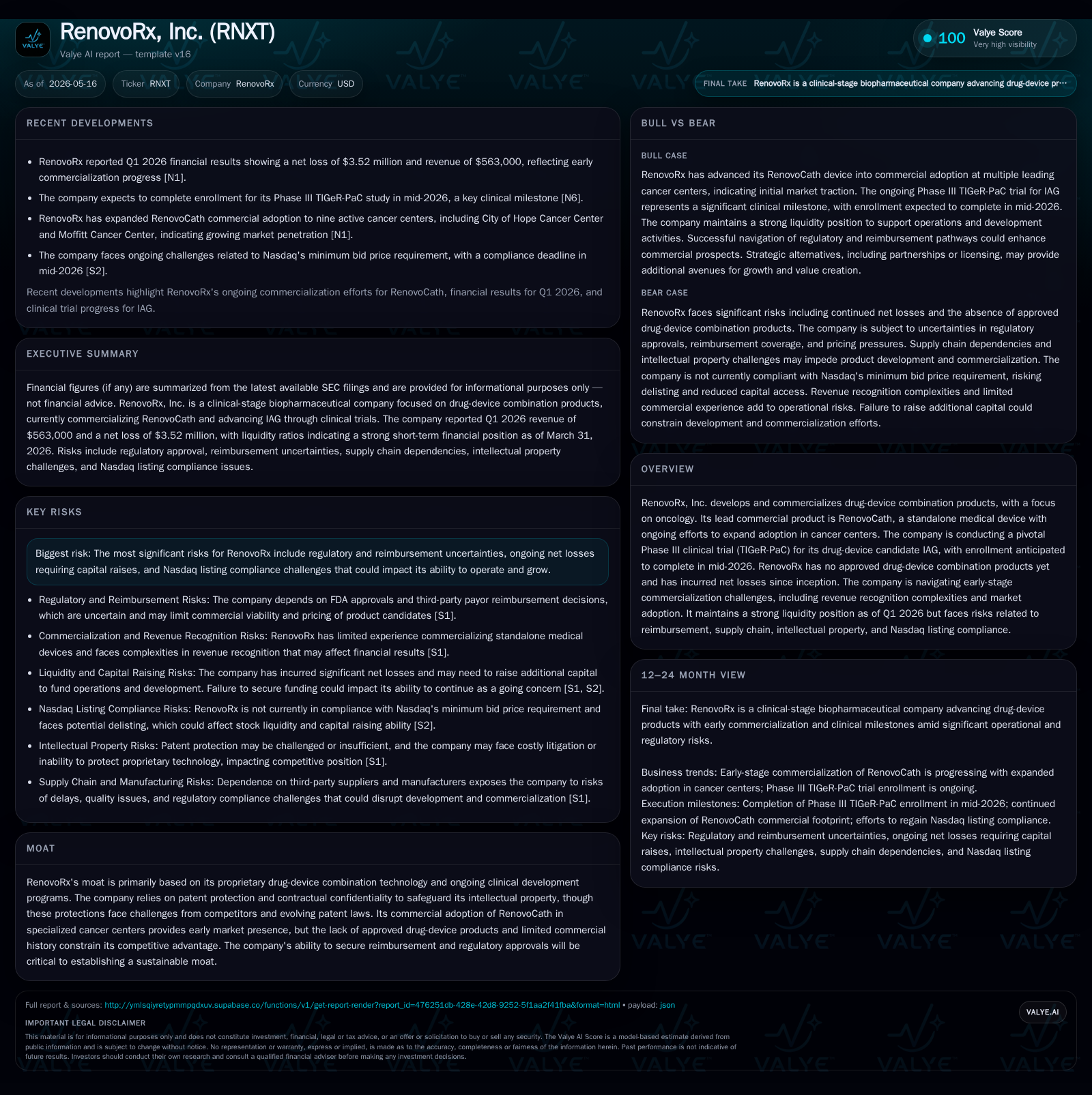
RenovoRx reported Q1 2026 results highlighting progress commercializing RenovoCath amid ongoing losses and nearing completion of its Phase III TIGeR-PaC trial enrollment for IAG.
RenovoRx is balancing early-stage commercialization of its standalone medical device RenovoCath with pivotal clinical development of its drug-device combination candidate IAG. The company continues to incur net losses but maintains a solid liquidity buffer as it approaches mid-2026 enrollment completion for its Phase III TIGeR-PaC study. Market adoption of RenovoCath is progressing cautiously, with revenue recognition complexities and reimbursement uncertainties weighing on near-term growth. Risks include regulatory delays, capital needs, and Nasdaq listing compliance challenges. Key near-term milestones center on the trial readout and expanding commercial traction for RenovoCath within cancer centers.
Latest Quarterly Update Highlights Operational Momentum and Challenges
RenovoRx’s latest quarterly filing dated May 14, 2026 [S2] underscores a continued dual-track operating strategy: advancing commercialization of its standalone device RenovoCath while progressing enrollment in the pivotal Phase III TIGeR-PaC clinical trial for their drug-device combination candidate IAG. Despite ongoing net losses, the company reported revenue exceedance relative to internal estimates for Q1 2026 principally driven by early RenovoCath sales [N1]. However, such revenues remain modest due to the nascent stage of commercialization with limited penetration across cancer centers. Revenue recognition remains complex reflecting a mixture of developmental expenditures alongside initial commercial receipts [S2]. The firm aims to complete patient enrollment in TIGeR-PaC by mid-2026, a milestone that represents a critical inflection point to advance regulatory approval filings for IAG [S2].
While operational momentum around commercialization is evident, RenovoRx continues to bear significant cash burn reflecting development costs and expansion activities [S2]. This dichotomy reflects the challenges inherent in early-stage oncology device-commercial hybrid companies navigating both commercial execution and stringent clinical development. Their recent event filing further reiterates commitment to this strategy but flags ongoing risks linked to regulatory timelines and market adoption hurdles [S3].
RenovoRx Business Model: Drug-Device Innovation Meets Early-Stage Commercialization
RenovoRx’s business model bridges innovative drug-device combination therapies with standalone medical device commercialization. Current revenue streams are almost exclusively derived from sales of their RenovoCath delivery system—a device designed for localized chemotherapy administration—while regulatory approval for their lead drug-device product candidate IAG remains pending [S1]. The company thus operates on two blended fronts: an early-stage commercial rollout requiring sales infrastructure deployment aimed at specialized oncology centers alongside expensive Phase III clinical trials necessary to establish safety and efficacy of new combination therapeutics.
Revenue generation depends heavily on successful market adoption of RenovoCath as well as timely FDA approval of IAG followed by effective pricing and reimbursement strategies. The proprietary nature of RenovoRx’s platform technology grants some differentiation, supported by patent protections; however, this advantage is still fundamentally prospective given no drug-device combos have been approved commercially yet [S1][S6]. Revenue recognition complexity arises because sales of devices are interwoven with ongoing investigational product development activities rendering periodic earnings volatile and difficult to forecast [S2]. Without established long-term commercialization data or durable reimbursement contracts, predicting an inflection toward profitability remains tenuous.
Competitive and Industry Context for Oncology Drug-Device Combinations
The oncology drug-device combination sector remains highly specialized, regulated, and competitive. Regulatory approval pathways for these combination products often involve multi-dimensional scrutiny encompassing both medical devices’ engineering standards and pharmaceutical efficacy testing under FDA jurisdiction [S1]. This creates longer timelines and elevated costs relative to conventional drugs or devices alone.
Reimbursement environments weigh heavily on commercial success in oncology due to escalating healthcare cost controls favoured by payors globally. Third-party payors assess products based on demonstrated safety, effectiveness, medical necessity, comparative cost-effectiveness versus alternatives, and non-investigational status [S9]. This backdrop limits pricing flexibility and heightens dependence on generating robust clinical evidence supporting coverage decisions.
Patent landscapes offer some protection but entail risk from competing innovations designed to circumvent existing intellectual property or from patent enforcement complexities [S15][S20]. Adoption patterns within cancer centers can be slow due to clinical conservatism and budget constraints; hence penetration metrics for novel devices like RenovoCath provide crucial indicators of demand stability.
Key Growth Catalysts: Clinical Trial Milestones and Market Penetration of RenovoCath
The most material near-term growth driver is the expected completion of enrollment in the TIGeR-PaC Phase III trial by mid-2026 [S2], which will set the stage for potential submission of an NDA seeking FDA approval for IAG. A successful trial outcome would unlock the primary commercial pathway toward monetizing the proprietary drug-device candidate beyond the current standalone device revenues.
Simultaneously, expanding adoption of RenovoCath across additional cancer treatment centers represents an immediate source of incremental revenue growth. Scaling this device's footprint depends on successful sales efforts paired with obtaining favorable reimbursement coverage—a process that can vary regionally due to heterogeneous payor policies [S2][S3]. Enhanced reimbursement status would boost pricing power and margin prospects once volume thresholds are reached.
Overall margin expansion hinges upon crossing commercialization scale thresholds coupled with clinical validation.
Risks and Headwinds: Regulatory Approval, Reimbursement, and Financing Pressure
RenovoRx faces substantial risks typical in biopharma-led medical device innovation ventures. Foremost are regulatory uncertainties tied to the FDA’s assessment process for both the standalone device post-clearance expansions and especially the NDA review of IAG post-TIGeR-PaC completion [S7][S23]. Delays or unfavorable outcomes could materially impede commercial viability.
Reimbursement risk prevails given evolving healthcare cost containment trends domestically and internationally placing downward pressure on drug/device pricing alongside restricted coverage scopes depending on evidence sufficiency [S9][S24]. Failure to secure adequate payer acceptance reduces addressable market size significantly.
Financially, ongoing operating losses necessitate continued capital raises that may dilute existing shareholders or impose restrictive conditions affecting operational flexibility. Despite a healthy cash position as of Q1 2026 [$12.36 million cash & equivalents; current ratio 7.15] [F1], future fundraising is anticipated as necessary for advancing IAG approval activities alongside scaling marketing efforts for RenovoCath [S12][S26]. Additionally, Nasdaq listing compliance issues related to minimum bid price requirements pose governance risks potentially affecting stock liquidity [S8].
What Investors Should Monitor in the Coming Quarters
Key milestones warranting close attention include:
- Confirmation of full enrollment completion in the TIGeR-PaC pivotal trial around mid-2026 enabling progression toward NDA submission.
- Quarterly sales trends for RenovoCath indicating ramp rates within cancer centers alongside any updates on reimbursement achievements or payor negotiations.
- Liquidity status updates highlighting cash runway duration amid ongoing net losses.
- Any announcements regarding strategic partnerships or alternative financing arrangements that may alleviate funding pressures.
- Developments regarding Nasdaq minimum bid price compliance which could affect stock exchange status. Monitoring these factors will shed light on execution effectiveness across both developmental and commercial fronts critical for investor valuation considerations.
Financial Position and Liquidity Snapshot
Latest financial snapshot
| Metric | Value | Period |
|---|---|---|
| Cash & equivalents | $12.36mm | |
| 2026-03-31 | ||
| Current assets | $13.72mm | |
| 2026-03-31 | ||
| Current liabilities | $1.92mm | |
| 2026-03-31 | ||
| Current ratio | 7.15x | |
| 2026-03-31 |
Source: SEC companyfacts cache [F1].
This liquidity profile indicates a solid buffer relative to short-term obligations as of Q1 2026 [F1], supporting near-term operational continuity despite persistent negative operating income last reported at negative $12.5 million in year-end 2025 [F1]. The company acknowledges reliance on external capital markets given ongoing investment needs in pivotal trials combined with marketing scale-up investments [S12][S26]. Sustained net losses emphasize the importance of capital availability over ensuing quarters to support strategic objectives without compromising financial stability.
This analysis synthesizes all material information from recent SEC filings including the May 14th quarter report coupled with annual risk disclosures as well as expert sector context specific to oncology-focused drug-device combination enterprises. It avoids speculative projections beyond confirmed facts while highlighting key execution focus areas signalling possible inflection points ahead. Readers should carefully consider documented risks including regulatory hurdles, reimbursement dynamics, financing imperatives, and market adoption uncertainties when evaluating company progress.
Disclaimer: This report is for informational purposes only and does not constitute investment advice or recommendation.
Disclaimer: This is research-only, informational analysis and not investment advice. It may include AI-generated interpretation and general industry context. Always verify important details using primary sources.

Comments