
GrowHub Ltd Advances Web3 SaaS Focus as Product Trading Division Ceases Consignment Sales
Recent quarterly filings highlight GrowHub's strategic transition to a scalable SaaS platform with integrated blockchain and AI analytics, while exiting low-margin consignment sales.
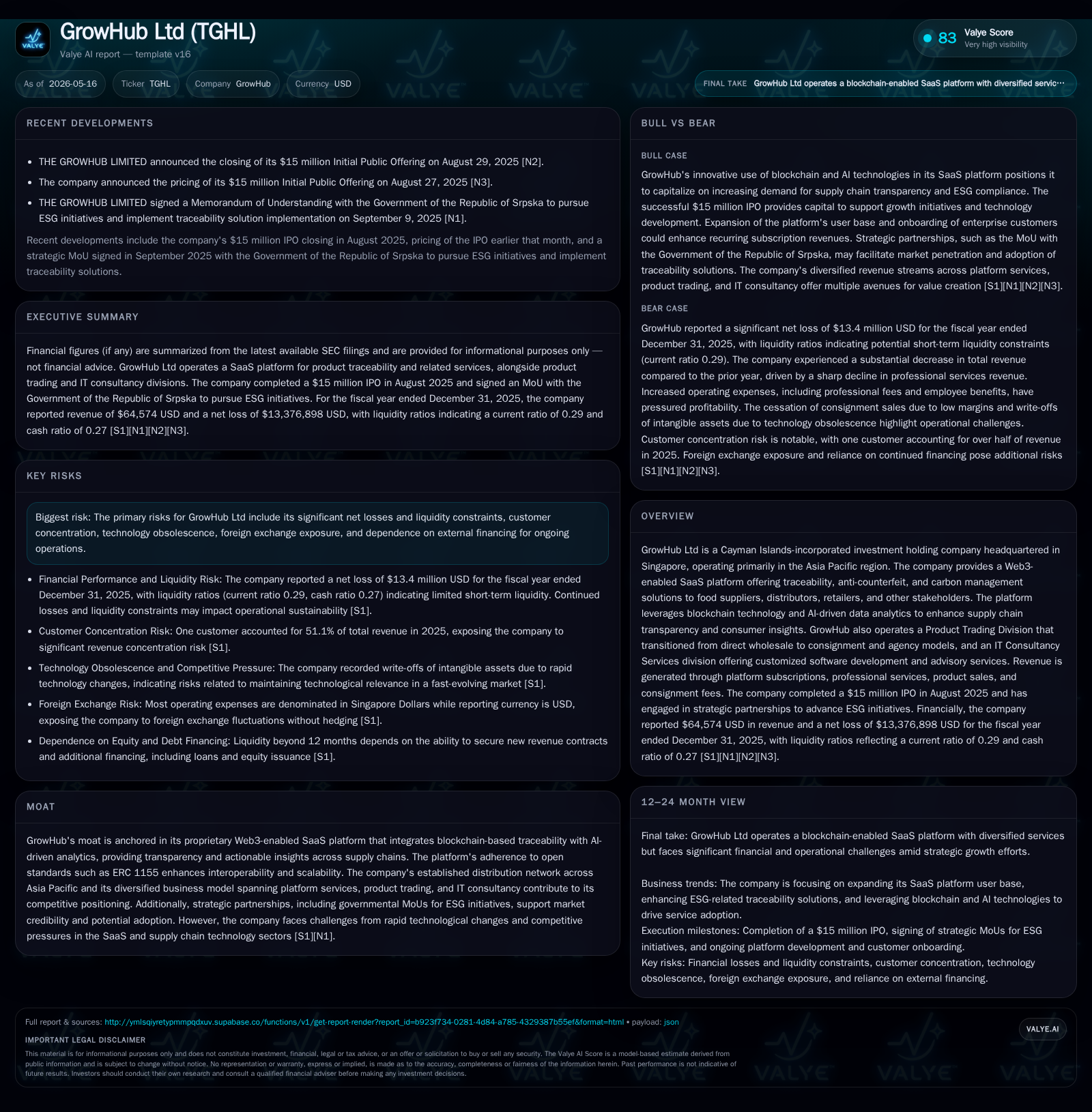
GrowHub Ltd reported significant shifts in its operating model during the fiscal year 2025, highlighted in its latest quarterly filing dated March 6, 2026. The company successfully transitioned from a consignment product trading approach to emphasizing its proprietary Web3-enabled SaaS platform offering traceability, anti-counterfeit, and carbon management solutions across the Asia Pacific region. Despite meaningful increases in professional fees and employee costs linked to post-IPO expansion, recurring subscription revenues showed modest growth amid challenging margins. Liquidity remains constrained with a low current ratio, underscoring the need for efficient capital management. Growth prospects are anchored on increasing platform adoption driven by ESG trends and AI-enabled analytics, but risks include technology obsolescence and ongoing net losses.
Recent Operating Update
GrowHub Ltd's most recent quarterly filing on March 6, 2026 ([S2]) affirms a smooth auditor transition from Audit Alliance LLP to Assentsure PAC without adverse opinions or unresolved disagreements regarding accounting policies for fiscal years ended December 31, 2024 and 2023. This underscores stable financial reporting amidst ongoing operational transformation.
Crucially, the filing confirms that as of January 1, 2026, GrowHub formally ceased operations of its Product Trading Division’s consignment sales due to persistently low margins ([S1]). This strategic pivot reflects a deliberate focus on scaling its proprietary Web3-enabled SaaS Platform that integrates blockchain-based traceability, anti-counterfeit mechanisms, and carbon management alongside AI-driven data analytics tailored for food suppliers, distributors, retailers, and other ecosystem participants across Asia Pacific.
Business Model and Revenue Mechanics
GrowHub operates primarily through three business divisions: the GrowHub Platform (SaaS), Product Trading Facilitation, and IT Consultancy Services ([S1], [S10], [S14]).
GrowHub Platform: The centerpiece is a scalable Software-as-a-Service offering accessible via tiered monthly subscriptions ranging from $160 to $300 USD. Customers pay recurring fees for access to three integrated solutions—traceability leveraging blockchain for end-to-end supply chain transparency, anti-counterfeit assurance via tamper-proof data layers compliant with ERC-1155 standards enhancing interoperability, and carbon footprint measurement tools supporting evolving ESG mandates ([S1], [S14]). Usage volume and selected feature sets dictate pricing tiers. This SaaS model aims to embed sticky user engagement with switching costs arising from deep integration into client supply chains.
Product Trading Facilitation: Historically operating as a wholesale principal in fast-moving goods such as food and skincare within an Asia Pacific network spanning Australia, Japan, Malaysia and Singapore, GrowHub shifted towards consignment-based product placement operations in 2024. By acting both as principal (retaining inventory risk) and agent (commission revenue), it sought to optimize revenue while reducing inventory write-offs ([S10], [S14]). However, this division was discontinued in early 2026 due to weak unit economics ([S1]). Before closure, AI algorithms leveraged QR code scan data combined with ecommerce transaction records across multiple channels for product placement insights designed to maximize partner revenues.
IT Consultancy Services: An internal technology team offers bespoke software development projects and retainer-based advisory services generating professional fees. This division contracted sharply in revenue during 2025 following IPO-induced restructuring but remains active preparatory work for future client engagements ([S21]).
Revenue recognized spans platform subscriptions (recurring licensing), professional services (project/retainer fees), product sales (transaction-based revenues on goods sold acting both principal/agent), and consignment fees (now ceased). The move from product trading principal sales towards SaaS subscription stability reflects a strategic attempt to build scalable recurring cash flow.
Industry Structure and Competitive Position
GrowHub situates itself at the intersection of supply chain traceability technology, blockchain adoption in food safety assurance, anti-counterfeit measures for consumer goods, and carbon emissions accounting within Asia Pacific—a region increasingly attentive to ESG compliance pressures. The company's unique value proposition lies in combining Web3 blockchain protocols with advanced AI analytics that provide actionable consumer preference insights beyond mere transparency (, [S1]).
By adopting open standards such as ERC-1155 tokens for traceability data packaging, GrowHub enables better cross-platform interoperability compared to proprietary closed ecosystems prevalent among industry peers. The embedded AI analytics engines further differentiate it by allowing clients not only to verify origin/product authenticity but also predict demand trends based on historical supply chain events.
The competitive landscape includes specialized SaaS firms focusing on supply chain digitization but often lacking integrated blockchain or advanced AI components. Larger ERP or logistics SaaS providers are adjacent competitors but typically do not offer dedicated anti-counterfeit or ESG carbon modules tailored specifically for food/agriculture sectors.
While GrowHub has established distribution networks across multiple APAC markets that aid product traction through partnerships with suppliers/retailers, barriers remain high given the rapid technological evolution within blockchain infrastructure and the capital-intensive nature of sustainable platform development. Strategic MoUs with government bodies further bolster credibility though may entail compliance overheads (, [S1]).
Growth Drivers
ESG Compliance Surge
Growing regulatory enforcement of Environmental Social Governance disclosures across Asia Pacific incentivizes corporates along supply chains to adopt traceability tools like GrowHub’s platform. As consumers increasingly link purchasing choices with sustainability credentials verified via transparent blockchain records, demand structurally supports the SaaS offering.
AI-Driven Data Analytics Adoption
Continued investments into AI capabilities facilitate deeper consumer behavior modeling which enables customers to optimize marketing approaches and inventory planning. This enhances perceived platform value prop beyond mere compliance—turning data into commercial intelligence ([S1]).
Platform User Base Expansion
Successful onboarding of new enterprise customers paying subscription fees underpins top-line growth potential. Recurring monthly fees create a base revenue layer less susceptible to fluctuations relative to transactional product trading volumes ([S10], [S21]).
Network Effects & Ecosystem Development
Further integration with retail partners' e-commerce channels allows leveraging transaction datasets for comprehensive analytics—creating positive feedback loops that strengthen platform stickiness against new entrants.
Risks / Watchpoints / Growth Constraints
Financial Performance & Liquidity Constraints
Despite revenue advances since IPO completion in August 2025, GrowHub continues to operate at sizable net losses exceeding $13 million annually ([F1], [S11], [S12]). Negative cash flow from operating activities ballooned markedly in 2025 compared to prior years indicating ongoing capital burn that necessitates careful cash management given tight liquidity (current ratio ~0.29) ([F1]).
Technology Obsolescence & Market Competition
Rapidly evolving blockchain standards combined with shifting AI capabilities raise risk that existing platform tech may become outdated unless continual investment occurs—risk accentuated by significant intangible asset write-offs reported in 2025 ([S12]). Competitors may introduce more advanced or cost-effective solutions requiring strategic vigilance.
Foreign Exchange Exposure
Operating expenses mainly incur in Singapore Dollar while reporting currency is USD ([S3]), exposing margins to currency volatility without hedging presently implemented.
Customer Concentration & Adoption Uncertainty
Dependence on relatively few large customers or sectors could pose revenue volatility if market shifts or competitor wins disrupt contracts; platform adoption pace remains critical yet uncertain.
What To Watch Next
- Quarterly KPIs evidencing net new enterprise customer subscriptions on the SaaS platform that drive recurring revenues.
- Progress on reducing operating losses through improved gross margins on subscription services versus prior professional service contraction.
- Any announcements regarding new government or industry partnership agreements enhancing ESG platform visibility.
- Technology upgrade investments and R&D outcomes presented by management commentary around next-gen AI analytics or blockchain enhancements.
- Working capital trends including follow-on financing needs as indicated by shrinking current ratios or increased debt load beyond IPO proceeds already deployed (~$13 million spent) ([S23]).
Financial Profile Snapshot (USD equivalents)
Latest financial snapshot
| Metric | Value | Period |
|---|---|---|
| Cash & equivalents | $905187 | |
| 2025-12-31 | ||
| Current assets | $959928 | |
| 2025-12-31 | ||
| Current liabilities | $3mm | |
| 2025-12-31 | ||
| Current ratio | 0.29x | |
| 2025-12-31 |
Source: SEC companyfacts cache [F1].
| Metric | Value | Period End |
|---|---|---|
| Revenue | $64,574 | |
| 2025-12-31 | ||
| Operating Income | -$13,161,589 | |
| 2025-12-31 | ||
| Net Income | -$13,376,898 | |
| 2025-12-31 | ||
| Cash & Equivalents | $905,187 | |
| 2025-12-31 | ||
| Current Assets | $959,928 | |
| 2025-12-31 | ||
| Current Liabilities | $3,320,480 | |
| 2025-12-31 | ||
| Current Ratio | 0.29 | Calculated |
The financials reinforce sizable net losses still burdening operations despite IPO cash injection used partly for loan repayments (14%) and working capital needs (80%). Persistent negative operating cash flows reflect ongoing ramp-up costs especially tied to expanded employee headcount (+75% rise in personnel expense) necessary for platform growth execution ([F1], [S11], [S21], [S22]).
This analysis is based entirely on information filed with the SEC as of mid-2026 without any investment advice or price forecasts. It represents an assessment anchored on publicly disclosed operational developments highlighting GrowHub Ltd’s ongoing pivot towards a differentiated SaaS model targeting supply chain transparency enhanced by blockchain/AI technologies amidst tightening liquidity constraints and competitive pressures.
Disclaimer: This is research-only, informational analysis and not investment advice. It may include AI-generated interpretation and general industry context. Always verify important details using primary sources.

Comments