
Brera Holdings PLC Shifts Focus to Solana Treasury Amid Sports Portfolio Reevaluation
Recent quarterly filings reveal Brera’s strategic pivot towards digital asset treasury management anchored on Solana, alongside a review of its legacy sports portfolio.
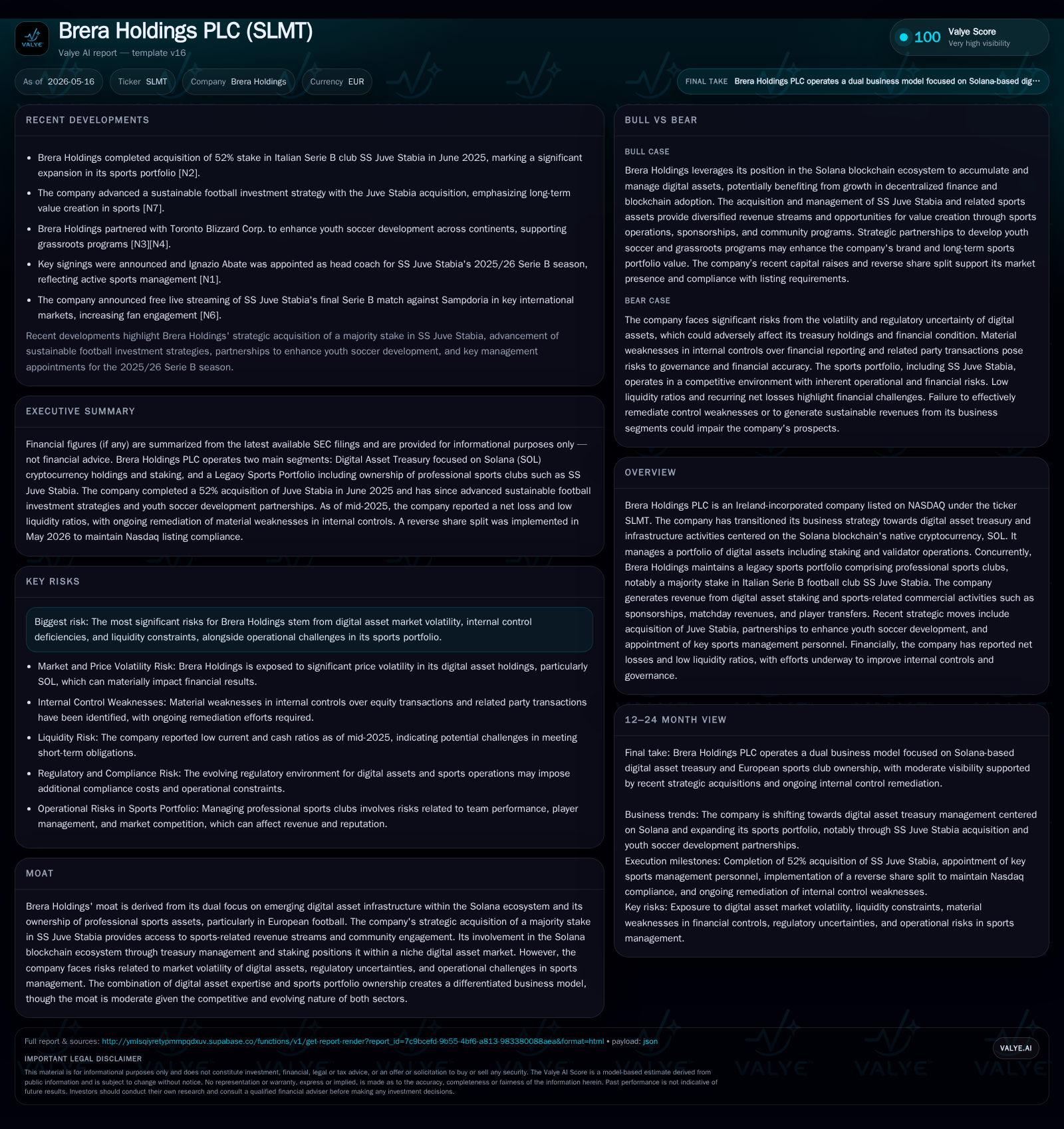
Brera Holdings PLC has accelerated its transition from a primarily sports-focused business to a digital asset infrastructure company centered on the Solana blockchain, as evidenced in the latest 6-K filings. The company is leveraging strategic advisory agreements and staking operations to grow its SOL treasury, while concurrently reassessing its sports assets for potential wind-downs. This dual business model introduces growth opportunities but also exposes Brera to significant market volatility, liquidity constraints, and operational complexity in two distinct sectors.
Latest Quarterly Update Highlights Strategic Pivot
Brera Holdings PLC's May 12, 2026 Form 6-K filing [S2] corroborates significant corporate developments signaling a strategic shift. The company executed a 1-for-10 reverse share split approved by shareholders on April 7, 2026, effective May 14, specifically to meet Nasdaq's minimum bid price requirements [S17]. This move stabilizes trading liquidity and investor perception. Concurrent filings in early May also updated investors on the expected timing of this reverse split [S3]. These governance actions complement Brera's transition into a Solana-focused digital asset infrastructure player – a marked pivot from its previous identity as a global professional sports network operator.
Alongside this structural change, Brera disclosed ongoing strategic advisory arrangements initiated post-PIPE transaction in September 2025 [S1]. These advisors provide specialized insight on digital assets and emerging markets such as the UAE. Compensation tied to the strategic advisor agreement includes notably significant equity warrants and annual fees calculated as a percentage of the company’s SOL Assets Under Management (AUM), underscoring the importance of staking growth to corporate value.
Dual Business Model: Crypto Treasury and Professional Sports
Brera now operates across two primary segments as redefined in its latest annual report: Digital Assets Treasury and Legacy Sports Portfolio [S1], [S6].
The Digital Assets Treasury centers on accumulating SOL tokens – the native cryptocurrency of the Solana blockchain – alongside validator node operations through partnerships like RockawayX Infra Ltd. [S13]. Revenue streams emerge primarily from staking rewards allocated entirely to Brera from delegated SOL tokens, with operating costs borne by validator partners. This structure yields protocol-native income while enabling scalability via treasury expansion. Investors thus gain indirect exposure to Solana's ecosystem performance through Brera’s disciplined treasury management strategy.
Conversely, Brera retains ownership stakes in several men’s and women’s sports clubs globally but chiefly holds majority control of SS Juve Stabia in Italy’s Serie B league [S1]. Revenue generation here includes conventional streams such as sponsorships, ticket sales (matchday revenues), merchandising, and player transfer fees. However, ongoing performance evaluations have prompted indications that parts of the sports portfolio may be wound down or restructured to focus capital on more synergistic activities aligned with digital asset investments.
This bifurcated approach provides diversification but also raises complexity as these distinct markets exhibit vastly different cyclicality, regulatory regimes, customer behaviors, and operational requirements.
Competitive Dynamics Across Digital Assets and European Football
Within the digital asset infrastructure segment specializing in Solana blockchain staking, competition is characterized by efforts to optimize yield amidst volatile token prices and rapidly evolving regulatory landscapes. Validator node operators compete not just on technical performance (e.g., uptime) but on cost structures since validator service providers like RockawayX retain non-staking economic benefits (e.g., MEV-related income) while delegating staking rewards fully to Brera [S13]. Effective treasury growth depends on accumulating SOL assets without excessive risk exposure amid unpredictable crypto market cycles.
Parallel challenges exist in European football management. Serie B clubs face intense competitive pressure for promotion into Serie A or survival against relegation threats. This dynamic directly influences sponsorship attractiveness and commercial revenues. Additionally, club valuations hinge partly on player development pipelines which may be strengthened via youth soccer partnerships recently formed by Brera. Regulatory frameworks governing club ownership structures and financial fair play add layers of operational risk.
Together these sectors demand distinct specialized expertise – staking economics require sophisticated risk management of volatile digital assets whereas football club operations navigate traditional but highly competitive sports commercial factors.
Growth Catalysts: SOL Staking and Sports Asset Optimization
Key growth drivers within Brera’s new model include expanding the scale of its SOL treasury holdings through disciplined acquisition strategies as envisioned since the PIPE transaction closure in September 2025 [S1], combined with expected yield gains from robust validator operation agreements [S13]. As the Solana ecosystem matures toward global payments and decentralized finance applications built atop its high throughput capabilities, increased demand for liquidity providers like Brera could enhance steady fee income derived from growing SOL AUM.
Within sports assets, growth levers revolve around tactical portfolio rationalization—winding down less profitable teams—and developing community value via enhanced youth academy partnerships which may bolster long-term franchise value, [S1]. Player transfers remain an episodic but potentially material revenue component.
Execution success will depend heavily on balancing capital deployment between these two verticals with opposing market dynamics.
Risks and Operational Constraints in Crypto Volatility and Sports Management
Brera faces multifaceted risks. As detailed in its latest annual filing [S1], price volatility of SOL is acute; negative price swings can materially harm reported values of digital assets held in treasury. The limited trading history of SOL adds uncertainty about future liquidity especially during adverse macroeconomic conditions or restrictive regulatory environments impacting crypto markets globally [S8].
From a liquidity perspective, metrics paint a constrained picture: as of mid-2025 reported current ratio stands at approximately 0.28 indicating significant short-term liability coverage risks given current assets [F1]. Maintenance of operating cash flow is critical especially given sizable equity-based compensation expenses noted in recent years which inflate non-cash losses [S15].
On governance fronts, the company acknowledged material weaknesses relating specifically to internal controls over related party transactions that pose potential for financial misstatements if unremedied [S10].
Sports operations introduce classical execution risks inherent in football club ownership including fluctuations linked to team performance outcomes influencing attendance and sponsorship deals as well as broader sector competition for talent acquisition.
Upcoming Milestones and Investor Guidance
Investors should prioritize monitoring integration progress following the reverse share split completion for signs of improved stock liquidity as outlined in both May 6 and May 12 press releases addressing shareholder-approved structural changes [S2], [S3].
The ongoing exercise of pre-funded warrants by major stakeholders like RBCH Ltd., injecting incremental cash proceeds recently totaling approximately $136K USD at $0.50/share pricing (May 2026), signals modest near-term capital support for operational needs [S4].
Crucially, clarity regarding disposition plans for selected sports assets will provide transparency into capital allocation shifts favoring scaled investment in SOL treasury activities—a tangible milestone for validating Brera's repositioned strategic thesis [S1],.
Summary of Current Financial Position
Brera’s financial footing shows mixed health indicators based on latest disclosures. Cash & equivalents stood around $2.48 million USD at end-2023 while current liabilities exceeded €9.8 million EUR at mid-2025 against current assets near €2.77 million EUR resulting in an unfavorable current ratio near 0.28 [F1]. This underscores significant liquidity pressures requiring remedial finance maneuvers or asset monetization.
The company incurred net losses magnified by equity-compensation-related non-cash charges totaling over €264 million for fiscal year ended December 31, 2025 - reflecting aggressive incentivization but also reported operational challenges [S15]. Despite these hurdles, financing activities yielded over €231 million mainly attributed to PIPE share sales during late 2025 aligning with initial strategic realignment capital requirements [S15], [S5].
Effective management of these financial headwinds alongside successful execution on its STO-focused treasury expansion will be pivotal for sustainable path forward.
Disclaimer: This analysis is based solely on publicly available information up to May 16, 2026 including SEC filings cited herein. It does not constitute investment advice or recommendations.
Disclaimer: This is research-only, informational analysis and not investment advice. It may include AI-generated interpretation and general industry context. Always verify important details using primary sources.

Comments