
Maui Land & Pineapple Confronts Real Estate Cyclicality With Diverse Land Portfolio and Resort Operations
Latest quarterly results confirm steady revenue but operating losses persist amid cyclical market and development challenges.
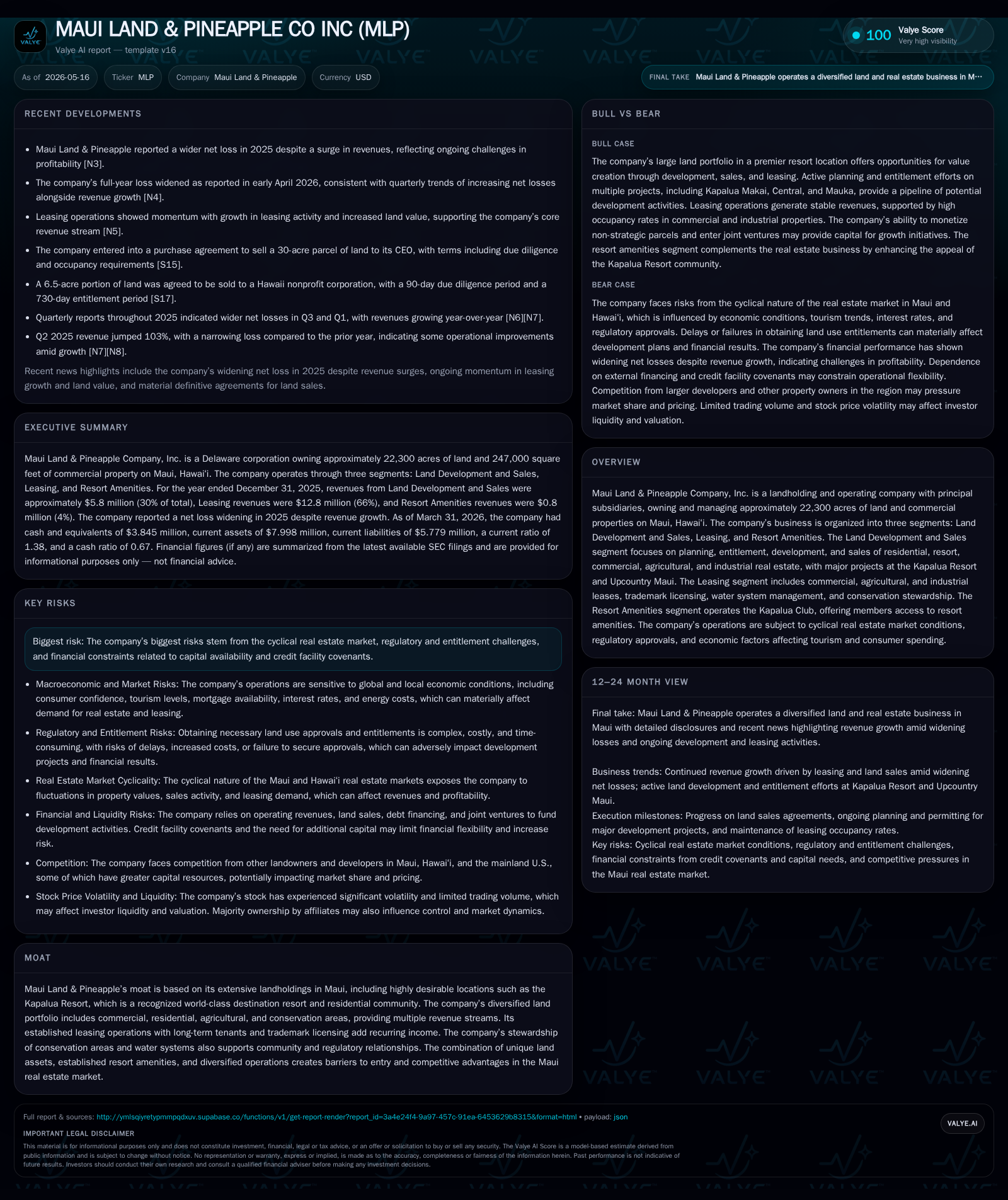
Maui Land & Pineapple Company, Inc. reported consistent revenue for the quarter ended March 31, 2026, reflecting its diversified land development, leasing, and resort amenities business model anchored in Maui. Despite revenue stability, the company continues to face operating losses driven by cyclical real estate market pressures and ongoing pre-development costs. The firm's vast land holdings at Kapalua Resort and Upcountry Maui provide a structural moat but also expose it to regulatory and entitlement risks. Growth initiatives hinge on progressing sizeable residential and resort projects while managing cyclical demand and capital access constraints.
Recent Operating Update
Maui Land & Pineapple's latest quarterly report for the period ended March 31, 2026 confirms stable top-line performance but continued operating losses [S2][S3]. The company issued a press release on May 15th detailing these results alongside maintaining prior risk disclosures without material changes [S2][S3]. Revenues are supported by ongoing leasing activities and intermittent land sales while pre-development investments weigh on profitability.
The overall operating environment remains challenging given persistent cyclical softness in Hawaii’s real estate market combined with incremental costs linked to infrastructure upgrades mandated by regulation—specifically upgrades to wastewater treatment facilities subject to state health department orders [S1].
Business Model Overview
Maui Land & Pineapple operates through three core business segments:
Land Development and Sales: Engages in entitlement planning, development execution, and subsequent sales of real estate across residential, resort, commercial, agricultural, and industrial categories. This segment focuses heavily on master-planned communities such as Kapalua Resort in West Maui and emerging developments at Upcountry Maui including Hali'imaile town [S1][S12][S29].
Leasing: Comprises long-term leases of commercial properties (247k square feet), agricultural lands primarily used for pineapple cultivation legacy operations, industrial spaces along with trademark licensing—leveraging the well-recognized Kapalua brand—and management of potable/non-potable water systems critical to community infrastructure [S1][S12][S29].
Resort Amenities: Operates the non-equity Kapalua Club providing exclusive membership access to premium amenities within the resort community. This segment complements residential sales by enhancing lifestyle appeal [S1].
Revenue generation relies on multi-pronged income streams: land sale proceeds tied to market timing and project completion milestones; recurring lease payments often under long-term contracts providing stable cash flows; royalties from trademark licensing; membership fees from the club; and service revenues from water system operations. Margins are inherently variable—land sales can yield substantial profits when executed timely but entail upfront capital deployment and market risk. Leasing offers steadier but lower-margin returns sustained by occupancy rates.
Industry Structure and Competitive Position
As a dominant landholder with approximately 22,300 acres under management on Maui—the bulk concentrated in the Kapalua Resort area complemented by large parcels Upcountry—Maui Land & Pineapple possesses significant strategic advantages [S1][S12][S29]. The scarcity of premium developable land on Maui creates inherent barriers to entry.
Kapalua Resort is internationally revered as a luxury destination with integrated golf courses, beaches, hospitality services, and gated residential communities. This differentiates MLP from smaller-scale local developers or owners focused solely on single-use property classes. The company’s mixed-use approach enables balancing between cyclical residential demand downturns offset by leasing resilience.
Competition arises primarily from other Hawaiian landowners/developers as well as luxury mainland U.S. resorts that vie for high-net-worth investors interested in second homes or vacation residences [S1][S16]. However, MLP’s entrenched branding via trademark licenses and well-established resort amenities (e.g., Kapalua Club) provide meaningful moats.
Growth Drivers
Progressing Key Real Estate Developments
MLP’s growth outlook leans heavily on unlocking value through phased development at Kapalua Mauka—a planned luxury single-family neighborhood entitling up to 639 homes—and expansion efforts within Upcountry Hali’imaile town including joint ventures that capitalize on Opportunity Zone benefits [S12][S21]. These projects represent multi-year timelines with potential for staged lot sales generating meaningful cash inflows.
Leveraging Lease Portfolio Stability
The Leasing segment provides steady revenue diversification via commercial tenants—including retail outlets serving both residents and tourists—as well as agricultural lessees maintaining traditional pineapple farming heritage lands. Trademark licensing further monetizes brand equity while water system management ensures essential utility service continuity supporting community goodwill [S1][S16].
Enhancing Resort Amenities Offering
The exclusive membership-driven Kapalua Club nurtures customer loyalty among residents and visitors alike through curated experiences that strengthen overall property desirability. This creates incremental value in both primary home sales pricing power and renewal rates for leasing or membership fees [S1][S29].
Risks / Watchpoints / Growth Constraints
Cyclical Exposure & Market Volatility
The Hawaii real estate market exhibits pronounced cyclicality tied to macroeconomic conditions such as interest rates impacting mortgage availability, tourism cycles influencing buyer confidence, and equity markets affecting wealth creation [S1][S4]. Downturns can delay land sales or depress pricing.
Regulatory & Entitlement Complexities
MLP faces stringent environmental regulations particularly relating to wastewater treatment compliance necessitating costly infrastructure upgrades currently underway pending state approvals [S1][S4]. Rezoning or obtaining entitlements may provoke delays or community opposition constraining development pace.
Financial Leverage & Capital Access Risks
With a credit facility capped at $25 million carrying covenants limiting total liabilities below $45 million alongside liquidity requirements (~$2 million minimum cash), MLP must carefully manage its balance sheet amid capital-intensive pre-development outlays [S5][F1]. The total evidenced debt is several multiples higher than cash reserves requiring attention.
Impact of Natural Disasters & Tourism Cycles
Residual economic impacts following recent wildfires continue to affect island-wide activity disrupting commercial tenants’ performance and tempering short-term demand for luxury properties [S27]. Recovery timelines remain uncertain.
What to Watch Next
- Regulatory approval milestones concerning mandated wastewater treatment facility enhancements.
- Sales velocity of residential lots at Kapalua Mauka phase rollout and Upcountry developments including timing of joint venture closings.
- Occupancy trends across commercial leases post-wildfire recovery indicating economy normalization.
- Membership growth or retention rates at the Kapalua Club signaling amenity appeal.
- Commentary on credit covenant compliance given deployment of capital into development vs cash inflows.
- Broader macroeconomic indicators especially U.S. interest rate movements influencing mortgage financing availability for primary buyers.
Financial Profile (Supporting Context)
Latest financial snapshot
| Metric | Value | Period |
|---|---|---|
| Cash & equivalents | $4mm | |
| 2026-03-31 | ||
| Current assets | $8mm | |
| 2026-03-31 | ||
| Current liabilities | $6mm | |
| 2026-03-31 | ||
| Current ratio | 1.38x | |
| 2026-03-31 |
Source: SEC companyfacts cache [F1].
As of March 31, 2026 (latest available snapshot), MLP reports cash & equivalents totaling approximately $3.85 million with current assets near $8 million versus current liabilities of roughly $5.78 million yielding a current ratio of about 1.38—a modest liquidity cushion [F1]. Total debt appears elevated at over $43 million (last best estimate dated September 2011), implying considerable net debt after accounting for cash holdings—though exact current debt data is not fully detailed in recent filings [F1]. Operating income remains negative at close to -$4.5 million last reported year-end emphasizing ongoing investment phase rather than profitability [F1].
In summary, Maui Land & Pineapple maintains a unique position via expansive premium land holdings integrated into one of Hawaii’s most prestigious resort destinations with diversified revenue sources spanning development gains, leasing rents, brand licensing royalties, and upscale resort memberships. Yet the operational reality contends with cyclical real estate markets compounded by regulatory demands and capital intensity inherent in large-scale Hawaiian developments. Execution effectiveness especially regarding entitlement progress and navigating macroeconomic pressures will be pivotal in advancing shareholder value over the medium term.
This report reflects information available as of May 16, 2026 based primarily on SEC filings including the latest quarterly report filed May 15th. It is intended solely for informational purposes without offering investment recommendations.
Disclaimer: This is research-only, informational analysis and not investment advice. It may include AI-generated interpretation and general industry context. Always verify important details using primary sources.

Comments