
Edible Garden AG Solidifies Farm-to-Formula Vision Amid Liquidity Pressures
Edible Garden AG advances its integrated sustainable agriculture and nutrition product platform while confronting tight liquidity and customer concentration risks.
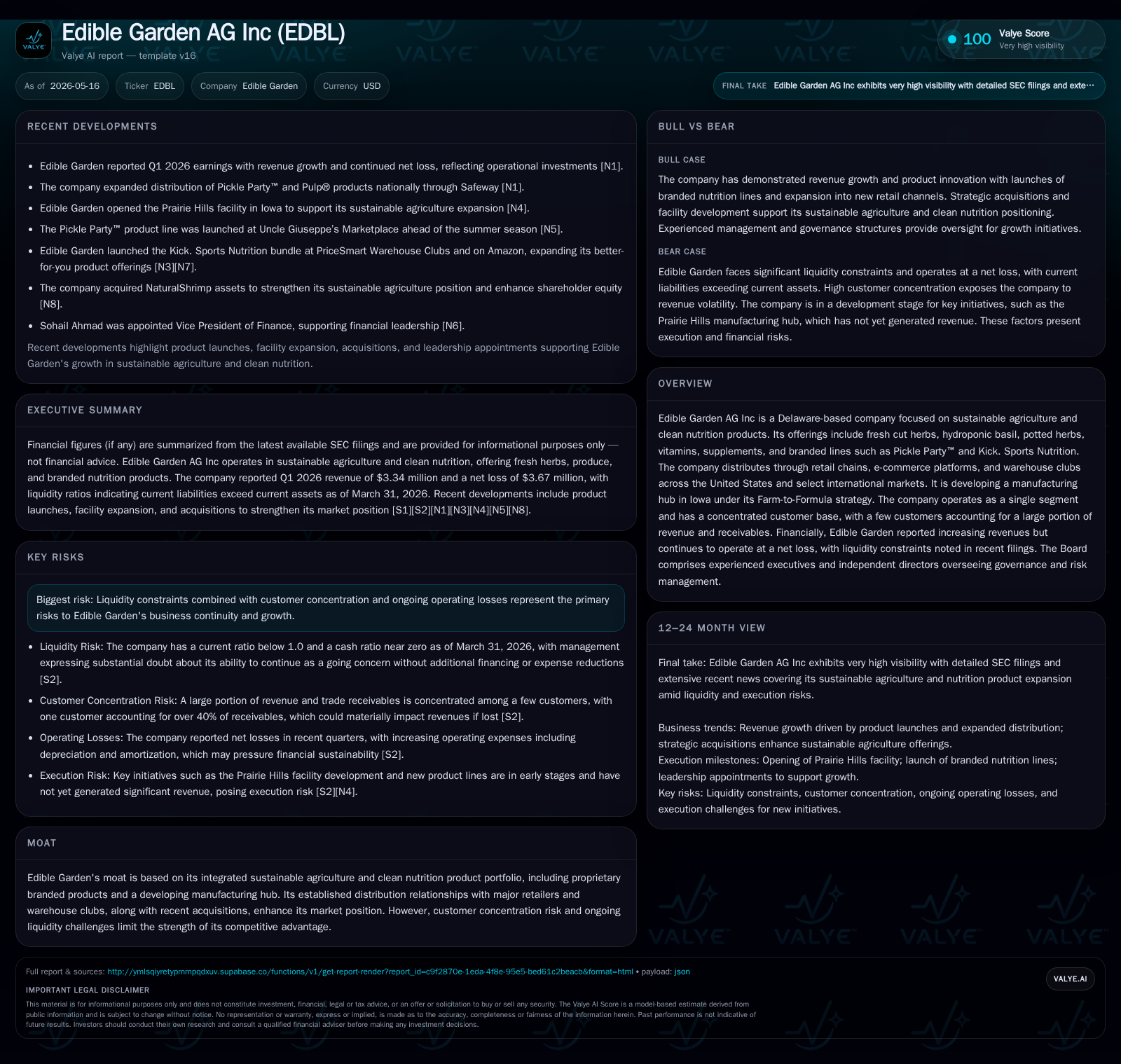
In its latest quarterly 10-Q filing dated May 15, 2026, Edible Garden AG highlights progress on developing its Prairie Hills ready-to-drink (RTD) nutrition manufacturing hub under the Farm-to-Formula strategy, although this facility remains pre-revenue. The company continues to face notable liquidity constraints and operating losses, with going concern doubts detailed in disclosures. Its business model integrates fresh herbs and produce with clean-label vitamins, supplements, and proprietary branded products sold through major retail and e-commerce channels. While growth catalysts include expansion of the Iowa manufacturing hub and increased branded SKU penetration, customer concentration risk and financial pressures present near-term headwinds.
Latest Quarter Operating Developments
In the May 15, 2026 quarterly report (10-Q), Edible Garden AG provided important updates on its strategic initiatives alongside financial challenges. The company is actively developing its Prairie Hills facility in Webster City, Iowa as a ready-to-drink (RTD) clean nutrition manufacturing hub within its Farm-to-Formula strategy [S2], [S14]. Despite progress in construction and preparation phases, this initiative remains pre-revenue with commercial operations yet to commence.
The company targets health-conscious consumers seeking fresh, locally sourced produce combined with clean-label better-for-you nutrition products — an alignment seen as core to Edible Garden’s integrated offering model. Management noted changes in revenue recognition policies under ASC 606 due to treatment of payments for fixtures as revenue reductions rather than gross receipts [S2]. This accounting adjustment impacts near-term reported top-line comparability.
Business Model: Integrated Sustainable Agriculture and Nutrition Products
Edible Garden operates primarily within a single segment combining sustainable agricultural products with clean-label nutritional supplements. Its product suite includes fresh cut herbs, hydroponically grown basil, potted herbs alongside branded vitamin and supplement lines such as Pickle Party™ and Kick Sports Nutrition [S1], [S14]. This approach aims to create a farm-to-formula value chain by integrating upstream cultivation through downstream branded product development.
Revenue is generated from wholesale distribution to major retail grocery chains, warehouse clubs, and expanding e-commerce platforms predominantly within the United States with select international exposure [S1]. The company’s single-segment structure simplifies reporting but exposes earnings volatility tied to a concentrated pool of large customers: approximately five customers account for nearly 90% of outstanding trade receivables at year-end 2025 with one customer alone representing over 40% [S26]. Such concentration presents material credit risk.
Margins are pressured by the fresh produce category’s competitive pricing environment juxtaposed against the premium positioning sought by clean-label nutritional products. Vertical integration via the Farm-to-Formula strategy—exemplified by the Prairie Hills RTD facility—intends to improve margin profiles by internalizing manufacturing costs for beverages aligned with consumer health trends.
Competitive Position within Clean Nutrition and Fresh Produce Markets
Within the fragmented fresh herb market and fast-emerging clean nutrition category, Edible Garden’s moat resides in its vertically integrated supply chain coupled with proprietary branded offerings that appeal to health-conscious consumers. Retail distribution relationships offer barriers to entry given shelf space scarcity and retailer preference for reliable quality supply chains.
However, the heavy dependence on a limited number of customers introduces vulnerability to shifts in buyer priorities or renegotiation leverage. Additionally, competitive forces in both fresh produce—from local growers emphasizing organic/freshness—and nutritional supplements—as established players execute multi-channel brand promotions—limit pricing power.
Industry dynamics around sustainability compliance and local sourcing further elevate operational complexity but also raise switching costs for some clients once stable supply agreements are established.
Growth Drivers: Prairie Hills Facility and Branded Product Expansion
The centerpiece growth initiative is the Prairie Hills manufacturing hub focused on producing RTD clean nutrition products incorporating the company’s farm-grown ingredients into beverage SKUs targeting wellness-focused demographics [S2], [S14]. The transition from development to production scale here represents a critical inflection point. Successful commissioning could anchor recurring contract revenues.
In parallel, expanding presence of Pickle Party™ and Kick Sports Nutrition brands aims to capitalize on wellness demand trends. Broader footfall across warehouse clubs and online platforms seek to deepen household penetration nationally while selective international markets offer incremental opportunities [N1].
Tracking KPIs like capacity utilization at Prairie Hills post-launch, sales velocity of branded SKUs, renewal rates of key retail contracts, and gross margin improvements will be pivotal markers for validating long-term profitability prospects.
Risks: Liquidity Constraints, Customer Concentration, and Profitability Pressures
Liquidity risk dominates near-term concerns: despite issuing a $1.5 million Streeterville Note bearing high interest plus fees—with principal repayments capped monthly—the company forecasts continued difficulties meeting obligations absent further capital raises or aggressive cost cuts [S2]. Such funding uncertainty could disrupt operations or strategic investments.
Customer concentration amplifies revenue volatility risk. Losing a top-five customer could materially depress top line due to their disproportionate share. Edible Garden’s collections concentration also elevates credit risk exposure within accounts receivable [S26].
Finally, persistent net losses fueled by SG&A spend doubling relative to revenues along with high cost depreciation from investments weigh on cash flow generation [S7].
Such data points will clarify pace of Farm-to-Formula deployment success alongside financial stabilization efforts.
Latest Financial Snapshot
| Metric | Value | Period |
|---|---|---|
| Current assets | $5.6mm | |
| 2026-03-31 | ||
| Current liabilities | $7.7mm | |
| 2026-03-31 | ||
| Current ratio | 0.72x | |
| 2026-03-31 |
Source: SEC companyfacts cache [F1].
As of March 31, 2026, Edible Garden held current assets of approximately $5.6 million against current liabilities of about $7.7 million, resulting in a current ratio of 0.72, underscoring strained liquidity conditions at quarter-end [F1]. The company’s gross debt was approximately $4.33 million as of March 31, 2023, with net debt near $4.22 million at that time [F1]. The recently issued Streeterville Note provides some near-term financing but the company acknowledges ongoing liquidity challenges and substantial doubt about its ability to continue as a going concern absent additional funding or expense reductions [S2].
The company's operating expenses continue substantially exceeding revenues reflecting ongoing investment in infrastructure growth contrasted with immature volume ramp-ups [S7]. These dynamics emphasize importance of achieving operational milestones rapidly while securing adequate funding paths.
Disclaimer: This analysis is based on publicly filed regulatory disclosures as well as verified news transcripts up to May 16, 2026. It does not constitute investment advice or recommendations but provides an informed perspective on Edible Garden AG Inc's business strategy, competitive positioning, growth opportunities, risks, and latest financial context.
Disclaimer: This is research-only, informational analysis and not investment advice. It may include AI-generated interpretation and general industry context. Always verify important details using primary sources.

Comments