
Artisan Consumer Goods Faces Operational Hurdles Amid Manufacturing Challenges
Artisan Consumer Goods grapples with halted production and liquidity constraints as it seeks a new manufacturer to revive its Within/Without Granola brand.
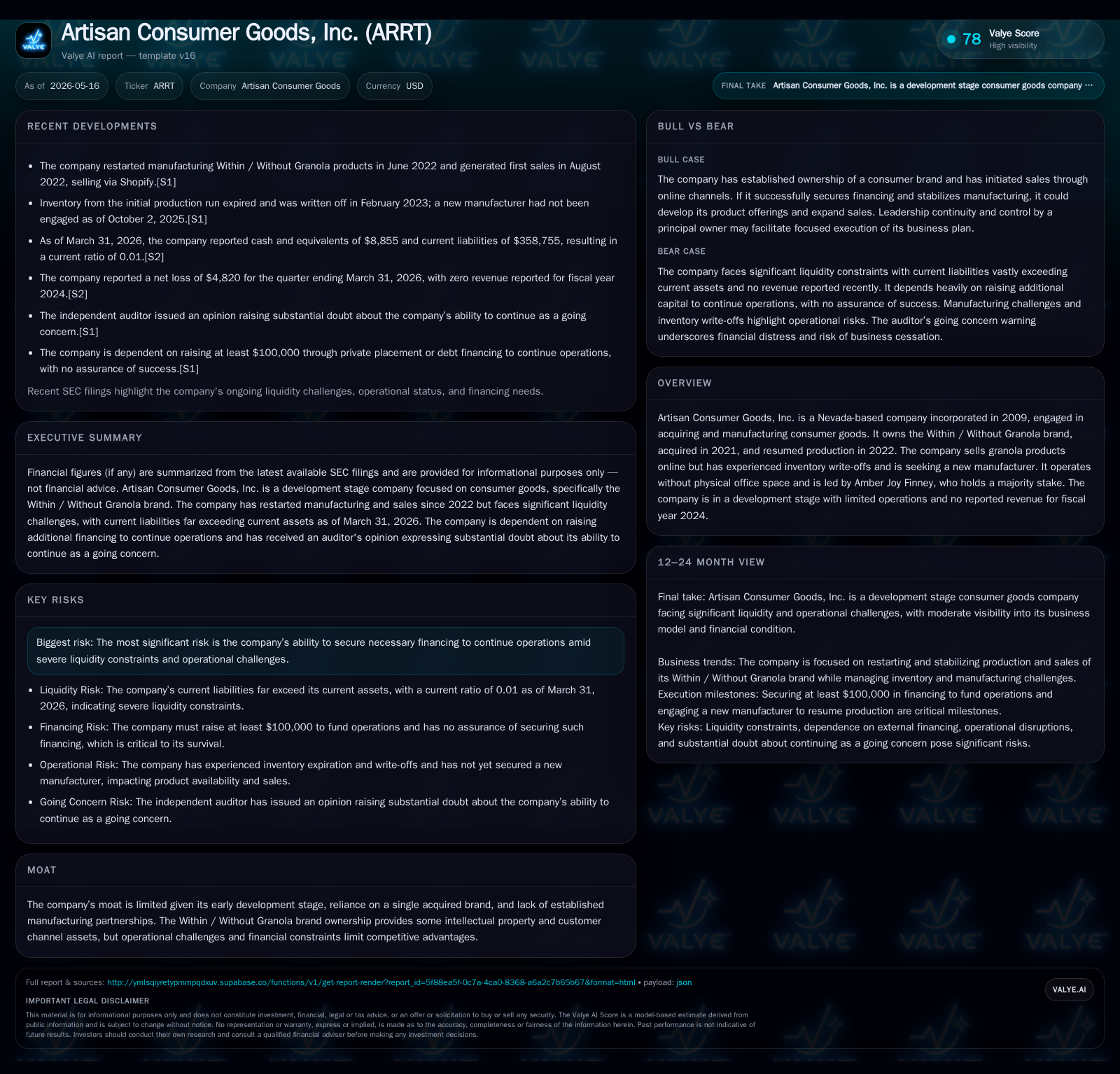
The latest 10-Q filing reveals that Artisan Consumer Goods, Inc. has ceased production of its Within/Without Granola products due to manufacturing disruptions and an inventory write-off. The company continues to operate without revenue and faces significant liquidity challenges, with a current ratio near zero. The business model revolves around brand ownership and outsourced manufacturing but lacks established production partnerships. Upcoming growth hinges on securing financing and a reliable manufacturer to restart operations.
Latest Quarterly Operating Update: Production Halt and Inventory Write-Offs
The company’s May 2026 10-Q discloses critical operational setbacks stemming from its Within/Without Granola (WWG) product line. Artisan Consumer Goods ceased production following expiration of initial inventory from its first manufacturing run completed in mid-2022, resulting in a full write-off of unsold stock during February 2023 [S1][S2]. This outcome reflects an inability to maintain continuous manufacturing access as no replacement contract manufacturer had been engaged by October 2025 despite ongoing efforts [S1]. Consequently, WWG sales have effectively stalled with no reported revenue since inception through mid-2024, underscoring significant operational stagnation during what should be a nascent growth phase [F1].
This halt not only impairs top-line development but disrupts momentum for brand reactivation during an already constrained liquidity environment.
Business Model Overview: Asset Acquisition and Small-Batch Manufacturing
Artisan Consumer Goods operates as an asset-light entity focused on acquiring established consumer brands and intellectual property rather than building manufacturing or retail infrastructure internally. Its primary asset—acquired from Paleo Scavenger LLC in July 2021—is the WWG brand encompassing trademarks, customer lists, manufacturing rights, and sales channels [S1]. The strategy centers on leveraging these intangible assets by outsourcing actual product manufacturing to third-party producers specializing in small-batch runs.
Distribution is primarily direct-to-consumer via Shopify e-commerce platforms, targeting niche specialty granola buyers seeking original and maple-flavored options. However, absence of committed contract manufacturers constrains product availability and limits broader retail penetration potential. Additionally, Artisan does not maintain physical office or production facilities, highlighting operational cost containment but increasing vulnerability to external supplier reliability.
Competitive Positioning in Specialty Granola Market
Within the specialty organic snack segment—characterized by strong consumer demand for natural ingredients and artisanal branding—Artisan occupies an early-stage position reliant exclusively on WWG’s legacy asset base. This market features well-established private label brands benefiting from economies of scale in ingredient sourcing, co-manufacturing relationships, and distribution networks.
Artisan’s reliance on a single SKU line without scale advantages or proprietary formulations leaves it exposed against entrenched competitors who can offer wider assortment variety or lower costs through volume commitments. Customer adoption remains nascent without graduating beyond initial online channels into broader retail or subscription markets.
Growth Drivers: Brand Ownership and Plans for Refinanced Operations
The central lever for growth involves successfully raising fresh capital—management targets at least $100,000—to recommence operations including onboarding a dependable manufacturer capable of producing smaller batch sizes aligned with Artisan’s limited capital base [S1]. Achieving this would unlock ability to generate incremental sales revenue within approximately twelve months according to internal forecasts.
Longer term growth depends on improving inventory management practices to avoid repeat write-offs while expanding marketing efforts aimed at scaling the WWG brand digitally. Strategic focus remains on executing a lean operational model that maximizes IP usage while progressively enhancing product availability through selective manufacturing partnerships.
Risks and Constraints: Financing, Operational Dependencies, and Market Entry Barriers
Liquidity risk is acute with Q1 2026 current assets totaling only $2,513 versus liabilities exceeding $358,000—yielding a perilous current ratio of 0.01 that signals near insolvency conditions absent immediate capital infusion [F1]. Uncertainty regarding successful private placement offerings exposes the company to existential threat; failure to raise funds could compel either high-cost debt financing—which may be inaccessible given Artisan’s development stage—or cessation of operations altogether [S1][S2].
Operational dependencies compound exposure: absence of internal manufacturing facilities mandates rapid identification and contracting with third-party producers who can meet cost efficiency and quality standards necessary for profitability. Delays here directly stifle revenue generation capability.
Finally, competitive barriers related to scaling production volumes amid specialty food regulations add complexity for any potential manufacturer switch given labeling compliance and ingredient sourcing requirements in organic granola sectors.
Upcoming Milestones: Financing Efforts and Manufacturing Partnerships
Key near-term developments critical for evaluating Artisan’s viability will include closing results of anticipated private placement financings targeted at covering operating expenses and initial restart costs [S1]. Parallelly important will be announcement or signing of agreements with selected contract manufacturers able to produce WWG products at manageable batch sizes compatible with Artisan’s resource constraints.
Subsequent milestones will involve monitoring early traction post-relaunch via sales metrics such as order volume stabilization from Shopify or expansion into alternative channels if deployed. These markers will collectively shape visibility into whether Artisan can transition beyond its prolonged developmental stalemate.
Current Financial Snapshot: Liquidity and Balance Sheet Highlights
Latest financial snapshot
| Metric | Value | Period |
|---|---|---|
| Current assets | $2513 | |
| 2026-03-31 | ||
| Current liabilities | $358755 | |
| 2026-03-31 | ||
| Current ratio | 0.01x | |
| 2026-03-31 |
Source: SEC companyfacts cache [F1].
| Metric | Value (USD) | Date |
|---|---|---|
| Cash & Equivalents | 8,855 | |
| 2022-12-31 | ||
| Current Assets | 2,513 | |
| 2026-03-31 | ||
| Current Liabilities | 358,755 | |
| 2026-03-31 | ||
| Current Ratio | 0.01 | |
| 2026-03-31 | ||
| Revenue | 0 | |
| 2024-06-30 | ||
| Operating Income | -49,991 | |
| 2025-06-30 | ||
| Net Income | -50,732 | |
| 2025-06-30 |
This snapshot encapsulates Artisan's liquidity crunch: nominal cash reserves contrasted against substantial short-term obligations illustrate an urgent need for capital injections before operational viability deteriorates further. The absence of reported revenue underscores continuing failure to commercialize products effectively despite ownership of established brand IP.
This analysis is based strictly on disclosed filings through May 15, 2026 ([S2], [S1]), supplemented by company financial data ([F1]) and Valye proprietary insights. It does not constitute investment advice but aims to provide a clear assessment reflecting current operational realities faced by Artisan Consumer Goods.
Disclaimer: This is research-only, informational analysis and not investment advice. It may include AI-generated interpretation and general industry context. Always verify important details using primary sources.

Comments