
Future FinTech Group’s Shift from Commodity Finance to Brokerage Amid Regulatory and Profitability Challenges
Recent quarterly disclosures confirm continued operational contraction in bulk commodities financing and growing emphasis on brokerage and consulting services.
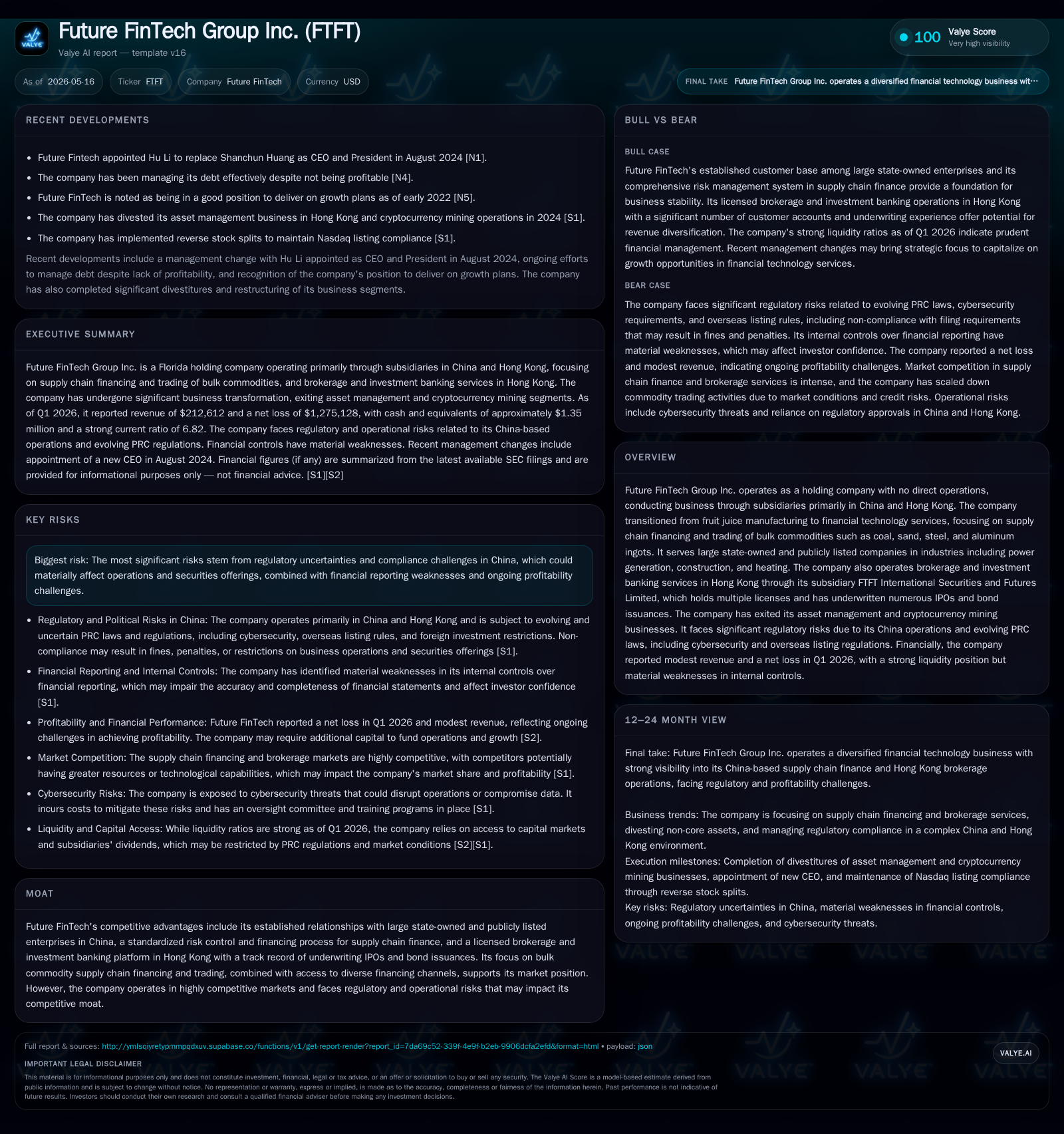
Future FinTech Group Inc. reported continued scale-down of its supply chain financing and bulk commodity trading businesses as of Q1 2026, reflecting cautious capital deployment amid regulatory risks in China. Concurrently, the company emphasizes growth in its Hong Kong-based brokerage and investment banking operations, which have expanded through acquisitions and now serve a sizable customer base. The company's business model faces significant regulatory scrutiny and competition, while financial results reveal operational losses and unresolved internal control weaknesses. Growth hinges on capital market activities in Hong Kong, successful consulting engagements, and navigating evolving Chinese regulations.
Recent Operating Update
The Q1 2026 Form 10-Q filing ([S2]) reiterates that Future FinTech Group has significantly scaled down its supply chain financing and bulk commodity trading operations—primarily coal, steel, sand, and aluminum ingots—due to cautious capital allocation during subdued activity in China’s domestic commodity markets. This segment currently represents an immaterial portion of total revenue, signaling a strategic retreat from what was once a key business pillar. The company has shifted focus toward expanding higher-margin brokerage and investment banking services conducted via its Hong Kong subsidiary, FTFT International Securities and Futures Limited.
Notably, the company reported no material revenue contributions from its nascent listing readiness consulting services during fiscal year 2025 ([S5,S6]). These initiatives remain at preliminary stages, with limited client engagements primarily outside the U.S., requiring regulatory clarity before scaling.
Business Model
Future FinTech operates as a holding company with no direct operational activity; all business is conducted through subsidiaries based mainly in China and Hong Kong ([S1]). Historically rooted in fruit juice manufacturing, it pivoted away from physical commodity production toward fintech services centered around supply chain financing for large state-owned enterprises (SOEs) and publicly listed companies primarily in energy, construction, and heating sectors ([S9,S14]). Its supply chain finance model involves providing credit facilities secured by contracts on bulk commodities transported to designated locations or held in warehouses. Revenue recognition depends on whether the company holds control over goods or acts as an agent; this impacts margin profiles ([S9]).
In recent years, diminishing activity in domestic commodity markets combined with tighter capital and credit conditions prompted management to scale back this capital-intensive segment significantly. Concurrently, Future FinTech expanded into online brokerage, equity capital markets (ECM), and debt capital markets (DCM) via FTFT International ([S10,S26]). Holding multiple licenses from the Hong Kong Securities and Futures Commission (types 1, 2, and 4), FTFT provides retail brokerage for Hong Kong equities plus offshore US equities (via partnerships), underwriting IPOs (29 since 2020), and US dollar-denominated bond issuances for Chinese issuers ([S10,S26]). These financial services are fee-driven rather than asset-heavy, potentially offering more scalable income streams.
Listing readiness consulting is a complementary service line aimed at private companies preparing for public offerings. Services include corporate governance structuring, audit coordination, internal controls readiness, and financial reporting assistance ([S5,S6,S13]), though the business is nascent without meaningful revenues recorded.
Industry Structure and Competitive Position
The supply chain financing sector in China is fragmented but evolving rapidly under strong regulatory scrutiny ([S11,S16,S17]). Success depends heavily on risk management capabilities across receivables collection, supplier reliability, price volatility of commodities, as well as access to diverse funding sources such as banks, factoring firms, asset-backed securities markets ([S9,S14]). Future FinTech touts an independent risk control system aligned with standardized financing processes that facilitate efficient decision-making ([S14,S15]). Its client base features high-credit-quality customers anchored by large SOEs like subsidiaries of China Datang Corporation.
Despite these strengths, competitive intensity is high. Numerous peers with deeper pockets or better technology compete aggressively on price and service innovation ([S16,S19]). The industry’s rapidly changing nature forces constant evolution of product offerings to maintain client loyalty.
In Hong Kong brokerage markets where FTFT International operates ([S13,S26]), dominant global players benefit from brand recognition, broader product suites including margin lending or wealth management services not offered by FTFT. However, FTFT's technological infrastructure supports multi-asset trading with competitive pricing attracting a reported 60k+ accounts ([S10,S26]). The ability to originate ECM/DCM deals adds further differentiation but sustaining deal flow depends on maintaining strong relationships with Chinese issuers amid increased regulatory oversight.
Listing advisory services face regulatory interpretation risks given cross-border securities laws complexities ([S5,S13]). Market growth prospects are tied closely to Chinese companies’ appetite for overseas public listings—a process now more tightly regulated by CSRC’s New Overseas Listing Rules effective March 2023 ([S8,S12,S25]). Further cybersecurity regulations may impose onerous compliance burdens on critical information infrastructure operators if the company’s scale enlarges sufficiently ([S10,S18]).
- Profitability Challenges: Operating losses are substantial; the company reported an approximately $34 million operating loss for fiscal year ended December 2025 against a small base revenue (~$3.8 million) indicating negative operating leverage ([F1]). Coupled with internal control deficiencies over financial reporting noted repeatedly by management ([S21]), profit restoration is constrained.
- Competitive Pressures: Both core segments face intensifying competition—supply chain finance competitors may undercut prices or offer superior products; brokerage rivals benefit from scale advantages potentially limiting FTFT’s market penetration [S16,S19].
- Legal/Settlements Burden: Historical litigation resolved via settlements involving multi-year cash payments plus share issuances impact cash flow flexibility and shareholder dilution risks; management reports current compliance but ongoing obligations exist ([S20,S27]).
- Economic Sensitivity: Industry downturns or slower domestic infrastructure growth can depress demand for bulk commodities financing; economic volatility including possible recessionary pressures globally may reduce client spending affecting all lines of business ([S7]).
- Execution Risks: Integration risk from acquisitions remains real given prior divestiture of asset management business due to unprofitability; failure to scale consulting services could limit diversification benefits ([S6,S22]).
What To Watch Next
- Progression of CSRC filings regarding overseas offerings post-March 2023 rule changes will reveal how regulatory uncertainties resolve impacting capital market services ([S8],[S12],[S25]).
- Execution milestones around strategic acquisitions currently under due diligence ([S15]) could materially shift future operational scope.
- Client onboarding volume trends at the brokerage arm beyond reported 60k accounts will provide color on market penetration.
- Revenue recognition from listing readiness consulting engagements will be an early indicator of market acceptance or regulatory friction ([S5],[S13]).
- Management’s ability to remediate internal control weaknesses documented ([S21]) is critical to restoring investor confidence.
- Monitoring future quarterly earnings releases for improvement or further deterioration in profitability metrics relative to Q1 indications.
Financial Profile Summary
Latest financial snapshot
| Metric | Value | Period |
|---|---|---|
| Cash & equivalents | $1,346,642 | |
| 2026-03-31 | ||
| Current assets | $49,508,216 | |
| 2026-03-31 | ||
| Current liabilities | $7,258,494 | |
| 2026-03-31 | ||
| Current ratio | 6.82x | |
| 2026-03-31 |
Source: SEC companyfacts cache [F1].
Despite challenging earnings dynamics reported (-$34 million operating loss in FY 2025 [F1]), Future FinTech maintains substantial liquidity with approximately $1.35 million cash & equivalents as of March 31, 2026, against low recorded debt (~$179k at mid-2022 [F1]). This results in a strong current ratio of approximately 6.82 at quarter-end 2026 [F1]. The company's net debt position appears negative due to liquid assets exceeding debts [F1]. This liquidity position provides some runway amid ongoing restructuring efforts but sizable operating losses highlight persistent profitability issues before operational turnaround can be achieved.
In summary, Future FinTech’s near-term outlook hinges on stabilizing its footprint in much less capital-intensive financial services such as brokerage licensing platforms while managing regulatory headwinds stemming from PRC policy shifts. Its historical dependence on volatile bulk commodity trading has sharply receded. Absent successful expansion of advisory consulting or strategic acquisitions yielding profitable diversification, challenges around competitive positioning plus compliance risks could constrain growth prospects.
This analysis is prepared solely for informational purposes without offering investment recommendations or advice relating to Future FinTech Group Inc. The commentary reflects a synthesis grounded strictly in disclosed SEC filings through May 2026.
Disclaimer: This is research-only, informational analysis and not investment advice. It may include AI-generated interpretation and general industry context. Always verify important details using primary sources.

Comments