
Xiao-I Corp Executes Reverse ADS Split Amid Severe Liquidity and Profitability Challenges
The AI-focused holding company enacts a one-for-twenty reverse ADS split as financial losses deepen and liquidity tightens.
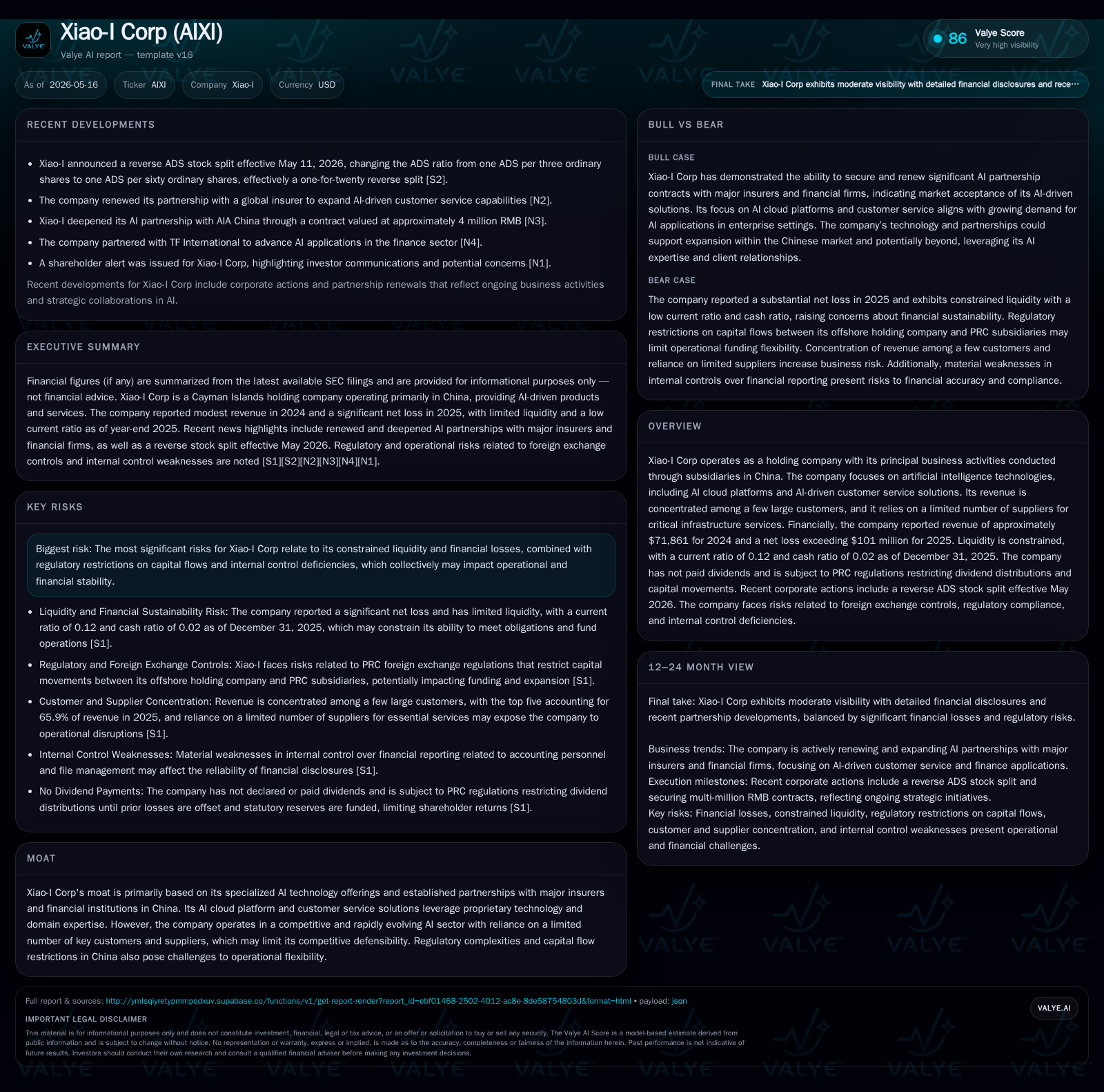
In May 2026, Xiao-I Corp announced a significant change to its American Depositary Shares ratio, consolidating ADS at a one-for-twenty ratio, effectively a reverse stock split. This move reflects ongoing financial stress characterized by a net loss exceeding $101 million for 2025 and severely constrained liquidity with a current ratio of just 0.12. The company's business remains concentrated on AI-driven cloud platforms and customer service solutions in China, but its competitive position is moderated by regulatory complexity and concentration risks. Going forward, Xiao-I's growth trajectory is heavily dependent on navigating China’s regulatory environment and improving operational efficiency amidst persistent challenges.
Recent Operating Update
Xiao-I Corporation announced on May 7, 2026, a substantial change in its American Depositary Share (ADS) structure: reducing ADS outstanding via a one-for-twenty reverse split. This adjustment changes the ADS representation from one ADS covering three ordinary shares to one ADS covering sixty ordinary shares effective May 11, 2026 [S2]. The decision followed earlier similar corporate actions including a one-for-nine reverse split in August 2024 [S6].
This reverse split directly impacts the trading float and price per ADS but does not affect the total number of underlying ordinary shares issued or outstanding. It appears aimed at addressing listing requirements on Nasdaq related to minimum bid prices and potentially improving market perception during severe financial stress.
Earlier in May 2026, Xiao-I also completed an auditor transition dismissing Assentsure PAC and appointing CHI-LLTC as its new independent auditor effective April 13, 2026. The change was approved without disagreement or qualification concerning prior financial statements but follows ongoing remediation of identified internal control weaknesses, detailed in their annual report [S3].
Business Model Overview
Xiao-I Corp operates primarily as an artificial intelligence holding company with most operations conducted through Chinese subsidiaries focused on AI cloud platforms and AI-driven customer service solutions tailored mainly for insurers and financial institutions domestically [S1]. Revenue generation comes largely via contractual arrangements with key clients for software deployment coupled with maintenance and support services.
The company relies heavily on a narrow set of high-value clients; the top five customers accounted for nearly two-thirds of revenues in recent years — indicative of customer concentration risk. Similarly, due to limited supplier options within China’s AI infrastructure space, around half of the company’s purchases are concentrated among the top three suppliers providing cloud data centers and hardware components necessary for its offerings [S1], [S22].
Revenue recognition revolves around software sales combined with ongoing maintenance & support services which account for approximately ten percent allocation of total transaction prices when explicit pricing is unspecified [S20]. The nature of contracts implies recurring revenue elements but significant fluctuations potentially occur tied to contract renewals or new deployments.
Industry Structure and Competitive Positioning
Xiao-I operates in the fast-evolving artificial intelligence sector focused on enterprise applications within China’s regional ecosystem—a highly competitive market landscape peppered with local startups delivering vertical-specific solutions alongside multinational technology providers offering broader cloud services.
Its moat stems from proprietary AI technologies adapted specifically for China’s insurance and financial sectors alongside entrenched partnerships which provide some defensibility against competition. Nonetheless, reliance on limited customers constrains bargaining power while operational dependencies on few suppliers raise supply chain fragility concerns.
Regulatory pressures compound industry complexity; Chinese government policies impose restrictions on foreign currency flows, dividend distributions from subsidiaries to parent entities outside mainland China, and compliance burdens that may hinder quick redeployment of capital or expansion abroad [S1], [S25]. Such constraints potentially limit strategic agility relative to more globally diversified peers.
Growth Drivers
Structural demand emerging from China's push into digital transformation fuels medium-term growth opportunities for companies like Xiao-I supplying cloud-enabled AI services targeted at automating complex customer interactions within finance sectors. Increased adoption of AI-enhanced workflow tools in underwriting claims processing augmentation represents tailwinds.
Further expansion could hinge on deepening integration into client ecosystems thereby increasing switching costs while leveraging advances such as natural language processing enhancements or expanding offerings into adjacent verticals beyond finance.
Incremental improvements to internal processes highlighted by remediation plans for prior internal control gaps might improve operational execution capacity supporting scalability going forward.
Risks and Constraints
Xiao-I faces acute financial sustainability challenges evidenced by a staggering net loss exceeding $101 million for FY2025 against minimal revenues reported primarily in fiscal 2024 ($71k), underscoring severe operating cash burn [F1]. Liquidity metrics mirror stress: cash resources stand at approximately $2.3 million against current liabilities north of $103 million yielding an extremely low current ratio (0.12) indicating potential short-term solvency issues absent successful refinancing or capital infusion [F1].
Concentration risks—both customer- and supplier-related—render revenue streams vulnerable if key relationships deteriorate or procurement bottlenecks arise given limited alternatives locally available [S1], [S22]. Additionally, regulatory complexities regarding offshore fund flows restrict flexibility around dividend payments or capital movements hindering parent-level funding strategies [S25].
Internal controls deficiencies disclosed—particularly concerning financial statement closing processes—raise concerns about reliability of reported results without ongoing remediation efforts completed successfully [S9], [S18].
Convertible loan agreements active since mid-2024 reflect reliance on debt instruments with attendant interest expenses worsening loss profiles; amortization timing and debt conversion paths should be monitored closely for dilution risks or refinancing needs [S4].
What to Watch Next
Key areas warrant continued observation include management’s progress toward strengthening internal financial controls alongside assessment if operational improvements graduate revenues above break-even scales. Monitoring quarterly updates post-ADS reduction will reveal any stabilization trends in share price performance relevant for Nasdaq listing compliance.
Additional milestones involve:
- Updates on customer acquisition or renewal momentum reflecting sustainable demand trends;
- Developments in supplier relationships or technology upgrades signaling resilience against supply chain disruptions;
- Commentary around PRC regulatory environment shifts affecting foreign exchange conversion approvals.
Financial Profile (Latest Snapshot)
Latest financial snapshot
FY End 2025 |
Cash and equivalents totaled approximately $2.3 million at fiscal year-end 2025, while current liabilities were reported at over $103 million, resulting in a current ratio of 0.12 [F1]. Net debt was negative at about $-0.93 million, reflecting cash exceeding total debt of approximately $1.39 million [F1]. It does not constitute investment advice but provides an analytical overview grounded in public SEC filings and known industry dynamics.
Disclaimer: This is research-only, informational analysis and not investment advice. It may include AI-generated interpretation and general industry context. Always verify important details using primary sources.

Comments