
Datavault AI Advances Quantum-Ready Edge Network with Significant Capital Boost
Datavault AI’s latest quarterly report highlights substantial capital inflows fueling deployment of its proprietary quantum-ready GPU edge infrastructure across U.S. urban markets.
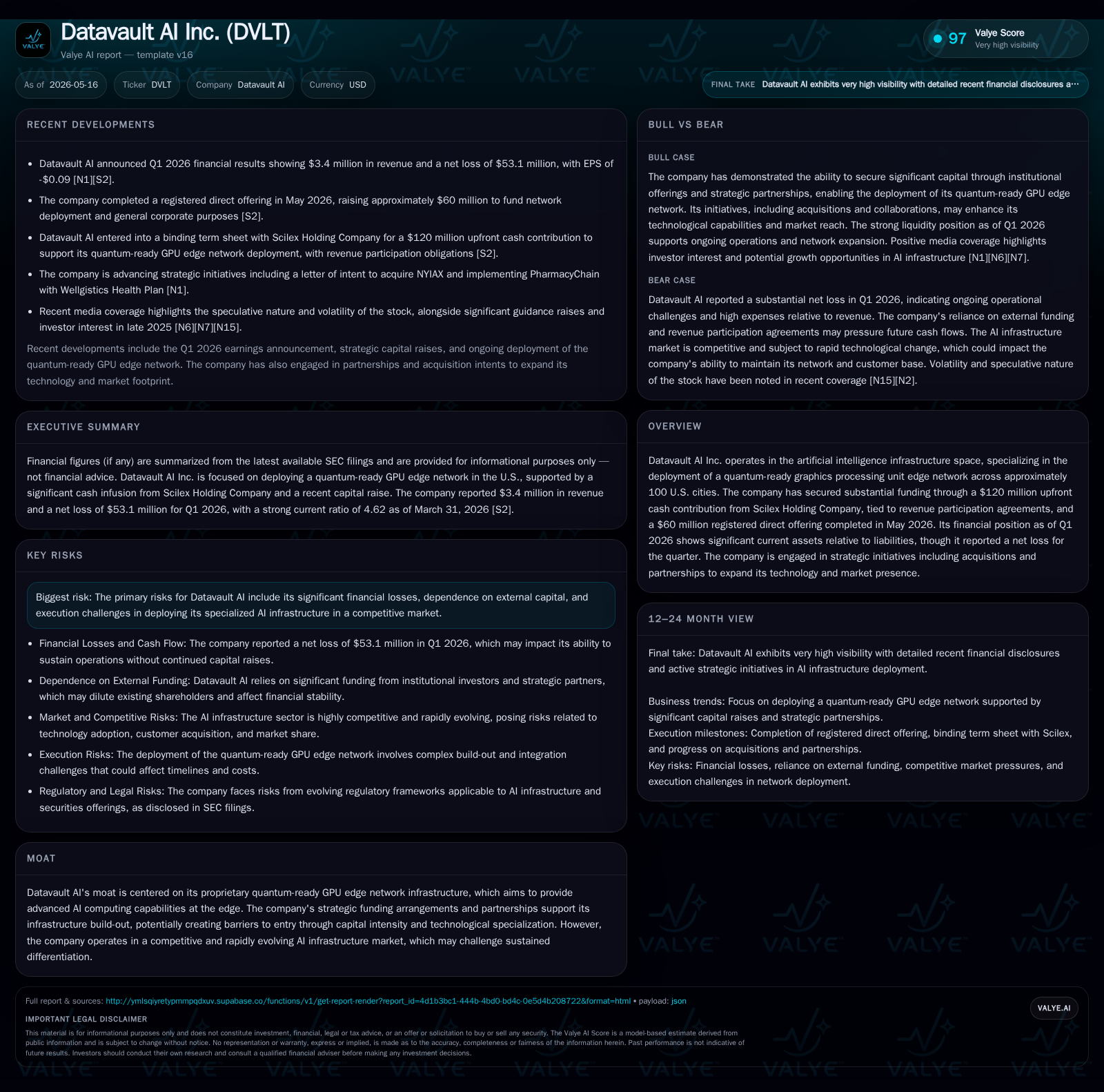
In Q1 2026, Datavault AI reinforced its financial foundation with a $120 million upfront commitment from Scilex Holding Company and a subsequent $60 million direct offering, supporting ongoing rollouts of its quantum-ready GPU edge network spanning roughly 100 U.S. cities. Despite continued net losses driven by heavy investment in technology and expansion, the company maintains a strong liquidity position with a current ratio above 4.6. Its differentiated business model centers on delivering advanced localized AI processing at the network edge, leveraging specialized quantum-capable GPUs to address rising enterprise demands for low-latency AI operations. Competitive dynamics include capital-intensive barriers and fast innovation but pose risks linked to execution complexity and reliance on semiconductor supply chains. Future growth hinges on accelerating network deployments, revenue participation scaling, and strategic partnerships.
Latest Operational Developments Reflecting Strategic Momentum
Datavault AI Inc.’s Q1 2026 filings ([S2], [S3]) reveal pivotal financial and operational developments underpinning its strategy to deploy quantum-ready GPU infrastructure for AI edge computing. The company secured an upfront payment of $120 million from Scilex Holding Company tied to revenue participation agreements—a structural funding mechanism linking repayment to future network-generated revenues. Moreover, Datavault closed a $60 million registered direct offering in early May 2026 ([S6], [S7]), collectively providing essential capital in an otherwise loss-making phase.
Despite recording a net loss for the quarter consistent with its investment-heavy profile, liquidity metrics remain robust: the current ratio stood at 4.62 with current assets over $106 million against $23 million in liabilities as of March 31, 2026 ([F1]). Strategic partnerships have been pursued alongside acquisitions intended to enhance both technological capability and market reach.
Such capital injections are not simply financial lifelines but align closely with operational progress — funding sustains accelerated deployment of its proprietary quantum-ready GPU edge nodes aimed at delivering ultra-low latency AI processing close to data sources. The combination of growing urban coverage and funding linked to future revenues signals management’s commitment to establishing scalable market footholds.
Examining Datavault AI’s Business Model and Product Offering
Datavault’s business model centers on deploying a distributed edge compute network utilizing quantum-ready GPUs optimized for artificial intelligence workloads requiring rapid inference and localized data processing ([S1], ). Customers primarily comprise enterprises seeking enhanced performance beyond centralized cloud offerings—particularly where latency or data sovereignty constraints limit remote processing viability.
Revenue is derived principally through revenue participation agreements associated with usage of Datavault’s GPU-enabled edge infrastructure facilitated via multi-year contracts or service agreements. These agreements hinge upon actual consumption or throughput metrics rather than standard fixed fees alone, providing variable but potentially scalable revenue streams indexed directly to customer activity.
The company invests considerable resources into developing technology architecture blending specialized semiconductors with advanced networking protocols ensuring extensibility and security. Quantum readiness implies hardware compatibility with emerging quantum technologies or acceleration methods—a potential differentiator as hybrid classical-quantum applications gain traction.
Additionally, delivery depends on close coordination with semiconductor manufacturers—third-party entities that fabricate Datavault’s bespoke GPUs—and integration with cloud services where hybrid models complement pure edge deployments ([S1]). Product quality factors revolve around scalability (ability to add nodes efficiently), availability (network uptime), speed/latency characteristics vital to AI inference tasks, and robustness against cybersecurity threats.
Competitive Dynamics and Industry Positioning in AI Infrastructure
The AI infrastructure industry is bifurcated between dominant centralized cloud providers (e.g., hyperscalers) and emerging edge-focused players like Datavault AI who emphasize spatial proximity computing advantages ([S1], ).
Barriers to entry are substantial: the capital intensity required for city-scale GPU node networks restricts casual entrants. Furthermore, complex technical know-how in integrating quantum-ready GPUs with scalable edge networking compounds difficulty.
Nevertheless, competition arises from established cloud giants expanding edge services and fast-moving startups innovating hardware/software convergences. Pricing pressure exists due to commoditization risks in general-purpose GPUs; however, Datavault’s focus on quantum-enhanced specialized processors could preserve some pricing power if innovations prove valuable.
Supply chain matters exert influence—global semiconductor shortages or manufacturing disruptions bear the risk of constraining capacity additions ([S1]). Additionally, regulatory scrutiny related both to security/privacy aspects of distributed computing infrastructures and compliance with securities filings imposes operational vigilance.
Datavault’s moat appears rooted in its exclusive financial arrangements enabling sustained funding for technology rollouts combined with unique product specification targeting near-term quantum application readiness—elements that together erect hurdles against replication by casual competitors.
Key Growth Catalysts and Expansion Prospects
Growth for Datavault is structurally driven by rapid enterprise adoption of sophisticated AI applications demanding low-latency edge compute capabilities ([S2], [S3], [N1]). As more industries digitize operations—ranging from autonomous systems to real-time analytics—localized AI networks offering dedicated GPU resources become indispensable.
The company’s footprint approaching 100 cities provides a foundation for scaling further into more metropolitan areas or vertically into sectors requiring niche compliance or latency profiles (). Strategic acquisitions aim not only at enlarging technological depth but also at capturing complementary customer bases or augmenting sales channels.
A critical near-term KPI will be expansion in the number of operational network nodes correlating with incremental revenue participation growth—serving as a leading indicator for sustainable top-line ramp up ([N1]). Management’s guidance underscores expectations for accelerating deployments over the balance of 2026.
International expansion remains a longer horizon opportunity contingent upon regulatory approvals and capability localization challenges; thus U.S.-centric build-out remains primary focus currently.
Risks and Limitations Impacting Business Trajectory
Despite promising runway supported by recent funding rounds, several risks temper the outlook:
- Persistent operating losses underscore reliance on continuous external financing; failure to secure further capital under favorable terms may force cutbacks or restructuring ([S1], [S2]).
- Equity issuance dilutes existing shareholders’ stakes potentially impacting stock valuation.[S1]
- Deployment complexities inherent in rolling out quantum-ready GPUs at scale may introduce schedule slippage or cost overruns undermining planned economics.[S2]
- Supply chain continuity risk tied to semiconductor manufacturing poses threat given market volatility and geopolitical tensions.[S1]
- Legal exposure includes an ongoing lawsuit alleging securities violations; although currently assessed as non-material by management it introduces uncertainty ([S1]).
- Competition escalating from both tech incumbents expanding their edge portfolios and nimble startups could compress margins if differentiation erodes.[S1]
- Concentration risk identified as a small number of customers account for significant revenue share; losing key contracts would materially impact results ([S1]).
- Regulatory developments affecting deployment or investor relations could impose compliance costs or operational delays.[S1]
Milestones and Indicators to Monitor Going Forward
Attention should focus on quarterly disclosures detailing:
- Rate of new network node activations reflecting geographic expansion velocity;
- Changes in revenue participation receipts signaling adoption momentum;
- Announcements regarding further capital raises or partnership deals enhancing scale;
- Progress reports on acquisitions integration outcomes impacting product pipeline;
- Update status on pending litigation resolutions affecting risk profile;
- Shifts in regulatory environment impacting either technology deployment or financial reporting transparency. Maintaining alignment between deployment pace and customer uptake remains essential for positive trajectory evidence.
Current Financial Position and Liquidity Overview
Latest financial snapshot
| Metric | Value | Period |
|---|---|---|
| Cash & equivalents | $2.2mm | |
| 2026-03-31 | ||
| Current assets | $106.3mm | |
| 2026-03-31 | ||
| Current liabilities | $23.0mm | |
| 2026-03-31 | ||
| Current ratio | 4.62x | |
| 2026-03-31 |
Source: SEC companyfacts cache [F1].
As of March 31, 2026 ([F1]), Datavault reported:
| Metric | Value (USD) |
|---|---|
| Cash & Equivalents | 2,205,000 |
| Current Assets | 106,268,000 |
| Current Liabilities | 23,024,000 |
| Current Ratio | 4.62 |
The absence of debt suggests a clean leverage profile although cash reserves relative to total assets imply substantial working capital held likely through receivables or short-term investments. Operating losses highlight that capital burn continues but recent $180 million total financing infusion reduces imminent liquidity concerns. Investors should weigh this balance sheet strength against execution risks tied to rapid scale-up expenses.
Disclaimer: This analysis is based strictly on publicly available information as sourced herein without any forward-looking price targets or investment recommendations. The content aims solely to provide informed discussion about Datavault AI Inc.'s business dynamics within the evolving artificial intelligence infrastructure sector.
Disclaimer: This is research-only, informational analysis and not investment advice. It may include AI-generated interpretation and general industry context. Always verify important details using primary sources.

Comments