
Franklin Crypto Trust's Q1 2026 Update Highlights Governance Strengthening and Index Diversification
Recent executive appointments and expanded index composition reinforce Franklin Crypto Trust's commitment to operational rigor and diversified digital asset exposure in its passive ETF structure.
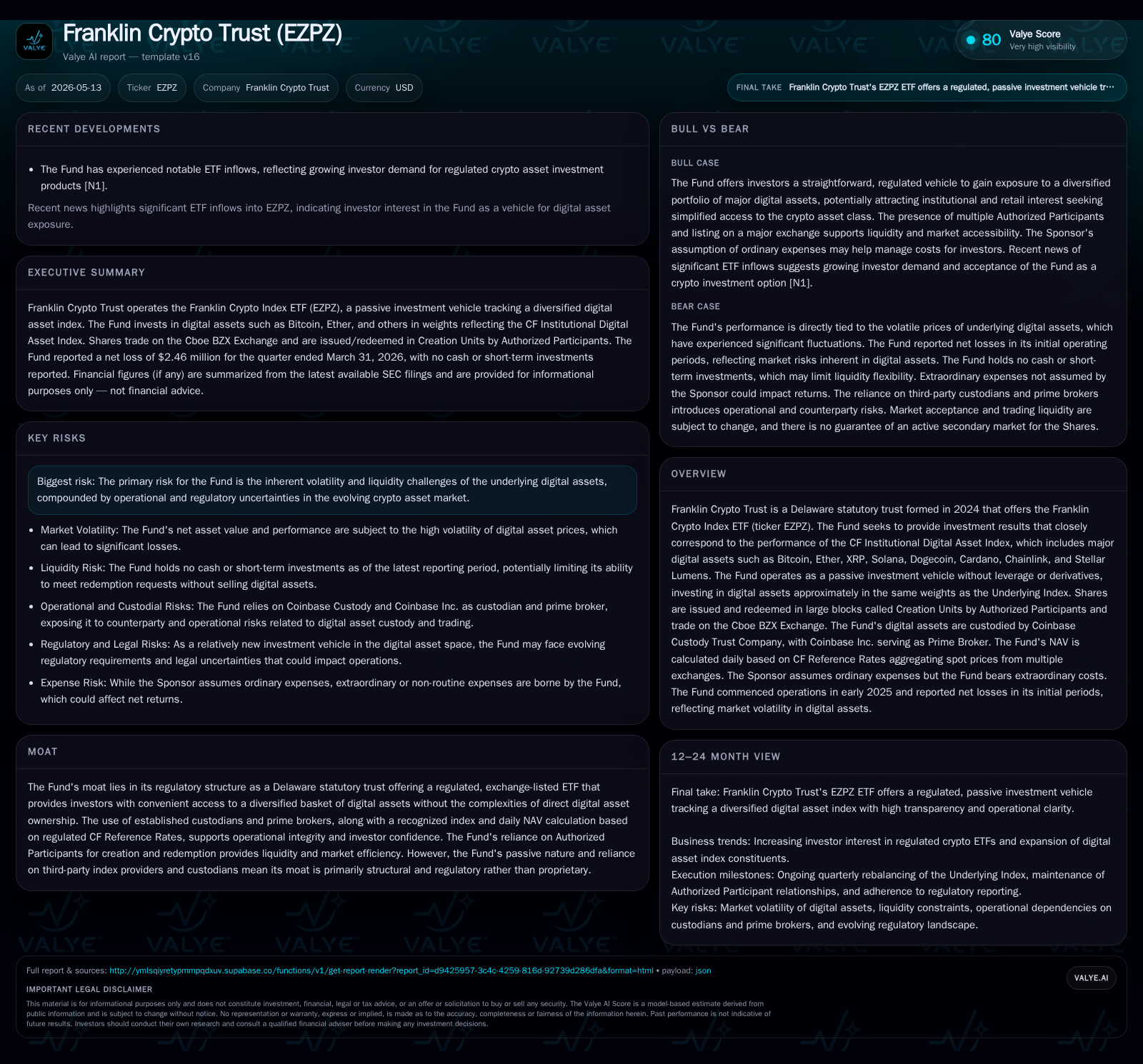
Franklin Crypto Trust’s latest quarterly filing reveals key governance appointments enhancing fund oversight, alongside a broadened underlying index encompassing eight major digital assets. Operating as a Delaware statutory trust, the Fund offers a passive, non-leveraged ETF tracking the CF Institutional Digital Asset Index through Coinbase Custody and prime brokerage services. Its creation/redemption mechanism relies on Authorized Participants to maintain liquidity. While benefiting from regulatory clarity and operational robustness, the Fund faces risks related to crypto volatility, liquidity constraints, and regulatory uncertainties. Growth opportunities include index expansion and increasing institutional adoption of regulated crypto ETFs.
Q1 2026 Operating Update and Governance Enhancements
Franklin Crypto Trust’s Q1 2026 10-Q filing dated May 13 ([S2]) details significant governance appointments with Christopher Berarducci named Chief Accounting Officer and Treasurer, and Christopher Kings appointed Chief Financial Officer of Franklin Holdings, LLC—the Sponsor of the Fund ([S3]). These appointments strengthen financial oversight amid heightened scrutiny over digital asset fund operations. The filings report no material legal proceedings or adverse developments ([S4], [S3]), reflecting stable risk management despite ongoing crypto market volatility.
The absence of reported control deficiencies further indicates consistent operational execution at this early stage of the Fund's lifecycle.
Fund Structure: Delaware Statutory Trust Model and Regulatory Status
Established in August 2024 under Delaware law ([S1]), Franklin Crypto Trust functions as a statutory trust offering one series—the Franklin Crypto Index ETF (ticker EZPZ). It operates outside the Investment Company Act of 1940 registration framework and is not a commodity pool under the Commodity Exchange Act. Instead, it is exchange-listed on Cboe BZX ([S1]) with structural safeguards such as the Inter-Series Limitation on Liability restricting claims solely to Fund assets ([S9]).
As an "emerging growth company," the Trust benefits from certain scaled reporting flexibilities while maintaining transparency through regular SEC filings ([S21]). This legal structure provides investors streamlined exposure to digital assets without direct custody responsibilities.
Index Composition and Passive Investment Strategy
The Fund passively tracks the CF Institutional Digital Asset Index – US Settlement Price version comprising eight major digital assets as of December 31, 2025: Bitcoin (BTC), Ether (ETH), XRP, Solana (SOL), Dogecoin (DOGE), Cardano (ADA), Chainlink (LINK), and Stellar Lumens (XLM) ([S1]). This represents an expansion from an initial two-asset index (BTC and ETH) prior to December 2025.
The index employs quarterly rebalancing based on free-float market capitalization weighting ([S1]). The Fund invests approximately in line with these weights without leveraging or using derivatives. This passive approach limits tracking error but caps potential alpha generation relative to active strategies.
Custody Solution, Prime Brokerage Services, and Liquidity Framework
Coinbase Custody Trust Company serves as custodian while Coinbase Inc. acts as prime broker managing an omnibus wallet system combining cold storage security with hot wallets for trading liquidity ([S7], [S9], [S29]). Assets move dynamically between secure cold wallets ('Vault Balance') and the 'Trading Balance' used for creations/redemptions and index rebalancing trades ([S7], [S27]).
Shares are created or redeemed only in Creation Units of 50,000 shares by Authorized Participants—registered broker-dealers with formal agreements facilitating these large-block transactions that underpin secondary market liquidity ([S9], [S23], [S24]). NAV calculations rely primarily on CF Reference Rates aggregating multiple pricing sources to ensure alignment between underlying asset values and share prices ([S16]).
While this custody-prime broker model supports operational efficiency, it introduces counterparty concentration risk requiring ongoing oversight.
Competitive Positioning in the Crypto ETF Landscape
EZPZ’s competitive advantage stems largely from its regulated Delaware statutory trust status combined with SEC registration enabling exchange listing—differentiating it from unregulated trusts or closed-end crypto funds prone to valuation discounts or premiums. Its passive indexing approach simplifies investor access relative to active managers facing custody complexities amid shifting regulatory environments.
However, the Fund’s moat is structural rather than technological or alpha-based; switching costs remain low amid a growing array of competing crypto ETFs offering overlapping exposures.
Growth Drivers: Index Expansion and Institutional Adoption
Growth prospects hinge on continued diversification of underlying index constituents beyond BTC/ETH dominance—a response to investor interest in tokens associated with decentralized finance ecosystems such as Solana and Chainlink ([S1]).
Increasing institutional acceptance of compliant crypto ETFs provides avenues for scaling assets under management. The presence of established Authorized Participants like Jane Street Capital LLC, J.P. Morgan Securities LLC, Virtu Americas LLC, and Goldman Sachs & Co. LLC supports liquidity provisioning critical for growth ([S15]). Potential innovations in index methodology or constituent inclusion criteria could further stimulate inflows.
Risks: Volatility, Liquidity Constraints, Counterparty Exposure, Regulatory Uncertainty
Notwithstanding robust design features, intrinsic risks persist due to extreme volatility in digital asset prices impacting NAV stability; liquidity constraints during stressed markets complicate redemption processes ([S4], [S5]).
Counterparty risk is concentrated with Coinbase entities handling custody and prime brokerage despite controls including cold storage predominance and vetted connected trading venues such as Bitstamp, Kraken, LMAX ([S26], [S29]).
Ongoing regulatory uncertainty regarding classification of digital assets may affect future fund operations or compliance requirements under SEC/CFTC frameworks.
Near-Term Developments to Monitor
Investors should watch for further governance enhancements following Q1 leadership changes ([S2], [S3]), impacts from quarterly index rebalancing on holdings composition and trading dynamics, reported trading volumes on Cboe BZX reflecting demand shifts, evolving regulatory guidance affecting product scope or classification ([S21]), and activity levels among Authorized Participants indicating institutional flow momentum.
This analysis relies exclusively on publicly filed SEC documents through May 13, 2026. It is intended for informational purposes to provide context on Franklin Crypto Trust's operating framework within the evolving regulated digital asset ETF industry.
Disclaimer: This is research-only, informational analysis and not investment advice. It may include AI-generated interpretation and general industry context. Always verify important details using primary sources.

Comments