
Arbutus Biopharma Advances Hepatitis B Pipeline While Settling Major LNP Litigation with Moderna
Q1 2026 results show streamlined R&D focus and fortified balance sheet amid critical patent litigation resolution.
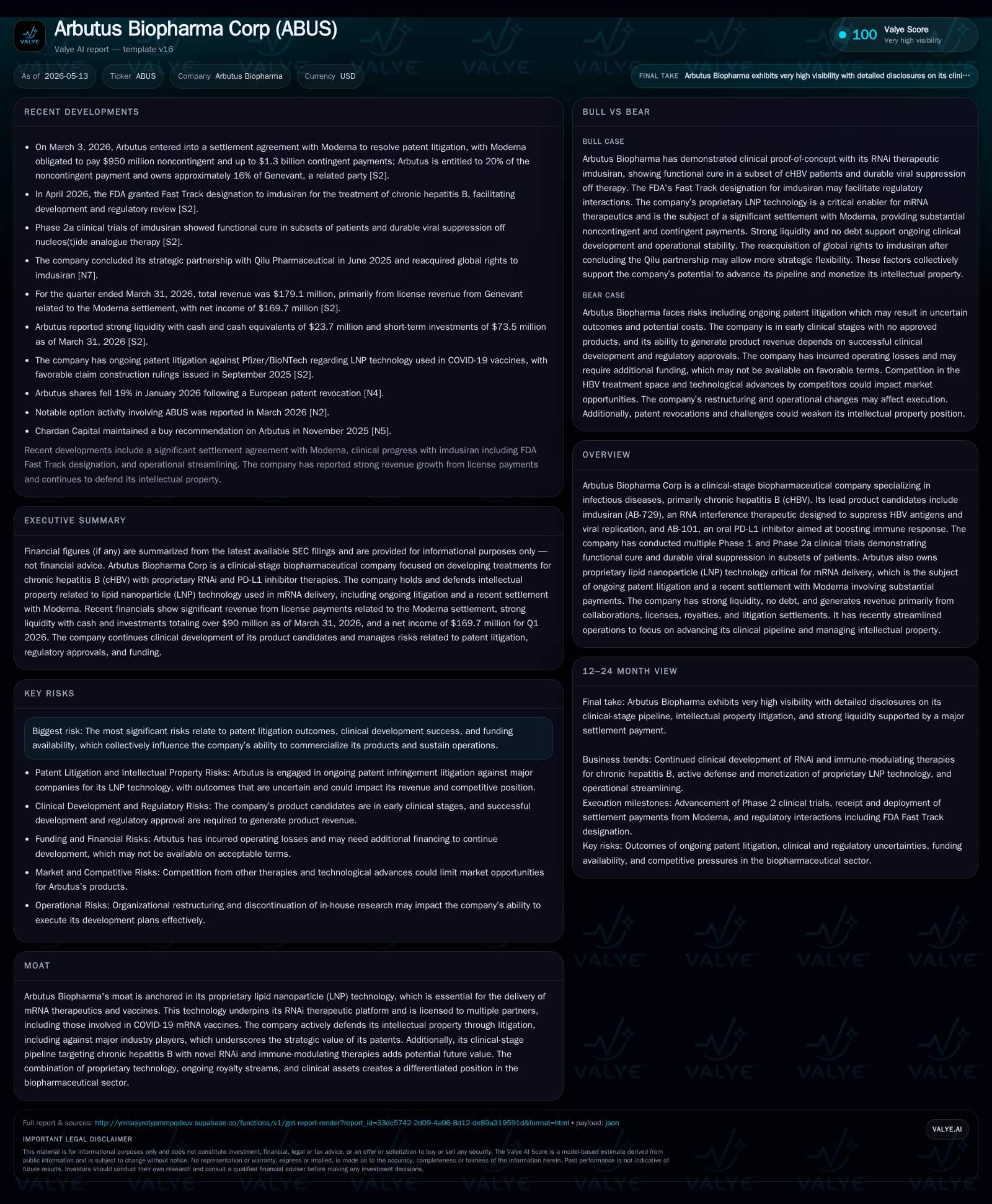
Arbutus Biopharma’s latest quarterly filings reveal significant strategic shifts, including the settlement of patent disputes with Moderna yielding a $950 million noncontingent payment and continued litigation progress against Pfizer/BioNTech. The company is focusing its clinical-stage assets on chronic hepatitis B treatments, notably imdusiran and AB-101, while maintaining strong liquidity with zero debt. The proprietary lipid nanoparticle (LNP) technology remains central to Arbutus’s competitive moat, underpinning its RNAi platform and license revenue streams. Key near-term developments include clinical trial advancements and litigation milestones that will shape the company's growth trajectory.
Recent Operating Update: Q1 2026 Highlights
Arbutus Biopharma’s first quarter report filed on May 13, 2026 provides crucial insight into near-term operational dynamics. The company reported $8.1 million cash used in operating activities for the quarter versus $13.4 million a year prior, reflecting cost containment largely through workforce reductions and strategic refocusing on core assets — the RNAi candidate imdusiran (AB-729) and oral PD-L1 inhibitor AB-101 for chronic hepatitis B (cHBV) treatment [S2][S21]. Cash and equivalents increased sequentially to $23.7 million as of March 31, 2026 with zero reported debt, underscoring strengthened financial flexibility post significant legal settlements [F1][S21].
Critically, Arbutus resolved extensive patent infringement litigation with Moderna on March 3, 2026 through a settlement agreement providing an immediate lump sum of $950 million plus a potential contingent payment of up to $1.3 billion contingent upon further legal victories in §1498 appeal proceedings [S2][S10]. This settlement effectively settles all pending domestic and international claims against Moderna concerning their use of Arbutus’s proprietary lipid nanoparticle (LNP) technology essential for mRNA vaccine delivery.
Concurrently, Arbutus continues active litigation against Pfizer/BioNTech over patent protections for its COVID-19 mRNA-LNP vaccines. Following a favorable municipal court claim construction determination released in September 2025 — a key procedural milestone — further scheduling awaits in this high-stakes patent dispute [S2][S7].
Business Model
Arbutus Biopharma operates fundamentally as a clinical-stage biotech firm centered on infectious disease therapeutics with an emphasis on chronic hepatitis B. Revenue generation is currently anchored not by product sales but through a hybrid model combining licensing fees, royalties from partnered products incorporating its LNP technology (notably Alnylam’s ONPATTRO), milestone payments from agreements (such as the now-concluded Qilu Pharmaceuticals partnership for Greater China rights to imdusiran), and large-scale litigation settlements/awards [S1][F1].
The company’s unique proprietary technology is its lipid nanoparticle platform vital for delivering RNA-based therapies. This proprietary vector underpins its RNA interference therapeutic pipeline including imdusiran—a GalNAc-conjugated subcutaneously administered siRNA aimed at suppressing HBV antigens—and immune modulator AB-101 targeting PD-L1 inhibition orally to restore host immune responsiveness. These targeted approaches reflect both a platform-driven model leveraging core LNP know-how and focused development toward functionally curing or durably suppressing cHBV infection [S1][S2].
Margins currently reflect negative operating income due to heavy investment in clinical development and infrastructure rather than product commercialization. Operating expenses are being strategically trimmed following previously halted discovery efforts and trial preparations for IM-PROVE III study while honing resources on advancing late-stage candidates [S1].
Industry Structure and Competitive Position
Within the broader infectious disease biopharmaceutical niche — particularly chronic hepatitis B treatment — Arbutus occupies a differentiated position given its dual role as both developer of proprietary RNAi agents and licensor/owner of foundational mRNA delivery technologies.
The global market for HBV therapies remains significant due to persistent viral prevalence despite existing treatments that largely manage but do not cure disease. Arbutus’s candidates promise functional cures or more durable suppression via innovative mechanisms distinct from nucleos(t)ide analogues or interferons dominating current standards.
Moreover, the company’s ownership of core LNP intellectual property used by leading industry players such as Moderna and Pfizer/BioNTech places it at a strategic inflection point amidst explosive growth in mRNA therapeutics catalyzed by the COVID-19 pandemic [N1][S7]. Ongoing litigations emphasize both the value of this IP moat and potential volatility in associated royalty streams until fully resolved.
Competitors encompass large pharmaceutical firms pursuing HBV cures via diverse modalities including RNAi (e.g., Alnylam), therapeutic vaccines, capsid inhibitors, siRNAs with alternate delivery vectors, as well as immunomodulatory agents competing with AB-101. Barriers such as regulatory complexity, delivery vehicle innovation requirements, and clinical validation timelines constrict new entrants’ ability to quickly replicate Arbutus’s integrated offering.
Growth Drivers
Key growth drivers unfold across multiple fronts:
- Clinical Progression: Advancing imdusiran through Phase 2a studies demonstrating functional cure markers alongside moving AB-101 through early human trials could yield pivotal data driving partnerships or eventual commercialization.
- Royalty Monetization: Continued receipt and expansion of royalties from licensed LNP usage – like ONPATTRO – underpin recurring revenue inflows.
- Litigation Outcomes: Favorable intellectual property adjudications can unlock substantial contingent payments (as with Moderna) or sustained royalty flows (pending Pfizer suit).
- Strategic Partnerships: Licensing or co-development arrangements post re-acquisition of global rights from Qilu for imdusiran strengthen go-to-market prospects.
- Technology Licensing: Expanding third-party licensees for LNP platforms beyond COVID vaccines into broader mRNA therapeutics addressable markets could grow revenue over time.
Monitoring these risks alongside emerging trial data releases is critical when assessing operational resilience.
What to Watch Next
Focus should be on several concrete developments:
- Quarterly updates around enrollment progress or interim data readouts for imdusiran’s late-phase trials signaling efficacy trends.
- Appellate court decisions in patent cases against Pfizer anticipated over next year which may directly affect royalty revenue forecasts.
- Announcements regarding contingent payment triggers under Moderna Settlement Agreement linked to §1498 appeal victories or setbacks.
- Potential new collaboration deals expanding commercial capabilities or pipeline breadth—given past restructuring deprioritized earlier programs.
- Royalty revenue trajectory on ONPATTRO post partial interest sale termination events impacting future cash flow predictability.
These milestones collectively shape both top-line sustainability and long-term valuation underpinnings.
Financial Profile (Q1 Ended March 31, 2026)
Q4 saw improved operating efficiency reflected by lower cash burn compared with last year corresponding to focused spend on later-stage candidates after cessation of other discovery programs. Despite no commercial product revenues yet realized from pipeline assets, recurring income streams from licenses and settlements provide a cushion while clinical work progresses. The absence of debt strengthens liquidity retention though careful capital management remains essential given ongoing net losses [F1][S2][S21].
This analysis synthesizes recent SEC filings combined with industry perspective to elucidate Arbutus Biopharma Corp's evolving operational status within the infectious disease therapeutic landscape propelled by RNA-based modality innovation. No investment advice is offered herein.
Disclaimer: This is research-only, informational analysis and not investment advice. It may include AI-generated interpretation and general industry context. Always verify important details using primary sources.

Comments