
Armlogi Holding Struggles with Liquidity Amid Expanding Warehouse Network and Cross-Border Logistics Demand
Recent quarterly disclosures reveal Armlogi Holding's intensifying financial strain despite operational expansion and strategic platform partnerships.
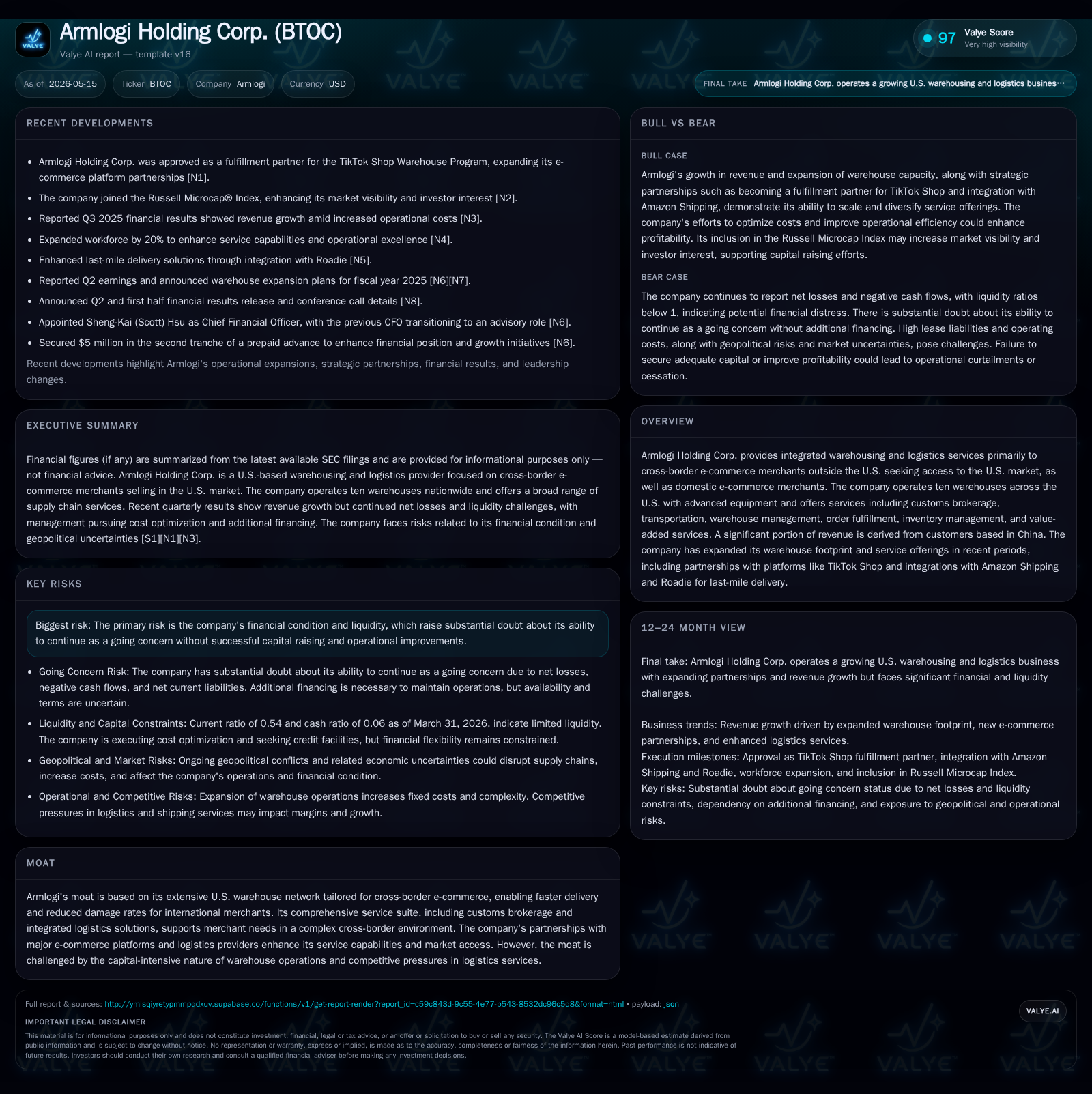
Armlogi Holding Corp., a U.S.-based warehousing and logistics provider specializing in cross-border e-commerce fulfillment, reported a net loss of $15.4 million for the nine months ended March 31, 2026, with substantial liquidity challenges casting doubt on its going concern status. The company has grown its warehouse footprint across the U.S. to serve primarily Chinese merchants entering the U.S. market and has integrated advanced service offerings including customs brokerage and last-mile delivery partnerships. Despite operational scale and margin improvements on select shipping channels, Armlogi faces structural financial risks from cost-intensive expansions, low margins, and deteriorating working capital metrics, which could constrain growth unless financing or profitability improvements materialize.
Recent Operating Update
Armlogi Holding Corp.’s latest quarterly filing dated May 14, 2026 ([S2]) signals escalating financial distress during sustained operating losses. The company recorded a $15.4 million net loss over the nine months ended March 31, 2026, accompanied by a negative operating cash flow of $5.5 million during this period ([S2],[N1]). At quarter-end, the company's cash and equivalents stood at roughly $2.7 million against total debt near $87,789 ([F1]), but it reported current liabilities exceeding current assets by $20.9 million with an overall current ratio of just 0.54 ([F1],[S2]). Management acknowledges substantial doubt about continuing as a going concern absent successful capital raise or enhanced cash generation ([S2]). Although cost optimization initiatives are underway alongside efforts to secure credit facilities from financial institutions ([S2]), outcomes remain uncertain.
Simultaneously, Armlogi faces delisting risks tied to Nasdaq listing rule non-compliance related to share price and public float thresholds ([S21],[S22],[S27]). After transferring its common stock from Nasdaq Global Market to Nasdaq Capital Market in early May 2026 with an extended grace period ([S21],[S27]), the company must regain compliance by late 2026 to avoid potential delisting.
Business Model
Armlogi Holding operates integrated warehousing and logistics services tailored principally for cross-border e-commerce merchants—particularly those outside the U.S., chiefly China-based sellers seeking quicker access into the U.S. market (). The company's revenue streams derive primarily from transportation services (about two-thirds) and warehousing services (roughly one-third), supplemented by ancillary offerings like customs brokerage, inventory management, and value-added logistics solutions ([S16],[S25]). Customers contract for storage space at any of ten strategically located U.S warehouses equipped with advanced automation tools enhancing throughput efficiency.
Revenue generation depends on service contracts with e-commerce merchants who pay fees based on shipment volume, storage usage duration, transportation distances, and service complexity including customs handling—areas demanding expertise due to regulatory complexities inherent in cross-border trade (,[S17]). Freight expenses dominate costs reflecting reliance on third-party carriers such as FedEx and UPS; however, recent volume shifts toward FedEx have improved gross margins on certain shipments ([S25]). Margins remain pressured due to heavy labor needs—both permanent and temporary—warehouse rental escalations linked partly to new facility openings which serve lower-margin operational functions like returns processing or cross-docking hubs ([S25]).
Industry Structure and Competitive Position
Armlogi competes in the fragmented sector of cross-border logistics—a subset of general third-party logistics providers (3PLs)—with specialized focus on e-commerce international fulfillment challenges. Its moat centers on an expansive U.S.-based network enabling faster delivery times versus direct overseas shipping from Asia reducing damage rates during transit (). Importantly, integrated customs brokerage bundled within its offering eases merchants’ compliance burdens amid complex regulatory regimes.
Partnerships with platforms like TikTok Shop plus major ecosystem players Amazon Shipping and Roadie for last-mile delivery enhance Armlogi’s competitive positioning by broadening customer reach and service innovation (). However, the capital intensity of maintaining warehouses—with long lease obligations exceeding $120 million—and fierce competition from established large-scale global logistics firms constrain pricing power and add risk ([S8],).
Growth Drivers
Demand for cross-border e-commerce logistics is structurally supported by continuing expansion in global online retail channels particularly involving Asian merchants targeting Western consumers ([S17] analysis). Armlogi’s strategy focuses on expanding warehouse capacity in key U.S. locations while diversifying service capabilities—from pure warehousing to full-stack supply chain solutions including order fulfillment integration—aiming to capture broader wallet share per merchant account.
Recent infrastructure additions include two new warehouses opened between mid-2024 and mid-2025 including a facility in Illinois functioning more as an operational hub for transfers and returns rather than traditional direct-to-consumer drop-shipping ([S25]). This shift reflects an effort to improve unit economics through scale efficiencies even where margins are thinner outright.
Moreover, tailoring offerings through partnerships—such as interfacing with TikTok Shop’s growing commerce ecosystem—stimulates incremental demand for seamless logistics supporting emerging social commerce channels (). Introducing flexible last-mile options via Amazon Shipping and gig-economy provider Roadie complements this growth push.
Risks / Watchpoints / Growth Constraints
The dominant risk remains financial sustainability: net losses are substantial ($15.4 million over nine months) against tight liquidity ($2.7 million cash) underscored by a weak current ratio (0.54) showing working capital shortfall basics ([F1],[S2]). Failure to secure additional financing or rapidly pivot toward positive operating cash flow could force severe cutbacks or cessation of operations.
Capital commitments are sizable given extensive warehouse lease liabilities exceeding $123 million mostly long-term ([S8]), limiting flexibility especially under current margin pressures.
Competitive intensity among 3PLs serving cross-border e-commerce escalates as large industry incumbents also digitize fulfillment tools; Armlogi's smaller scale constrains bargaining with carriers impacting freight costs despite some progress shifting volumes toward more favorable FedEx pricing tiers ([S25]).
Geopolitical instability involving U.S., Middle East tensions create macro uncertainties potentially disrupting supply chains or trade flows critical to Armlogi’s customer base primarily dependent on China-origin goods ([S2],[S29] risk disclosures). Also notable is Nasdaq listing compliance risk requiring sustained share price improvement or stock restructuring measures such as reverse splits to avoid delisting ([S21],[S27]).
What to Watch Next
Key operational milestones include progress on cost optimization plans targeting reduced expenses across warehouses and transportation services highlighted in recent quarterly commentary ([S2]). Warehouse utilization rates and growth in active customer counts—particularly retention among Chinese cross-border merchants—serve as metric barometers measuring sustainable demand traction.
Successful integration of new service platforms (TikTok Shop connectivity) and enhancement of last-mile delivery options could offer margin improvement opportunities; updates here deserve close observation.
Finally, achieving Nasdaq listing compliance by meeting minimum bid price requirements or successfully executing reverse stock splits represents an imminent corporate governance focus influencing investor sentiment.
Financial Snapshot (as of March 31, 2026) [F1]
Latest financial snapshot
| Metric | Value | Period |
|---|---|---|
| Cash & equivalents | $2.7mm | |
| 2026-03-31 | ||
| Total debt | $87,789 | |
| 2026-03-31 | ||
| Net debt | $-2.58mm | |
| 2026-03-31 | ||
| Current assets | $24.8mm | |
| 2026-03-31 | ||
| Current liabilities | $45.8mm | |
| 2026-03-31 | ||
| Current ratio | 0.54x | |
| 2026-03-31 |
Source: SEC companyfacts cache [F1].
While revenue growth was previously noted at roughly $49 million quarterly as of late fiscal 2025 (~$190 million annualized) it is offset by high cost structures leading to persistent gross losses around -5% margin range despite some improvement efforts ([S16],[S25]).
Disclaimer
This analysis is provided solely for informational purposes as an internal research product without investment advice or recommendations. Financial data is sourced exclusively from referenced SEC filings and validated databases without forecasts or speculative projections.
Disclaimer: This is research-only, informational analysis and not investment advice. It may include AI-generated interpretation and general industry context. Always verify important details using primary sources.

Comments