
WEN Acquisition Corp Faces Critical SPAC Deadline with No Target Yet Selected
Blank check company targeting fintech infrastructure must consummate business combination by May 2027 or liquidate trust account.
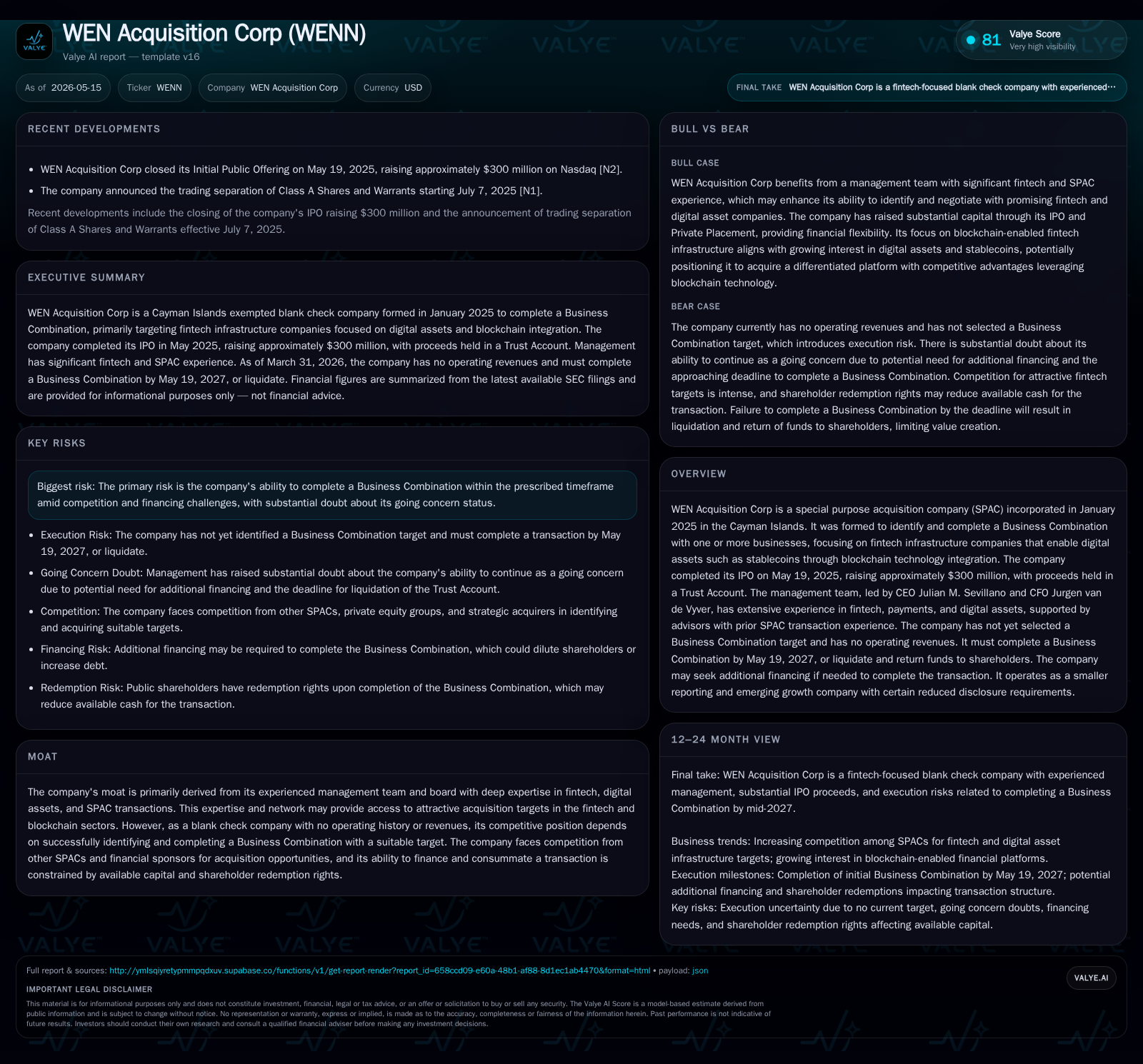
WEN Acquisition Corp, a fintech and digital asset-focused SPAC formed in early 2025, reported no operating revenues or business combination activities as of its latest 10-Q. With $300 million raised in its IPO and funds held securely in trust, its next critical milestone is identifying and completing an acquisition within two years before forced liquidation. The company’s competitive edge lies in seasoned management experienced in fintech and blockchain sectors but faces intense competition for attractive targets amid a crowded SPAC market. The highest risks include completing a deal within the mandate, managing shareholder redemptions, and securing any supplemental financing required.
Recent Operating Update: Latest Quarter Highlights
WEN Acquisition Corp’s latest quarterly filing on May 14, 2026 (Form 10-Q) confirms that the company remains a classic blank-check entity without any operating revenues or completion of a business combination to date [S2]. With the IPO having been completed on May 19, 2025, the Company still holds approximately $300 million raised from the offerings in trust. There have been no material changes in risk factors since initial filings, but management explicitly flagged "substantial doubt" about its ability to continue as a going concern if it cannot secure additional financing or consummate an acquisition prior to its May 2027 deadline [S2]. This frames the near-term urgency for the company’s strategic execution.
Business Model Overview
As a special purpose acquisition company (SPAC), WEN Acquisition operates with no commercial operations but as a capital vehicle to merge with one or more private fintech infrastructure companies specializing in blockchain-based digital asset enablement such as stablecoins [S1][S15]. Revenue generation and business metrics will only commence upon successful completion of its initial Business Combination (merger or acquisition). The company’s capital model revolves around deploying the trust-held proceeds—currently at about $300 million—and potentially additional financing to acquire or combine with a suitable growth-stage target that fits its fintech and blockchain thematic focus [S1].
The offering is structured solely around investor capital raised at IPO plus private placement warrants; there is currently no revenue source or other businesses under operation [S1]. Consequently, costs are limited mostly to legal, administrative, governance compliance, and pre-transaction expenses.
Industry Structure and Competitive Position
The fintech infrastructure space focused on digital assets like stablecoins is undergoing rapid evolution driven by regulatory pressures, technology innovation, and increasing institutional adoption. Targets typically include platform businesses with scalable blockchain integrations that can provide defensible solutions such as low-cost payments processing or tokenized asset management [S1].
WEN Acquisition’s moat primarily rests on its experienced management team led by CEO Julian M. Sevillano and CFO Jurgen van de Vyver who bring domain expertise in payments technology and digital assets. Their networks may afford identification of differentiated targets capable of sustained free cash flow generation with recurring revenue models favored by public markets [S1][S14]. However, as a blank check entity lacking operational assets, the company’s competitive position is inherently dependent on deal execution success.
Competition amongst SPACs targeting similar fintech niches is intense—multiple contemporaries pursue overlapping acquisition candidates. This competition elevates valuation levels and compresses the window for due diligence and negotiation. Additionally, shareholder redemption rights potentially reduce available cash for deals, constraining WEN Acquisition’s flexibility [S5].
Growth Drivers
Growth for WEN Acquisition is entirely contingent on identifying and successfully closing a Business Combination with a fintech infrastructure platform that possesses:
- Strong revenue visibility: Preferably recurring revenue streams maximizing efficient scale.
- Free cash flow generation: Ability to sustain margin integrity demonstrating financial stability.
- Scalable technology integration: Use of blockchain innovation facilitating competitive differentiation.
- Experienced management teams: Target companies must have proven leadership capable of running public companies post-merger.
Should WEN Acquisition consummate such a transaction ahead of its mandated deadline (May 19, 2027), growth modalities would shift toward executing the acquired entity’s operating strategy including leveraging public markets access for expansion capital—potentially encompassing equity issuance or strategic debt [S9].
Risks and Growth Constraints
The foremost risk confronting WEN Acquisition is its limited timeline to complete the initial Business Combination [S1]. Failure results in forced liquidation of Trust Account proceeds back to shareholders likely at par minus costs.
The company also carries "substantial doubt" about going concern status if unable to meet financing needs for merger-related costs amid pressure from these structural headwinds [S2].
What to Watch Next
Critical milestones for WEN Acquisition over the next twelve months include:
- Announcement of Business Combination Target(s): Identification and announcement will validate management’s ability to deploy capital against their fintech theme.
- Shareholder Vote Participation: If conducted, voting outcomes related to proposed mergers will reveal investor confidence.
- Financing Strategy Disclosure: Clarity on whether additional equity or debt capital will be raised concurrently with any transaction.
- Redemption Statistics: High redemption rates can impair deal economics while low redemptions imply shareholder alignment.
- Deal Closure Timeline: Tracking progress toward meeting the binding May 19, 2027 deadline is essential given prior risk warnings.
- Regulatory Compliance Updates: Any disclosures on governance readiness or SOX controls especially post-business combination phase.
These indicators will collectively influence perceptions of WEN Acquisition's capacity to transition from a shell vehicle into an operating public fintech infrastructure enterprise.
Financial Profile Briefly Contextualized
Latest financial snapshot
| Metric | Value | Period |
|---|---|---|
| Current assets | $532766 | |
| 2026-03-31 | ||
| Current liabilities | $189823 | |
| 2026-03-31 | ||
| Current ratio | 2.81x | |
| 2026-03-31 |
Source: SEC companyfacts cache [F1].
Despite being a non-operating blank check entity, WEN Acquisition maintains solid liquidity fundamentals given its trust-held IPO proceeds. As of March 31, 2026, current assets stood at approximately $532,766 while current liabilities were minimal at around $189,823 resulting in a current ratio of roughly 2.81—a strong short-term liquidity buffer supporting administrative costs pre-acquisition [F1].
Operating income or net income figures are not applicable as recurring operations do not exist yet; historical income figures reflect administrative expenses only [F1]. The financial structure reflects typical SPAC profiles where cash preservation until transaction closure remains paramount.
Conclusion
WEN Acquisition Corp embodies the typical challenges inherent in SPACs focused on specialized fintech infrastructure sectors. Its value proposition rests heavily on management’s domain expertise and access to promising blockchain-enabled platforms suitable for public market transformation. However, near-term execution risks tied to timing constraints and market competition are high.
Whether WEN can leverage its $300 million capital base effectively before May 2027 will determine if it can transition beyond a blank check vehicle toward creating long-term investor value through an operational fintech platform.
This analysis does not constitute investment advice or recommendations. It intends solely to provide an informed overview based on publicly available regulatory filings.
Disclaimer: This is research-only, informational analysis and not investment advice. It may include AI-generated interpretation and general industry context. Always verify important details using primary sources.

Comments