
Intrusion Inc. Struggles with Revenue Growth and Liquidity Despite Unique Zero Trust Offering
Intrusion’s latest quarter highlights operational challenges tied to government dependence and funding needs, overshadowing its proprietary cybersecurity technology.
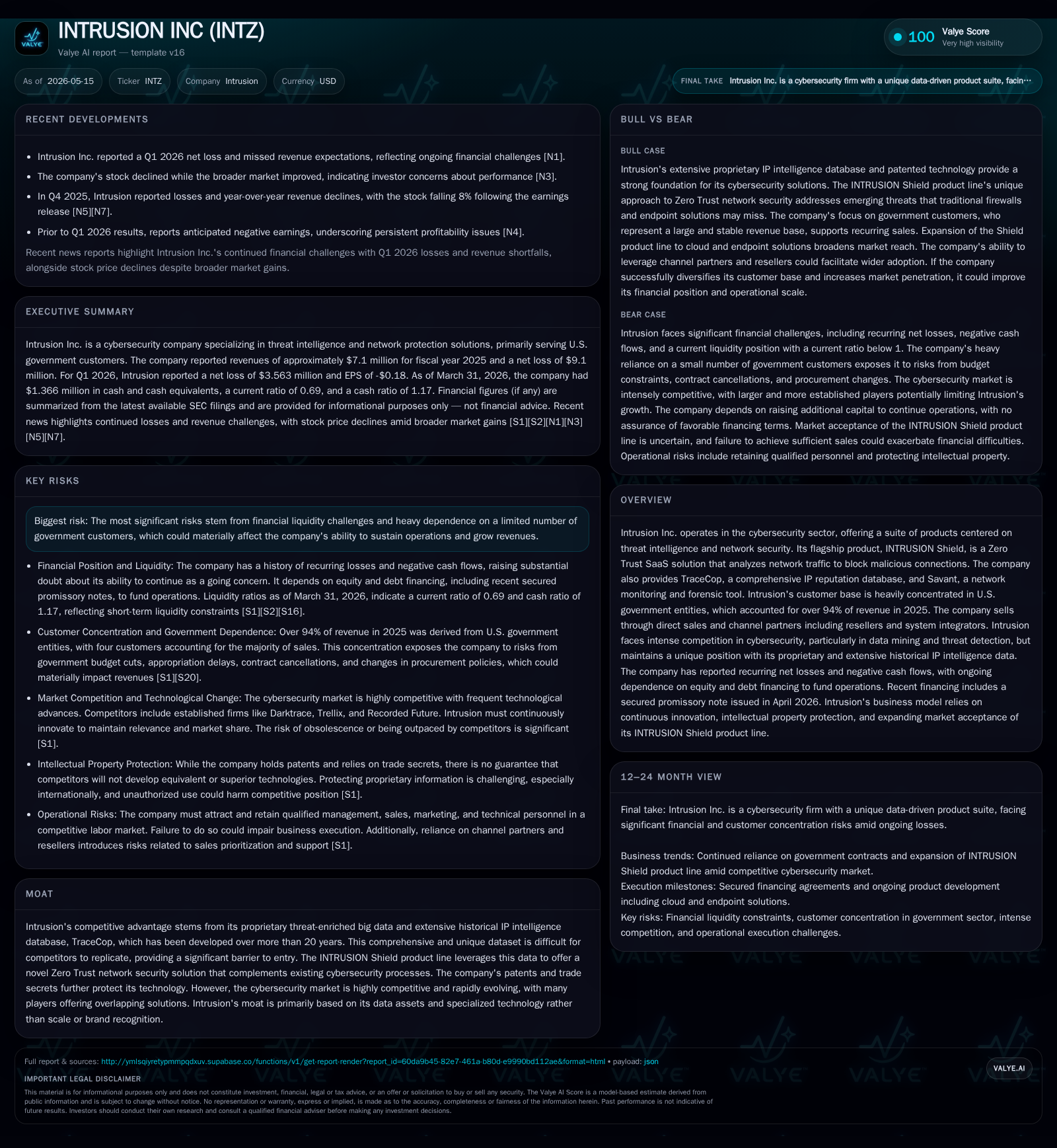
Intrusion Inc.’s 2026 Q1 results reveal ongoing struggles with revenue growth and liquidity, reflecting persistent net losses and negative cash flows despite incremental product expansion. The company’s business model centers on a Zero Trust SaaS solution leveraging a unique IP intelligence database, primarily serving U.S. government clients who account for the bulk of revenues. Intrusion faces pressure from concentrated customer exposure, competitive industry dynamics, and financing risks that cloud near-term growth prospects. While its proprietary data assets create competitive differentiation, operating scale and market adoption remain constrained. Key metrics to monitor include expansion beyond government contracts and capital raise success.
Recent Operating Update
Business Model
Intrusion develops cybersecurity solutions pivoted around its exclusive threat intelligence repository housing reputational data on over 8.5 billion Internet Protocol (IP) addresses accumulated over decades ([S8]). Its core product offering is INTRUSION Shield™, a proprietary Zero Trust Software as a Service (SaaS) platform designed to analyze network traffic in real time. This solution assesses both inbound and outbound network connections by inspecting IP addresses, domain details, ports used, and enriched threat intel to block malicious activities that typical firewalls may miss — especially zero-day exploits or malware-free breaches ([S19]).
The portfolio extends to TraceCop™, an IP reputation database considered among the company’s de facto moats due to its deep historical breadth that competitors find costly or practically impossible to replicate (). Additionally, Savant offers network monitoring coupled with forensic capabilities enhancing post-incident analysis.
Revenue generation depends largely on subscription sales of these software solutions bundled either directly to U.S. federal government clients or indirectly through an ecosystem of resellers and systems integrators ([S5], [S22]). Services including installation support and threat data interpretation form ancillary revenue streams but are not central drivers.
Industry Structure and Competitive Position
Intrusion operates within the saturated cybersecurity sector characterized by intense rivalry among well-capitalized incumbents offering data mining and threat detection tools (). The company’s relative differentiation arises from its exclusive big-data repository crafted over more than twenty years—a substantial intellectual property asset safeguarded by patents and trade secrets (, [S11]). This positions Intrusion uniquely in delivering reputational analysis embedded into its Zero Trust architecture.
Still, its limited commercial footprint compared to industry giants renders it vulnerable in indirect sales channels where resellers often favor larger vendors with broader recognized portfolios ([S5], [S22]). The fragmented nature of cybersecurity buyers — spanning defense agencies, civilian administrations, private enterprises — complicates scaling without broader brand awareness or expanded go-to-market investments.
Growth Drivers
Key growth initiatives focus on leveraging INTRUSION Shield’s evolving capability set — including recent launches such as Shield Cloud (protecting cloud-hosted infrastructure) and Shield Endpoint (endpoint device network protection) introduced since 2022 ([S19]). These expansions aim at addressing emergent cloud security demands growing across federal agencies.
More strategically consequential is broadening the concentrated customer base: while U.S. government entities accounted for roughly 94.6% of revenues in 2025 (up from 83.8% in 2024), Intrusion plans targeted expansion into civilian and administrative governments beyond traditional defense channels ([S1], [S18]). Concurrently growing indirect sales through value-added resellers (VARs), system integrators (SI), distributors aims to widen market coverage though competing vendor dynamics could dilute margins ([S5], [S22]).
Moreover, the company's proprietary data assets may enable differentiated analytics package upselling or customization that could boost pricing power if effectively monetized amid rising cyberthreat complexity.
Risks and Constraints
Several salient risks threaten Intrusion’s trajectory:
- Liquidity Concerns: Despite recent financings including a $3 million secured promissory note at onerous terms carrying an effective cost exceeding stated interest—plus fees—the company's cash position remains tight ($1.37 million as of March 31, 2026) against liabilities exceeding $2.88 million ([F1], [S20]). The firm carries no recorded debt besides this note but negative operating cash flow continues (~$6.8 million spent annually) raising going concern flags by auditors ([S1], [S11]).
- Customer Concentration: Heavy dependence on few U.S. government clients entails revenue volatility risks linked to changing federal budget priorities or contract cancellations which are possible with little penalty ([S7], [S18]). Such concentration impairs resilience against market or political shifts.
- Competitive Sales Environment: Reliance on non-exclusive reseller channels that also distribute larger competitor products presents prioritization hurdles potentially capping indirect channel growth or forcing unfavorable pricing concessions ([S5], [S22]).
- Talent Retention: Intense competition within cybersecurity labor markets threatens ability to hire/retain key technical personnel crucial for innovation continuity ([S18], [S21]).
- Market Penetration Timeframe: Newer INTRUSION Shield extensions targeting cloud workloads may require significant time for adoption thus elongating path toward scalable revenues ([S19]).
What To Watch Next
Critical indicators in upcoming quarters will include:
- Revenue trends outside established government contracts that would evidence diversification progress as intended.
- Backlog developments or large new contract wins signaling increased government or enterprise traction.
- Cash flow improvements or successful equity/debt raises improving liquidity runway.
- Monthly redemption activity under recently issued secured notes that might strain cash balances further given their structure ([S20]).
- Market feedback following continued rollout of Shield Cloud and Endpoint products impacting subscription uptake.
- Any changes in reseller relationships or channel strategies enabling tighter positioning versus competitors.
Financial Profile Summary
Latest financial snapshot
| Metric | Value | Period |
|---|---|---|
| Cash & equivalents | $1366000 | |
| 2026-03-31 | ||
| Total debt | 0 USD | |
| 2025-12-31 | ||
| Net debt | $-1366000 | |
| 2025-12-31 | ||
| Current assets | $2mm | |
| 2026-03-31 | ||
| Current liabilities | $3mm | |
| 2026-03-31 | ||
| Current ratio | 0.69x | |
| 2026-03-31 |
Source: SEC companyfacts cache [F1].
The firm faces execution-critical periods in next quarters aimed at reversing underwhelming top-line growth while managing liquidity constraints that question standalone viability without further capital infusions.
This analysis draws exclusively on publicly filed SEC documents through May 14, 2026 and does not constitute investment advice but aims to provide a comprehensive view of Intrusion Inc.'s business dynamics within its competitive cybersecurity niche alongside its financial condition and operational risks.
Disclaimer: This is research-only, informational analysis and not investment advice. It may include AI-generated interpretation and general industry context. Always verify important details using primary sources.

Comments