
Man AHL Diversified I LP Updates Strategic Outlook with Latest Quarterly Filing
The latest 10-Q highlights operational resilience amid volatility and evolving AI and regulatory risks for the systematic trading partnership.
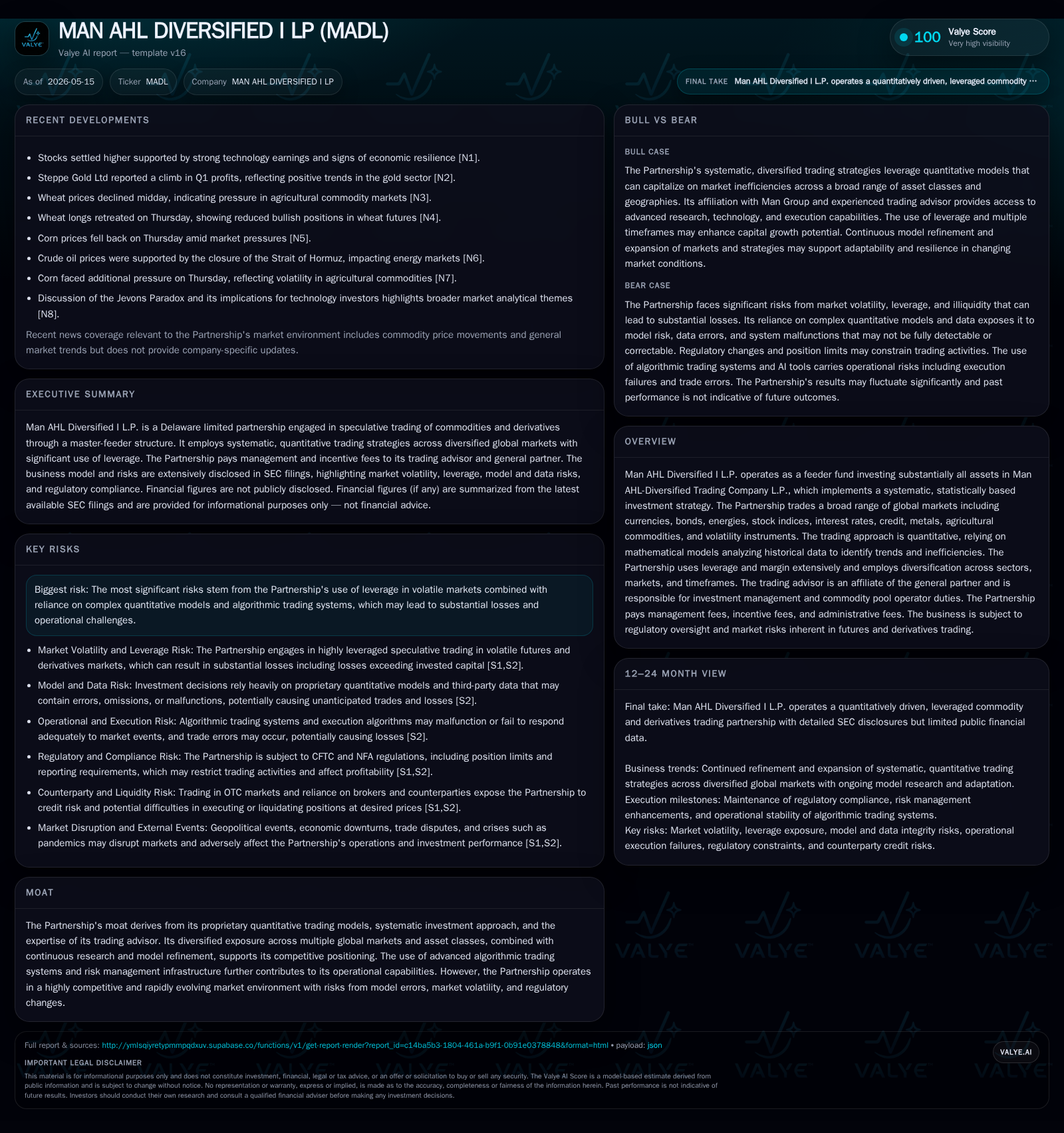
Man AHL Diversified I LP's Q1 2026 filing reaffirms its reliance on proprietary quantitative models and multi-asset diversification while emphasizing heightened market volatility and trade execution challenges. The partnership operates as a feeder fund into the master limited partnership executing systematic strategies across global futures, forwards, and derivatives markets. Its competitive edge stems from robust algorithmic infrastructure and ongoing research but remains vulnerable to leverage risks, model inaccuracies, and regulatory developments. Key growth opportunities include deeper AI integration and expanding access to new market inefficiencies, while operational constraints highlight illiquidity risks and speculative position limits.
Latest Quarterly Operating Update: What’s New
The May 14, 2026 quarterly report (10-Q) for Man AHL Diversified I LP foregrounds an operating environment characterized by amplified volatility triggered in part by ongoing tariff disputes between the United States and its major trading partners. The Partnership notes that these external trade frictions contribute to uncertain global economic dynamics that challenge execution efficiency across futures and forward markets. This volatility compounds typical difficulties associated with forecasting and implementing systematic investment signals derived from quantitative models.
The filing reiterates that while the Trading Advisor employs advanced algorithmic execution tools capable of rapid response to shifting conditions, limitations persist related to exchange-imposed "daily price fluctuation limits" and occasional illiquidity episodes. These factors can impede timely order fills at modeled prices, thus affecting overall strategy performance. Meanwhile, emerging incorporation of AI techniques is acknowledged as a strategic area of development but comes with inherent risks surrounding early-stage model reliability and security vulnerabilities—a critical cautionary note given the sophisticated nature of MADL's systematic operations.
Notably, no new material debt or capital structure alterations were disclosed in this quarter’s filing. The Partnership continues to operate within known structural risk boundaries anchored by leverage-sensitive positions prevalent in futures trading [S2][S3][S4].
Business Model and Investment Approach
Man AHL Diversified I LP operates primarily as a feeder fund channeling nearly all invested assets into Man AHL-Diversified Trading Company L.P., which directly executes a systematic investment approach. This structure segregates the operational trading strategy from investor-facing entity management.
The core investment methodology is founded on proprietary quantitative models that analyze vast historical data sets to detect persistent trends and temporary pricing inefficiencies across a comprehensive set of asset classes — currencies, bonds, equities indices, interest rates, credit instruments, metals, agricultural commodities, energies, and volatility products. Investment decisions emerge from mathematically driven signal generation rather than discretionary judgment.
Leverage is heavily utilized via low-margin requirements intrinsic to futures contracts alongside similar collateralized forward contracts and swaps to amplify returns on relatively modest capital bases. The Partnership incurs management fees on AUM plus incentive fees typically based on profits generated by the master fund’s performance—common in alternative liquid strategies like CTAs.
This fee structure aligns incentives but inherently amplifies return volatility due to leveraged exposure. Strict risk controls are integral to managing drawdown potential while seeking sustained alpha generation through disciplined diversification across sectors, regions, and time horizons. The Trading Advisor’s role encompasses not only model research but also execution oversight as commodity pool operator within this tightly integrated ecosystem [S1].
Competitive Position in Quantitative Systematic Trading
MADL’s moat lies principally in its proprietary quantitative models that have evolved through continuous refinement informed by extensive backtesting and live market feedback loops. This research-intense process ensures adaptability to shifting market regimes—a necessity given the rapid innovation cycles in systematic trading.
Sophisticated technological infrastructure supports ultra-fast algorithmic trade deployment balanced with real-time risk monitoring systems designed to mitigate losses stemming from unexpected market dislocations or software glitches. Such System Events are acknowledged as intrinsic risks owing to inevitable imperfections in complex model code or third-party data inputs.
Compared to peers within the CTA segment of alternative asset management—ranging from boutique quant shops to large multi-billion-dollar hedge funds—MADL leverages multi-asset class breadth providing diversified alpha sources that help temper correlation-driven drawdowns common in narrower strategies.
Nevertheless, competition remains fierce as numerous market participants deploy similar trend-following algorithms or adaptive AI-based strategies competing for limited mispricings. Regulatory impacts like MiFID II’s compliance costs further raise barriers but also favor larger operators like MADL equipped with resources for requisite oversight [S7][S13].
Industry Dynamics and Operational Environment
Systematic futures trading occupies a demanding niche within global financial markets governed by strict exchange rules including daily price movement caps (daily limits) which can suppress liquidity during periods of extreme price swings. These regulatory mechanics introduce execution complexity when large positions must be adjusted quickly—as premature liquidation can crystallize losses inflated by unfavorable pricing.
Moreover, increasing regulation of OTC derivatives markets under protocols such as EMIR (Europe) and Dodd-Frank reforms has heightened clearinghouse margin requirements and introduced mandatory trade reporting aimed at transparency but simultaneously increasing transaction costs. For funds like MADL engaging heavily in non-exchange-traded swaps or currency forwards, this raises counterparty credit scrutiny alongside operational overheads.
Geopolitical turmoil feeding into tariff impositions adds further layers of unpredictability influencing volatility cycles beyond typical economic fundamentals. Thus systemic quant programs must continuously recalibrate signal weighting versus fundamental shocks while maintaining a nimble infrastructure able to shift buffers or hedge structures rapidly [S5][S8].
Growth Drivers and Strategic Opportunities
A principal growth vector resides in enhanced artificial intelligence toolsets increasingly incorporated into signal derivation processes despite attendant technical risks flagged by management (System Events linked to nascent AI errors). CAREFUL CONTINUAL RESEARCH INVESTMENTS position MADL advantageously should these tools mature reliably.
Additionally expanding geographical reach into emerging economies’ futures markets could unlock fresh inefficiency pockets presently underexploited due to less crowded trade arenas or newer sovereign bond instruments gaining liquidity. Expanding product spectrum especially around volatility derivatives might offer profitable diversification complementary to existing trend signals.
Investor appetite for liquid alternatives continues steady growth underpinning capital inflows into well-established quantitative managers who exhibit operational transparency combined with robust risk-adjusted performance histories fostering long-term commitments [S6].
Risk Factors and Market Constraints
The business contends with substantial risk vectors: use of high leverage mandated by low initial margins means modest adverse price moves can erase entire margin deposits swiftly or induce losses exceeding invested capital volumes.
Dependency on mathematical Models exposes MADL to data quality issues or coding faults potentially undetected over long periods—averaging out only after significant drawdowns ensue. Trading system malfunctions present operational hazards intensified during fast-moving market events when human intervention might lag or prove ineffective.
Market illiquidity events triggered by exchange circuit breaker activations halt price discovery exacerbating exit difficulties particularly for options or thinly traded contracts. Regulatory ceilings on net speculative position sizes limit potential investment scale or force untimely liquidations reducing optimal portfolio construction flexibility.
Counterparty credit risk is nontrivial given sizable OTC derivatives exposure amid varying degrees of dealer solvency foundations internationally—necessitating stringent counterparty vetting yet residual default probability remains [S2][S13].
Key Milestones and What to Watch Next
Future quarterly reports will be instructive regarding NAV trends reflecting how effectively MADL navigates current volatility regimes alongside incremental AI integration outcomes influencing signal quality metrics.
Investors should watch for commentary on regulatory interpretations particularly relating to OTC clearing obligations which might reshape cost structures or permissible strategies abruptly. Monitoring redemption activity offers clues on confidence levels amidst earnings season macro narratives shaping sector rotation patterns.
Trade execution metrics including fill rates around daily limit events will further reveal platform robustness under stress scenarios crucial for sustained competitive edge amid fluctuating liquidity pulses globally [S2][S6].
Brief Financial Profile and Capital Considerations
Financial disclosures do not report substantive changes in capital posture since last annual review; operating income reflected net losses consistent with prior years linked mainly with market-driven fluctuations rather than structural impairments [F1].
It does not constitute investment advice or recommendations.*
Disclaimer: This is research-only, informational analysis and not investment advice. It may include AI-generated interpretation and general industry context. Always verify important details using primary sources.

Comments