
Ashford Hospitality Trust Faces Refinancing Pressure Amid Strategic Asset Sales
The latest quarterly update highlights Ashford’s ongoing liquidity challenges and strategic repositioning through hotel dispositions.
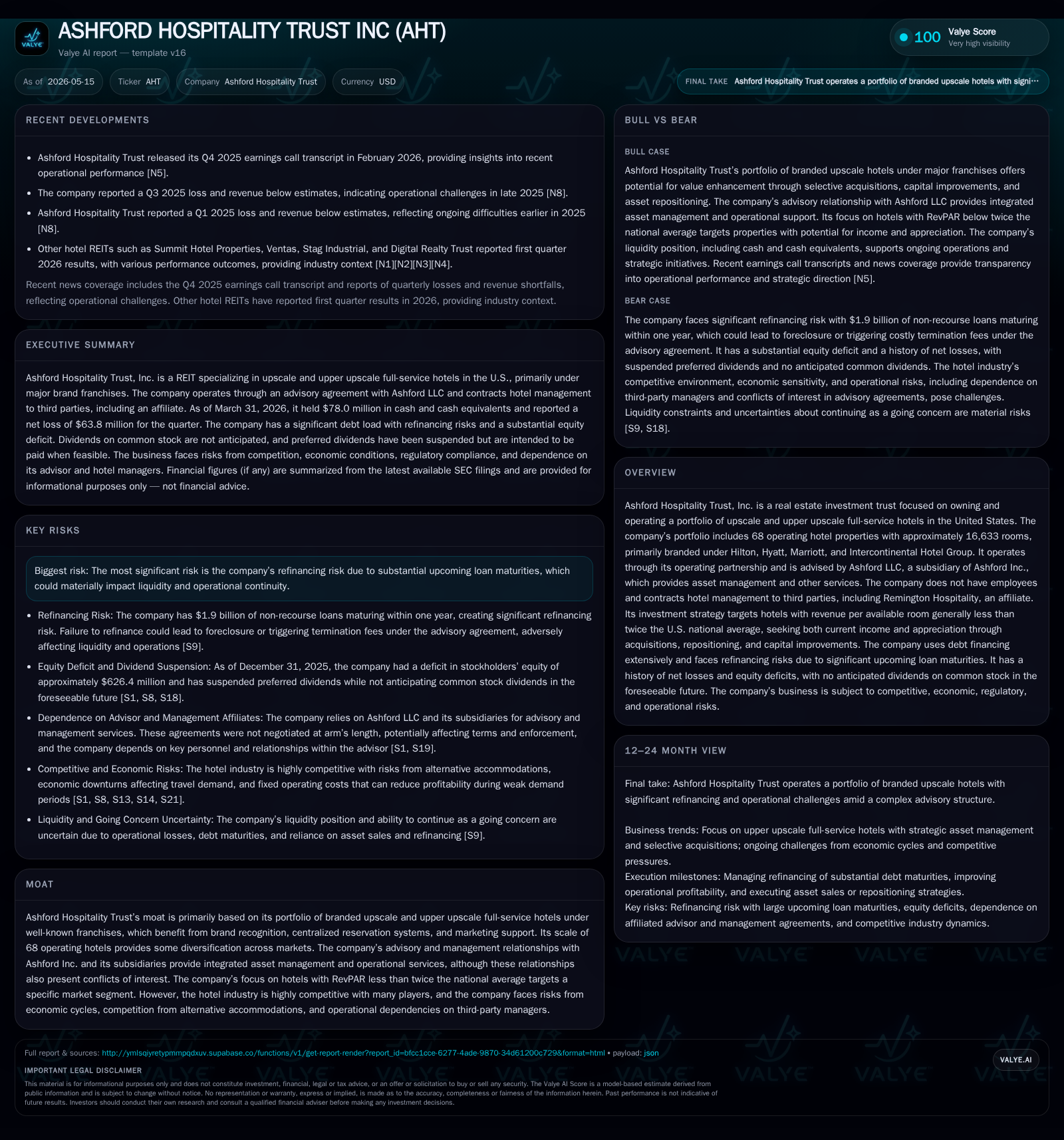
Ashford Hospitality Trust’s Q1 2026 filing reveals persistent refinancing risks driven by substantial near-term debt maturities and elevated variable-rate debt. The company continues to pursue asset sales, having recently divested multiple properties to bolster liquidity. Its portfolio focuses on upscale full-service hotels operated under major brands, managed predominantly by Remington Hospitality. While the business model leverages branded scale and third-party management, Ashford faces structural challenges from debt load, cash trap provisions, and cyclical sensitivity of its upper-upscale lodging segment. Strategic growth depends on successful refinancing and capital preservation amid industry competition and regulatory complexities.
Recent Operating Update
Ashford Hospitality Trust’s latest quarterly filing for Q1 2026 [S2] reiterates prior disclosures concerning the company's significant refinancing risks and liquidity uncertainties without identifying new risk factors. The sizeable $2.59 billion property-level debt load remains heavily weighted toward variable interest rates (~$2.4 billion) [F1], maintaining sensitivity to rising rates as noted in the annual filings [S4][S6]. To mitigate these pressures, Ashford has actively engaged in divesting assets; recent filings confirm sales closure for four hotels and definitive agreements for an additional two properties totaling over $130 million in cash proceeds [S16][S25]. These dispositions support the firm’s strategy of preserving liquidity during looming loan maturities concentrated within the next twelve months [S4][S13].
Management also continues to emphasize operational focus on its portfolio of full-service upscale and upper-upscale hotels primarily franchised under esteemed brands such as Hilton, Hyatt, Marriott, and Intercontinental Hotel Group (IHG) [S1][S12]. Despite maintaining scale across 68 properties and roughly 16,633 rooms [S1], the company is constrained by leasing arrangements with taxable REIT subsidiaries that engage third-party operators for hotel management, principally Remington Hospitality managing 50 hotels, with the remainder managed by external parties [S1][S12]. As a REIT, Ashford must adhere to dividend distribution requirements but has suspended dividends on common shares and preferred stock for 2026 while assessing liquidity improvements [S11].
Business Model
Ashford Hospitality Trust generates revenue indirectly through ownership interests in hotel real estate assets operating within a REIT framework that imposes certain income distribution rules and operating limitations. Its portfolio focuses on upscale full-service hotels where revenue per available room (RevPAR) is generally less than twice the U.S. national average, aiming to achieve returns via acquisitions, repositioning capital expenditures, and operational enhancements [S1]. Services traditionally handled internally are instead outsourced; Ashford employs no employees itself but contracts asset management services from Ashford LLC (advisor), an Ashford Inc. subsidiary, which also provides ancillary offerings including design and construction oversight, insurance procurement, brokerage services, and debt placement support [S1][S12]. Hotel operations are under long-term management contracts with Remington Hospitality acting as manager for most properties.
Revenue is driven primarily through occupancy rates multiplied by average daily room rates (ADR), modulated by brand strength that supports pricing power within competitive markets. The reliance on third-party managers introduces operational dependencies but also limits direct operating risk. Properties subjected to cash traps—where most operating profits are diverted directly to lenders due to performance triggers—reduce available distributable cash flow and complicate liquidity management [S13]. Capital recycling through selective dispositions supplements organic EBITDA generation as a vital source of working capital.
Industry Structure and Competitive Position
Operating exclusively in the U.S., Ashford sits among myriad publicly traded and private hotel investment trusts targeting mid-to-upper market segments dominated by large global chains. Its portfolio branding with Hilton, Hyatt, Marriott, and IHG offers access to broad centralized reservation systems and marketing channels essential in this fragmented but highly competitive industry where location convenience, service quality, price competitiveness, and brand affiliation heavily influence customer choice [S8][S18].
However, competition extends beyond traditional hotels: select-service offerings provide lower-cost alternatives attracting price-sensitive leisure travelers especially during economic slowdowns; meanwhile platforms like Airbnb amplify pressure via alternative accommodations disrupting demand patterns [S8][S18]. Ashford’s upper-upscale focus generates higher ADR but correspondingly heightened vulnerability during downturns when corporate travel budgets contract or consumer discretionary spending withdraws [S1][S22]. The firm also faces intricate governance dynamics given conflicts of interest inherent in its advisory relationships with affiliated entities controlling property management functions.
Growth Drivers
Ashford’s growth prospects depend chiefly on refining its capital structure amidst impending debt maturities approaching $1.9 billion within one year post-December 2025 [S16][S13], coupled with improving operational efficiencies at owned hotels. Key drivers include:
- Successful Refinancing or Restructuring: Diluted liquidity positions make timely refinancings indispensable. Lower interest costs or extended maturities would free cash flows otherwise trapped in debt servicing.
- Strategic Asset Sales: Continual disposition of non-core or mature assets provides liquidity injections enabling capital redeployment into accretive acquisitions or capital improvements.
- Capital Improvements & Repositioning: Enhancements targeting revenue growth via service level upgrades or renovation create potential RevPAR growth above targeted thresholds.
- Operational Optimization: Leveraging affiliated asset management expertise to contain costs enhances margins despite cyclical demand variations.
- Market Recovery & Demand Trends: Performance correlates with macroeconomic trends including GDP growth driving corporate travel demand along with leisure travel stability.
Indeed, active management of assets under value-add strategies interspersed with opportunistic market timing provides flexibility but depends greatly on unencumbered capital access.
Risks and Watchpoints
While offering scale benefits through brand affiliation and diversification across markets, Ashford confronts material risks:
- Substantial Refinancing Risk: The concentration of near-term loan maturities combined with high variable-rate debt exposes Ashford to interest rate volatility and refinancing headwinds particularly if credit availability tightens or market conditions deteriorate [S4][S13].
- Cash Trap Provisions: Nearly two-thirds of properties are locked into lender-controlled cash traps limiting distributable income until performance improves or waivers negotiated [S13].
- Cyclical Demand Sensitivity: Upper-upscale hotel segments typically endure sharper revenue declines during economic downturns affecting occupancy and ADR negatively [S1][S22].
- Competitive Pressures from Alternative Lodging: Non-traditional options including short-term rentals erode market share among certain traveler demographics increasingly cost-conscious.
- Advisory Relationship Conflicts: Affiliations with Ashford Inc.’s subsidiaries introduce potential divergent interests affecting decision-making fidelity versus minority shareholders’ expectations.
- Regulatory Compliance Costs: Ongoing regulatory requirements such as ADA compliance entail unplanned capital outlays impacting profitability.
- Dividend Suspension Impact: Suspension of dividends reflects caution yet may reduce investor appeal impacting stock liquidity or valuation dynamics.
What to Watch Next
Key milestones for monitoring Ashford’s trajectory include:
- Announcements regarding debt refinancing outcomes or maturity extensions covering large property loans maturing over next quarters.
- Updates on proceeds utilization from hotel asset sales reflecting progress in liquidity stabilization.
- Any modification to dividend policies indicating shifting confidence in operational cash flows.
- Quarterly changes in occupancy rates, ADRs, RevPAR metrics signaling improvements or deterioration in core operational KPIs.
- Developments relating to management agreements especially any renegotiations improving operational flexibility.
- Litigation resolutions particularly wage-hour litigation involving management contractors affecting reputational risk exposure.
- Market conditions influencing borrowing costs which can materially affect interest expense burden evidencing margin pressure trends.
Financial Profile (Brief)
Latest financial snapshot
| Metric | Value | Period |
|---|---|---|
| Cash & equivalents | $66mm | |
| 2025-12-31 | ||
| Total debt | $2.6bn | |
| 2025-12-31 | ||
| Net debt | $2.5bn | |
| 2025-12-31 |
Source: SEC companyfacts cache [F1].
As of December 31, 2025, Ashford held approximately $66 million in cash equivalents against total property-level debt nearing $2.59 billion resulting in net debt around $2.52 billion [F1]. Operating income was positive at $116 million whereas net income reflected a loss of approximately $180 million attributable largely to financing costs and non-cash impairments linked with challenging market conditions [F1]. The dominance of variable rate loans underscores ongoing exposure to rate hikes amid tightening monetary policy cycles leading into 2026 [S4][S10]. Dividend distributions on common shares were suspended along with preferred stock dividends as board assessments target cash preservation amid uncertain refinancing prospects [S11].
Disclaimer: This is research-only, informational analysis and not investment advice. It may include AI-generated interpretation and general industry context. Always verify important details using primary sources.

Comments