
COMPASS Pathways Advances Psilocybin Therapy with Pivotal Trial Success and Strong Liquidity
Latest quarterly filings underscore progress in Phase 3 trials for COMP360, positioning COMPASS Pathways at the forefront of psychedelic mental health treatments.
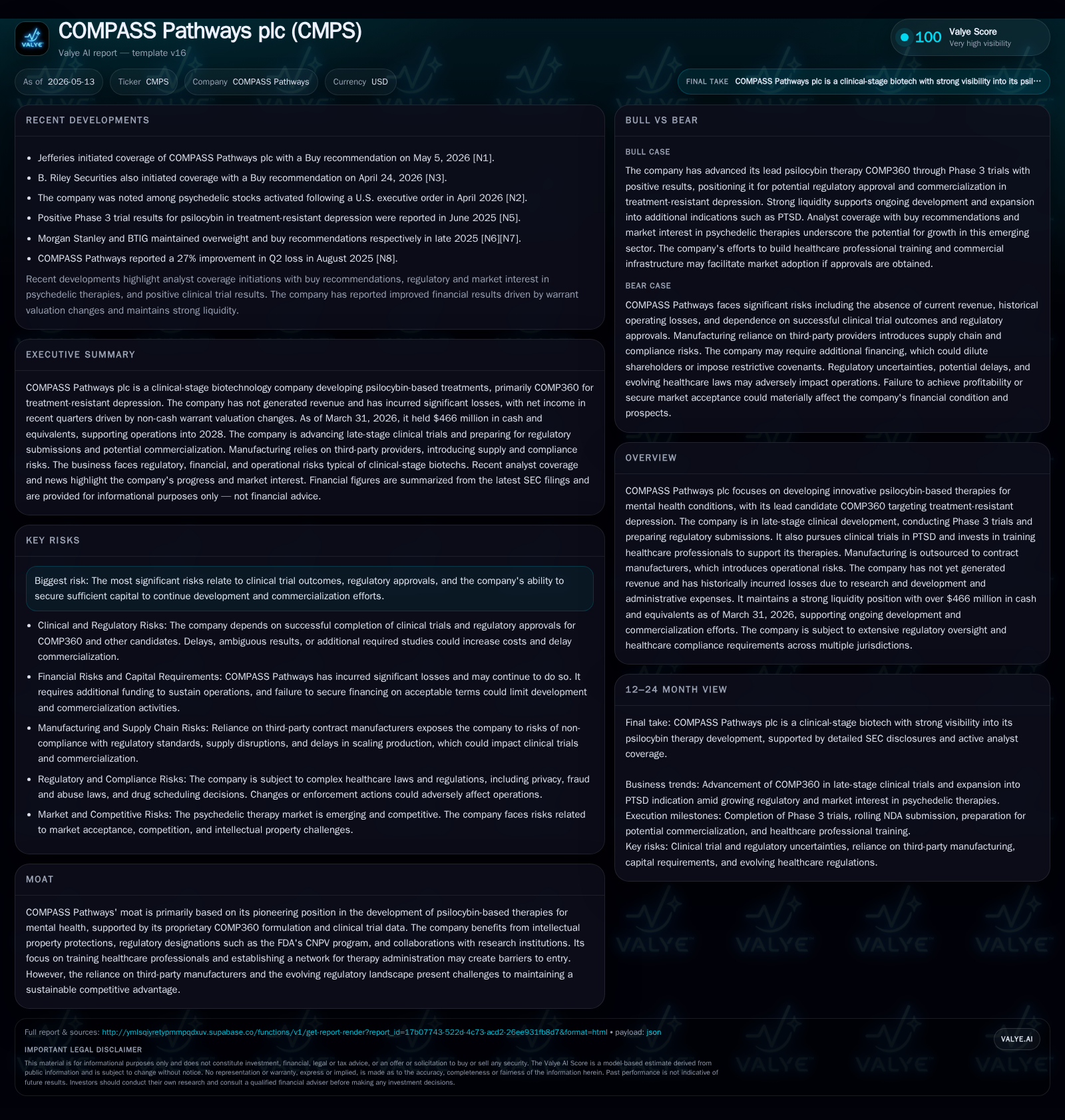
COMPASS Pathways plc reported significant advancements in its late-stage clinical development of COMP360, a proprietary psilocybin formulation targeting treatment-resistant depression (TRD). The first Phase 3 pivotal trial met primary endpoints with robust statistical significance, reinforcing its potential as a novel mental health therapy. Despite not generating revenue yet, COMPASS maintains strong financial health with over $466 million in cash and manageable debt, supporting ongoing development and commercialization preparations. The company faces evolving regulatory hurdles and operational risks related to third-party manufacturing and healthcare compliance but benefits from intellectual property protections and an emerging network for therapy administration.
Recent Operating Update
COMPASS Pathways plc’s latest quarterly filing (10-Q dated May 13, 2026) provides critical insights into its current operating status. Notably, the company reported net income of $91.2 million for Q1 2026 compared to a net loss of $17.5 million in the same quarter last year. This gain primarily derives from non-cash fair value changes related to warrant liabilities rather than operational profitability, indicating continued fundamental operating losses driven by research and development (R&D), regulatory efforts, and administrative overheads [S2].
Importantly, the first pivotal Phase 3 trial (COMP005) evaluating their lead investigational compound COMP360 achieved its primary endpoint measuring reduction in symptom severity of treatment-resistant depression (TRD) using the Montgomery-Åsberg Depression Rating Scale (MADRS). This trial demonstrated a highly statistically significant improvement with a clinically meaningful difference at six weeks following a single 25 mg dose versus placebo (p<0.001; -3.6 change in MADRS score) [S1]. The second pivotal trial (COMP006), investigating repeat dosing regimens is ongoing.
The company also underscored strategic prioritization around advancing COMP360 exclusively after halting other preclinical psychedelic therapeutic programs. This realignment concentrates financial resources and management focus on late-stage development and eventual commercialization preparations including the scaling of manufacturing capacity and healthcare provider training programs [S1].
Business Model
COMPASS Pathways operates as a clinical-stage biotechnology firm specializing in the development of psilocybin-based therapeutics aimed at addressing mental health conditions inadequately served by existing treatments. The core of its revenue model will eventually hinge on successfully obtaining regulatory approvals for COMP360 — their proprietary polymorphic crystalline psilocybin formulation designed for stability and high purity — followed by commercial sales of the drug coupled with service offerings.
Revenue generation is projected from multiple streams:
- Direct sale or licensing of the COMP360 drug product to healthcare providers or networks.
- Establishment of Centers of Excellence that administer treatments requiring professional monitoring post-dosing.
- Training programs targeted at healthcare professionals skilled in delivering psilocybin-assisted therapies.
The company currently does not generate revenue; expenses accrue chiefly from expansive R&D activities including clinical trial execution, regulatory interactions, and intellectual property maintenance.
Margins are expected to evolve post-commercial launch depending on manufacturing cost efficiencies — currently outsourced to contract manufacturers — pricing power constrained by payor negotiations and government regulation, and the scalability of treatment centers. High initial fixed costs related to infrastructure buildout present challenges while intellectual property rights provide pricing latitude contingent on competitive entrants.
Industry Structure and Competitive Position
COMPASS sits within an emergent biopharmaceutical niche focused on psychedelic compounds for neuropsychiatric conditions—a market characterized by increasing scientific validation but also considerable regulatory ambiguity. Its position is reinforced by:
- Early pioneering status with the first major FDA Breakthrough Therapy designation granted for psilocybin treatment in TRD.
- Comprehensive clinical data from Phase 2b/3 studies notably published in respected medical journals enhancing credibility.
- Proprietary pharmaceutical-grade formulation differentiating it from generic or research-grade psychedelics.
- Investments in ecosystem development including healthcare professional training and administration site networks creating barriers to entry.
However, competition is emerging from new biotech entrants exploring psychedelic molecules, large pharmaceutical firms investing via acquisitions or partnerships, plus academic research institutions advancing alternative modalities.
Moreover, reliance on third-party contract manufacturers introduces supply chain vulnerabilities amid global capacity constraints common in specialty pharmaceutical ingredients. Regulatory complexity compounds challenges given varying international controlled substance schedules affecting market access timelines.
Growth Drivers
Clinical Validation and Regulatory Approvals
Successful demonstration of safety and efficacy through rigorous Phase 3 data drives near-term regulatory submissions—including New Drug Applications (NDAs)—that underpin commercial launch pathways. Continued positive trial results can expand label scope beyond TRD into PTSD or other mental illnesses elevating addressable markets.
Market Expansion Through Provider Network Development
Scaling the number of trained therapists capable of administering psilocybin-assisted therapy is vital to adoption. The buildout of Centers of Excellence dedicated to this purpose not only facilitates patient access but also entrenches COMPASS’s ecosystem advantage.
Commercial Infrastructure Scaling
Establishing sales force competencies, payer engagement teams for reimbursement negotiation, along with supply chain scale-up via contract manufacturers supports revenue realization post-approval.
Intellectual Property Portfolio Maintenance
Robust patent protection over their unique psilocybin crystal form sustains market exclusivity enabling premium pricing strategies against generic entrants.
Risks / Watchpoints / Growth Constraints
Regulatory Uncertainty and Scheduling Risks
Potential delays or restrictive DEA scheduling classifications could limit product availability or necessitate complex Risk Evaluation Mitigation Strategies (REMS).
Reimbursement Challenges
Given psychedelics represent novel therapeutic classes, securing favorable coverage from insurers remains uncertain; payor reluctance or high patient co-pays could constrain demand penetration [S10].
Manufacturing Dependency and Capacity Constraints
Outsourcing compounding introduces risk around quality control failures or production delays which can disrupt clinical supply or commercial scale launches.
Healthcare Compliance Costs
Strict adherence to privacy regulations such as HIPAA alongside fraud-and-abuse statutes increases operational overhead; any violations may incur penalties or reputational harm [S4], [S12].
Capital Needs Versus Operating Losses
Continued material operating losses necessitate further capital raises or debt funding despite current liquidity; financing terms may become onerous if pipeline progress slows or macroeconomic sentiment weakens [S2].
Clinical Trial Risk Beyond Initial Indications
Failure in late-stage trials for PTSD or other indications could impair expansion prospects; early results imply efficacy but confirmatory evidence is pending.
What To Watch Next
- Completion reports from pivotal Phase 3 trial COMP006 assessing repeat dosing regimen effectiveness.
- Submission timelines and acceptance by FDA/EMA for NDA filings targeting TRD indication.
- Progress updates toward scaling manufacturing capacity supportive of commercial launch needs.
- Expansion/partnering agreements related to implementation of Centers of Excellence network domestically and internationally.
- Updates surrounding DEA scheduling outcomes or state-level approvals impacting distribution channels.
- Financial disclosures on burn rate trajectory relative to cash balances demonstrating runway sufficiency.
- Regulatory developments impacting reimbursement policies specific to psychedelic therapies informed by legislative or CMS actions.
Financial Profile Summary
Latest financial snapshot
| Metric | Value | Period |
|---|---|---|
| Cash & equivalents | $466mm | |
| 2026-03-31 | ||
| Total debt | $50mm | |
| 2026-03-31 | ||
| Net debt | $-416mm | |
| 2026-03-31 | ||
| Current assets | $511mm | |
| 2026-03-31 | ||
| Current liabilities | $154mm | |
| 2026-03-31 | ||
| Current ratio | 3.32x | |
| 2026-03-31 |
Source: SEC companyfacts cache [F1].
COMPASS’s balance sheet as of March 31, 2026 shows robust liquidity with cash & equivalents totaling approximately $466 million against total debt near $50 million resulting in a net cash position exceeding $416 million. Current assets stand around $511 million versus current liabilities approximately $154 million yielding a healthy current ratio (~3.32) indicative of strong short-term financial stability supporting ongoing operations without imminent liquidity risk [F1], [S2].
Operating expenses remain heavy due to high R&D outlays consistent with advanced clinical development phases; accordingly no revenues are recorded yet though investment continues toward commercial readiness. The company acknowledged recurring operating losses despite episodic net income occurrences tied to warrant liability revaluations which do not reflect sustainable profitability sources [S2].
In January 2026, COMPASS amended its loan agreement raising total allowed borrowing capacity up to $150 million with staged tranche releases conditional upon achievement milestones—demonstrating proactive capital planning aligned with pipeline progress assumptions [S11].
Disclaimer
This analysis is based exclusively on publicly available information as cited herein through SEC filings and credible news sources up to May 13, 2026. It does not constitute investment advice or recommendations regarding any securities mentioned. Readers should consider multiple aspects including regulatory developments, clinical data evolution, market dynamics, and corporate governance before forming any conclusions about COMPASS Pathways plc.
Disclaimer: This is research-only, informational analysis and not investment advice. It may include AI-generated interpretation and general industry context. Always verify important details using primary sources.

Comments