
Tavia Acquisition Corp. Eyes Sustainability Through Strategic SPAC Approach
The latest quarterly filing underscores Tavia's ongoing search for targets and financial readiness to capitalize on sustainability-focused opportunities.
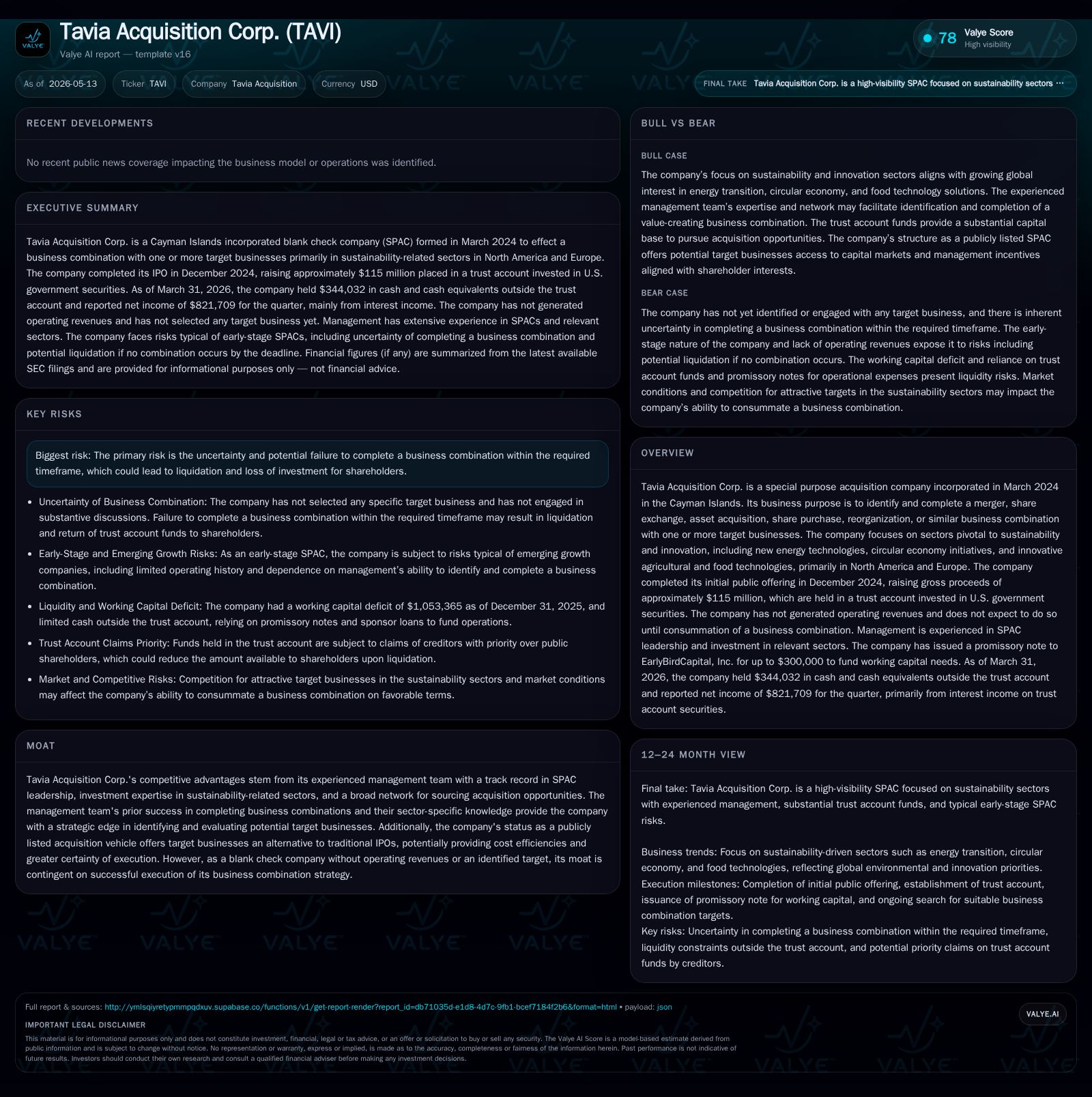
Tavia Acquisition Corp. remains without a selected business combination target as of its Q1 2026 report but retains a strong cash position supported by its trust account and recent promissory note facility. Its SPAC model zeroes in on sectors critical to energy transition, circular economy, and innovative agriculture technologies primarily in North America and Europe. The company's competitive edge hinges on experienced management and a niche investment thesis that may reduce direct competition but also narrows target availability. Time-sensitive execution risks persist given the absence of an announced deal within its defined timeframe.
Latest Quarterly Report: Status Update and Implications
Tavia Acquisition Corp.’s most recent SEC filing dated May 12, 2026 (10-Q) reveals that as of the end of Q1 2026, the company has not selected any target for its initial business combination nor engaged in substantive discussions regarding acquisition possibilities [S2]. This maintains status quo from prior filings while emphasizing the company’s continued focus on searching for suitable targets aligned with its sustainability-oriented mandate.
A notable development during this quarter was the issuance of a non-interest-bearing promissory note for up to $300,000 from EarlyBirdCapital (EBC), intended as short-term liquidity to support operational expenses while searching for a target [S2][S6]. The note becomes payable upon consummation of a business combination or liquidation if no deal is completed. This arrangement reflects prudent financial management amid ongoing cost incurrence without corresponding revenues.
The absence of an announced or identified target at this stage is material because SPACs operate under fixed timelines to close deals—failure to do so triggers mandatory liquidation which negatively impacts shareholder value. Nonetheless, Tavia retains a sizeable capital base sheltered in its trust account raised through its Initial Public Offering (IPO) activities completed in December 2024, totaling approximately $115 million gross proceeds held safely in U.S. government securities equivalents [S1][S6]. This substantial runway funds robust search efforts while limiting downside risk prior to deal announcement.
Business Model: A Blank-Check Vehicle Targeting Sustainability and Innovation
As a Special Purpose Acquisition Company (SPAC), Tavia functions as a blank-check vehicle incorporated in the Cayman Islands specifically to acquire one or more businesses through merger or similar transactions [S1]. It has not generated operating revenues because it has not yet completed a business combination; its income thus far derives from interest earned on trust account investments.
Tavia differentiates itself through a focused investment thesis targeting companies active in sustainability-related sectors: energy transition technologies (including new energy and critical materials), circular economy initiatives such as recycling infrastructure and biobased materials, and innovative agricultural/food technologies primarily domiciled in North American and European markets [S4]. This sector specialization aims to leverage growing global environmental concerns, regulatory tailwinds, demographic changes, and technological evolution fostering sustainable practices.
The company's IPO raised about $115 million at $10 per unit through public placement paired with private placements to sponsors, which are held in trust pending completion of acquisition(s) [S1][S6]. These funds provide capital to consummate deals combining cash with equity or debt instruments if deemed appropriate. Management's role centers on sourcing attractive targets matching defined criteria: strong management teams aligned with investors’ interests; clear revenue and earnings growth potential; strategic capability enhancement; and ability to benefit from public market access post-acquisition [S5].
Operationally, the company incurs administrative expenses related primarily to being publicly listed plus costs tied to due diligence and pursuit of merger candidates [S1]. Because it lacks operating revenue streams, margins are currently negative driven by these overhead outlays until combined.
Competitive Positioning and Industry Context for SPACs Focused on Green Tech
Tavia occupies an increasingly specialized niche within the broader SPAC universe by concentrating on the sustainability innovation vertical. This focus potentially reduces competitive bidding against generalist SPACs but simultaneously narrows the available pool of attractive targets meeting stringent investor expectations for growth profile, ESG compliance, scalable technologies, and geographic presence.
Targets in sectors like renewable energy materials supply chains (critical minerals like lithium or cobalt), circular economy platforms deploying advanced recycling processes or product-as-service models, and agri-food tech innovations benefit from accelerating regulatory mandates aimed at carbon neutrality and resource efficiency globally. However, these industries face challenges such as supply chain fragility for critical substances, evolving standards that may affect product certification costs, plus valuation complexity for early-stage companies without extensive track records.
The alternative path Tavia offers to prospective targets—going public via a SPAC merger rather than a traditional IPO—is positioned as providing valuation arbitrage benefits including lower underwriting costs, reduced market timing uncertainty, and access to expertise embedded within the sponsor team familiar with sustainable sector nuances. Nevertheless, pricing power for such transactions depends heavily on prevailing market sentiment toward green tech equities plus underlying asset quality.
Growth Drivers: Market Trends Favoring Eco-Friendly and AgriTech Investments
Macro-level tailwinds driving demand for businesses aligning with Tavia’s investment themes include tightening environmental regulations pushing decarbonization across industrial sectors; heightened consumer preference for sustainably sourced products; demographic shifts increasing food security emphasis; and global efforts incentivizing circular material flows over linear waste models [S1].
Specifically:
- Energy transition dynamics foster growth in renewable project developers, critical raw material processors supporting battery/electric vehicle supply chains.
- Circular economy expansion supports companies innovating in advanced materials recovery techniques or launching durable product-service offerings extending lifecycle value.
- Agri-food technology revolution stimulates emergence of novel biological inputs, controlled environment agriculture solutions that promise enhanced yield resilience amid climate challenges.
While quantifiable KPIs at this stage are limited due to lack of operational ownership over any asset yet, these industry trajectories create a robust pipeline of potential targets demonstrating revenue scalability foundations essential to Tavia’s criteria.
Risks and Watchpoints: Time Pressure and Execution Uncertainty
The foremost risk confronting Tavia remains its failure or inability to consummate a qualifying business combination within mandated deadlines (generally two years post-IPO), which obliges liquidation of trust assets at redemption value causing investors’ capital loss or minimal recovery [S2]. This timeline constraint imposes urgency that conflicts with the demands of identifying high-quality sustainability-focused targets meeting complex financial reporting standards required by SEC proxies.
Operationally, cost drag from ongoing administrative expenses without offsetting revenue continues while management devotes resources toward sourcing targets; reliance on relatively modest external financing arrangements like the EBC-promissory note exemplify constrained working capital outside trust funds [F1][S2].
Additionally:
- The diligent requirement that acquisition candidates provide audited financial statements conforming with U.S.
Given no active discussions were reported as of Q1 filing date and no newly disclosed deals since IPO completion nearly eighteen months ago [S2], progress toward binding agreements remains a critical watchpoint ensuring compliance with regulatory timing requirements.
Financial Profile: Capital Structure and Liquidity Snapshot
As per the latest data ending March 31, 2026, Tavia holds approximately $344,000 in cash & equivalents outside of its trust account along with around $487,000 total current assets supporting daily operations unrelated to deal funding activities [F1]. While detailed current debt disclosures are absent from filings post-EBC promissory note issuance, a non-interest bearing loan facility capped at $300,000 exists providing near-term liquidity buffer which will be repaid upon transaction close or liquidation if no deal occurs [S2][S6].
Critically:
- The vast majority of capital intended for acquisitions remains preserved within the trust account (~$115 million gross proceeds initially), invested conservatively per regulatory requirements primarily in U.S. treasuries ensuring principal protection until deployment upon business combination consummation [S1][S4].
- Operating losses reflect ongoing administrative costs (
$1.22 million annually per last full year reported) incurred during this pre-acquisition phase without generated revenues constraining net income profile despite interest income accretion realized on escrowed funds previously ($4.8 million net annualized) [F1][S1]. - Shareholders’ equity remains negative netting possible accumulated deficits excluding temporary equity classification tied to shares subject to redemption rights at roughly $10 per share level consistent with SPAC accounting treatment [F1][S2].
This analysis reflects only documented facts up through May 13th, 2026 drawn predominantly from official SEC filings. No forward-looking financial projections or speculative valuations have been included consistent with policy guidelines. Tavia Acquisition Corp’s ultimate success hinges critically on its ability to align its capital safeguards combined with niche sector expertise toward completing a material business combination on timeline—a common challenge facing blank-check entities even when strategically well-positioned.
Disclaimer: This is research-only, informational analysis and not investment advice. It may include AI-generated interpretation and general industry context. Always verify important details using primary sources.

Comments