
Abony Acquisition Corp. I: IPO Proceeds Await Strategic Business Combination
Abony Acquisition Corp. I remains a non-operating SPAC with strong capital positioning as it seeks to complete a business combination in targeted technology sectors.
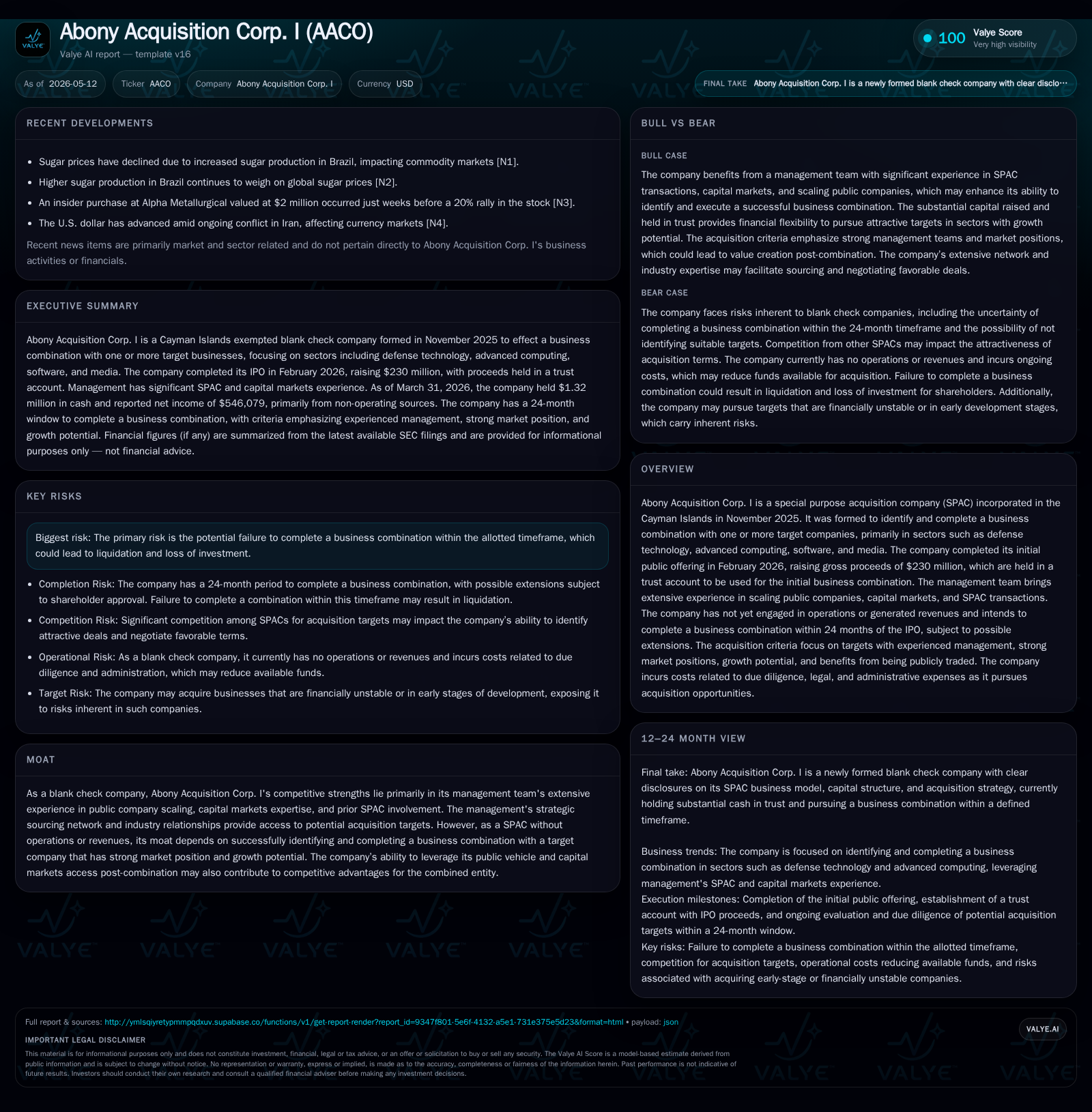
As of its latest quarterly filing, Abony Acquisition Corp. I holds substantial IPO proceeds in trust and continues preparation for its initial business combination within the next 24 months. Its business model centers on leveraging its management's capital markets experience to identify acquisition targets primarily in defense technology, advanced computing, software, and media. While the company has no operations or revenues to date, its significant liquidity and sponsor network underpin deal sourcing and execution potential. Key risks include the possibility of not completing a combination on time, which would force liquidation and return of funds to shareholders.
Latest Quarterly Update: Capital Position and Operating Status
Abony Acquisition Corp. I filed its latest quarterly report (Form 10-Q) on May 11, 2026 [S2], confirming it remains a blank check special purpose acquisition company (SPAC) with no operational activities beyond organizational setup and IPO execution. As of March 31, 2026, the company held approximately $1.32 million in cash and equivalents [F1], supported by a current asset base of about $1.47 million against current liabilities of roughly $192 thousand, resulting in an exceptionally strong current ratio of 7.64 [F1]. This liquidity profile underscores Abony’s solid financial footing following its February 2026 initial public offering (IPO), where it raised gross proceeds totaling $230 million [S1]. The funds raised reside predominantly in a U.S.-based trust account intended exclusively to finance the company’s initial business combination(s).
The May quarterly filing indicates no changes to previously disclosed risk factors [S2], maintaining the fundamental risk that failure to execute a qualifying business combination within the allotted timeframe would compel liquidation and return of funds to shareholders [S1]. The lack of revenues or operating income reported through year-end 2025 reflects typical SPAC status prior to merger completion [F1]. The near-term operating outlook remains anchored around successful target identification and transaction consummation.
SPAC Business Model and Abony’s Targeted Sectors
Structured as a Cayman Islands exempted company since November 13, 2025 [S1], Abony Acquisition Corp. I operates under a classic SPAC framework where it seeks to deploy capital raised from public investors into one or more private companies via merger or acquisition. The offering comprised units convertible into Class A ordinary shares plus redeemable warrants at specific strike prices designed to incentivize shareholder participation while preserving upside potential [S3].
Abony explicitly targets business combinations principally within the defense technology, advanced computing, software, and media sectors [S1]. These industry verticals reflect management's domain expertise and they prioritize enterprises with aggregate valuations between approximately $750 million and $1.5 billion or greater [S1]. This mid-market focus aligns with clusters of innovation-driven companies exhibiting robust growth prospects but which often require access to broader capital pools available through public markets.
The entity has not generated operating revenues nor engaged operationally, consistent with standard SPAC profiles pre-acquisition; interim income is limited to interest earned on trust account balances [S1]. Its funds are earmarked for deployment either wholly in cash or in combination with equity or debt in consummating an initial business combination.
Management Expertise and Competitive Position
Abony’s competitive moat is concentrated primarily in its management team’s extensive capital markets experience combined with their strategic networks cultivated over decades. CEO Lorne Abony brings credentials as a serial entrepreneur and investor across relevant sectors including defense technology and digital innovation; he has demonstrated success raising over $10 billion across public equity, debt offerings, and SPAC-related transactions during his career [S1]. CFO Leo Kofman’s background includes advising on over $10 billion in related transactions including PIPEs supportive of special purpose acquisition companies [S1].
This managerial proficiency provides Abony not only sourcing advantages—through proprietary referral pipelines from investors, advisors, intermediaries—but also acumen in complex transaction structuring necessary for competitive deal execution [S7]. Given the absence of operating assets or track record—the hallmark challenge for all blank check companies—this intangible advantage constitutes the core differentiation in standing out amongst crowded SPAC competitors vying for coveted growth-focused technology targets.
Industry Structure and Strategic Targeting
The focused target sectors—defense technology, advanced computing, software solutions, media—are characterized by rapid innovation cycles coupled with sizeable addressable markets driven by both government spending (especially defense) and commercial digital transformation.
Within defense tech, companies often benefit from steady governmental procurement cycles combined with increasing platform complexity requiring specialized software integration—a mix that favors scale consolidation players with capital access post-combination. Advanced computing encompasses AI-driven analytics platforms and hardware acceleration solutions that enjoy secular tailwinds from data-intensive applications across enterprises.
Media businesses targeted are likely positioned at the confluence of content delivery innovation and digital monetization paradigms reshaping sector economics amid evolving consumer preferences.
These industries face regulatory scrutiny especially when intersecting with national security considerations or data governance frameworks—increasing barriers but also enhancing moat potential for well-capitalized operators able to navigate compliance demands post-business combination ([S1] risk references). Valuation discipline is maintained by anchoring target selection against robust public comparables that lend transparent market benchmarks [S12].
Growth Catalysts: Pathways to Value Creation Post-Combination
Abony Acquisition’s prospective growth narrative is closely linked to successfully closing an attractive business combination which then transitions the entity into an operating public company equipped with:
- Enhanced operational scale aggregating complementary assets or technologies;
- Access to expanded capital markets resources enabling further organic investment or bolt-on acquisitions;
- Leveraging management’s strategic relationships to accelerate revenue pipelines;
- Potential multiple expansions reflecting improved market perception tied to size, profitability prospects, or sector positioning;
- Public market liquidity allowing shareholder value crystallization.
These drivers depend heavily on deal quality—selection of targets possessing durable competitive advantages within their niche—and smooth integration execution underpinned by effective governance frameworks laid during the blank check phase ([S1]).
Risks and Constraints: Timeframes and Execution Challenges
The paramount risk space for Abony lies in transactional timing constraints inherent in SPAC structures—specifically the need to consummate an initial business combination within approximately 24 months post-IPO or face mandatory liquidation per SEC rules ([S1], [S2]). Failure results in return of capital less expenses incurred.
Additional execution risks include: intense competition among numerous SPAC sponsors targeting overlapping industry verticals potentially compressing valuation margins; regulatory uncertainties affecting target sector valuations; risks associated with integrating early-stage or financially unstable acquisitions; any delay or failure reducing investor confidence which may impact financing flexibility post-combination (,[S1]).
No material updates to existing risk disclosures were noted in the latest quarter providing continuity assurance but highlighting that these fundamental structural risks remain extant ([S2]).
Key Upcoming Milestones and Investor Watchpoints
Investors should monitor several pivotal developments that will indicate progress toward transaction close:
- Announcements regarding selection of definitive business combination targets;
- Execution of merger agreements or definitive terms filings;
- Progression of unit separation actions commenced April 2026 per latest 8-K clarifying liquidity treatments for Class A shares versus warrants ([S3]);
- Shareholder communication related to voting or redemption procedures as deal approval steps unfold;
- Expiry timelines counting down toward milestone deadlines imposed upon business combination consummation;
- Transaction financing arrangements including possible debt facilities complementing trust fund usage.
Such markers collectively inform visibility into deal pipeline maturity which ultimately dictates timeline feasibility for closure.
Financial Snapshot: Liquidity, Assets, and Capital Structure
Latest financial snapshot
| Metric | Value | Period |
|---|---|---|
| Cash & equivalents | $1324398 | |
| 2026-03-31 | ||
| Current assets | $1467806 | |
| 2026-03-31 | ||
| Current liabilities | $192214 | |
| 2026-03-31 | ||
| Current ratio | 7.64x | |
| 2026-03-31 |
Source: SEC companyfacts cache [F1].
| Metric | Amount (USD) |
|---|---|
| Cash & Equivalents | 1,324,398 |
| Current Assets | 1,467,806 |
| Current Liabilities | 192,214 |
| Current Ratio | 7.64 |
(Source: Companyfacts as of March 31, 2026 [F1])
Abony maintains a conservative balance sheet devoid of long-term debt obligations ([S8]), reflecting its pure investment holding stage pre-business combination. The bulk of IPO proceeds remain sequestered in trust dedicated solely for acquisition use ensuring investor protections are structurally embedded ([S13], [S20]).
Underwriting fees consisting notably of $4.6 million cash component plus deferred commissions totaling approximately $8 million demonstrated customary issuance costs fully recognized ([S8], [S13]). There is facility for working capital loans up to $1.5 million from sponsors if needed prior to transaction close but no indications such funding has been deployed as yet ([S18]). The absence of operating revenue stream holds provisions for continued cost absorption until conversion into an operating entity upon successful deal conclusion.
This analysis reflects insights strictly grounded on documented filings through May 11, 2026. It does not constitute investment advice but aims to elucidate Abony Acquisition Corp. I’s current financial status and strategic positioning as it pursues its foundational business combination endeavor within emerging technology-focused industries.
Disclaimer: This is research-only, informational analysis and not investment advice. It may include AI-generated interpretation and general industry context. Always verify important details using primary sources.

Comments