
Abundia Global Impact Group’s Quarterly Shift Highlights Renewables Pivot and Liquidity Challenges
The April 2026 acquisition of RPD Technologies Americas underscores AGIG's strategic focus on renewable fuels while spotlighting ongoing liquidity pressures.
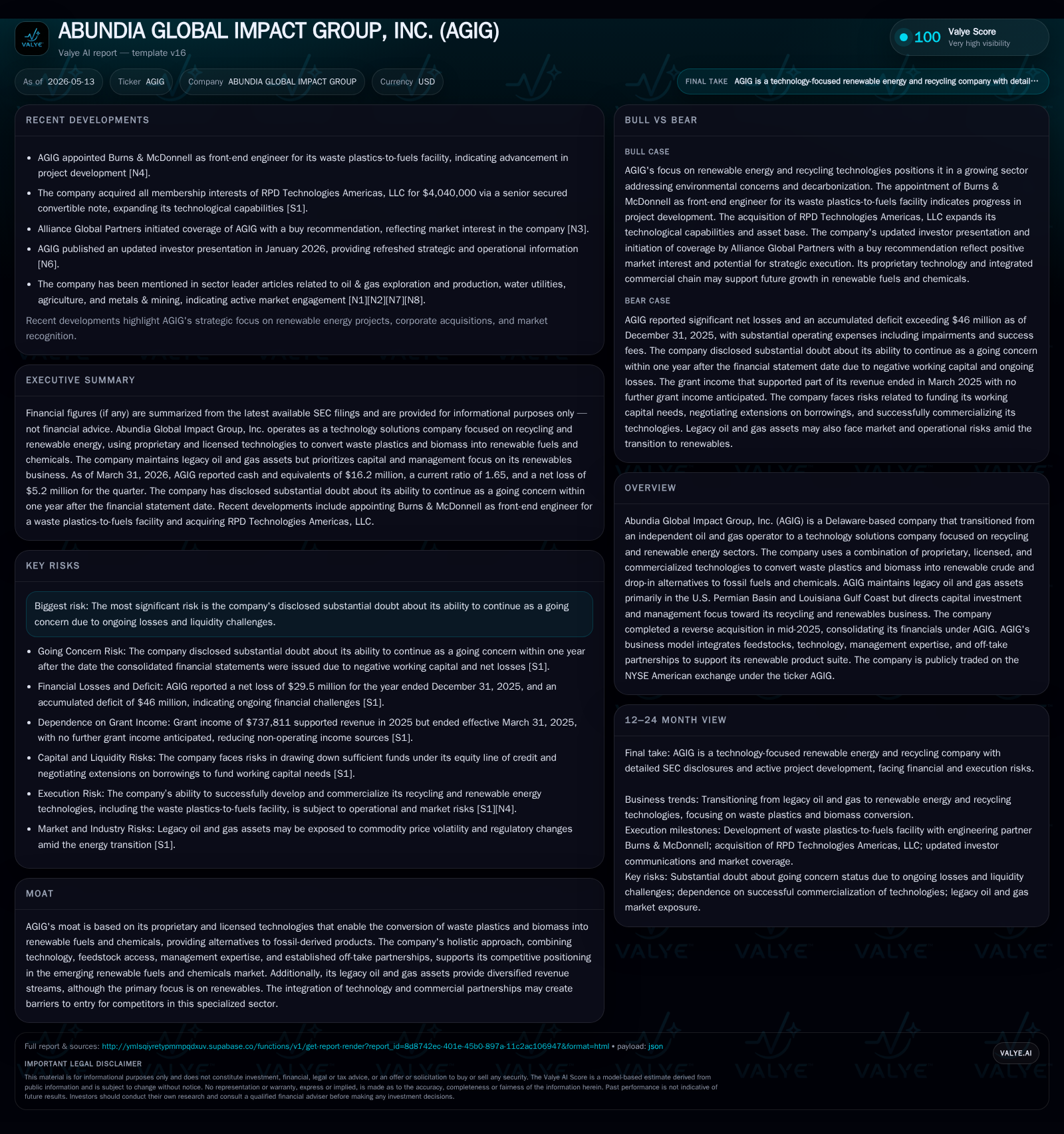
In its latest 10-Q filing dated May 8, 2026, Abundia Global Impact Group, Inc. (AGIG) formalized the acquisition of RPD Technologies Americas through a senior secured convertible note, cementing its pivot from legacy oil and gas operations to advanced recycling and renewable energy technologies. This move expands AGIG’s proprietary technology portfolio aimed at converting waste plastics and biomass into renewable crude alternatives, integral to its mission-driven transition. Despite possessing approximately $16.2 million in cash and a positive current ratio of 1.65, the company faces significant liquidity risks compounded by near $4 million in convertible debt carrying a 10% annual interest rate. Execution challenges remain around scaling technology commercialization and securing sustainable feedstock volumes, with the convertible note maturing in April 2027 presenting a critical refinancing milestone.
Latest Operating Developments: Acquisition Drives Strategic Shift
AGIG’s most immediate operational highlight is its completion of the acquisition of RPD Technologies Americas on April 1, 2026, financed through the issuance of a senior secured convertible note totaling $4.04 million due on the first anniversary date [S2][S3]. This convertible note carries a substantial 10% annual interest rate payable quarterly, introducing new fixed finance obligations that weigh on the company’s already pressured cash flows. The note includes customary default provisions that would accelerate repayment obligations or increase interest rates to as high as 15% upon a breach, emphasizing heightened liquidity vigilance. Importantly, this transaction underscores AGIG's strategic ambition to accelerate development in the recycling-to-renewable fuels space by growing its technological asset base.
This acquisition represents a tangible step away from the company’s prior identity as an independent oil and gas operator toward becoming a technology leader focused on decarbonizing energy through recycling and renewable alternatives. Management explicitly prioritizes capital deployment toward these renewables ventures rather than legacy hydrocarbons extraction operations located primarily in the Permian Basin and Louisiana Gulf Coast regions [S1].
Transforming Business Model: From Oil & Gas to Waste-to-Fuels Technology
Abundia Global Impact Group has undergone a fundamental business transformation following its mid-2025 reverse acquisition which consolidated its financial reporting under AGIG’s umbrella [S1][S24]. Historically engaged in exploration and production activities within traditional oil & gas fields, AGIG now operates predominantly as a cleantech solutions provider addressing environmental sustainability goals.
Central to AGIG’s value proposition is its combination of proprietary, licensed, and commercialized processes designed to convert waste plastics and biomass into renewable crude oils or drop-in alternatives for fossil-sourced fuels and chemicals [S1]. These technologies enable circular feedstock utilization by turning waste streams—normally problematic environmental pollutants—into economically viable inputs for fuel synthesis.
Revenue mechanics revolve around integrating feedstock procurement (plastics/biomass), applying conversion technology under license agreements (notably with Alterra Energy LLC), managing end-to-end process expertise via internal teams, and securing long-term off-take partnerships for product distribution. While AGIG retains legacy oil & gas assets yielding modest revenue streams ($410k in 2025), these hold secondary significance relative to renewables-focused capital allocation [F1][S1].
Industry Positioning: Proprietary Technology amid Emerging Renewable Fuels Market
AGIG competes within an increasingly important segment focused on renewable fuel alternatives derived from plastic waste and biomass—areas receiving regulatory support due to their alignment with decarbonization initiatives globally. Its competitive moat is anchored in proprietary conversion technologies licensed commercially, augmented by an integrated approach blending feedstock control, technological development, multidisciplinary management teams, and established off-take relationships [S1].
Within waste-to-fuels tech economics, scale matters significantly: converting heterogeneous waste streams efficiently requires robust process engineering coupled with consistent feedstock sourcing able to meet volume demands sustainably without severely escalating costs. Regulatory tailwinds such as low-carbon fuel standards potentially enhance pricing power but simultaneously raise compliance requirements that may limit rapid scaling without upfront investment.
Challenges exist around achieving unit economics competitive with entrenched fossil fuels plus navigating supply chain constraints vis-à-vis collection/sorting infrastructure for feedstock inputs—a common hurdle across biofuel startups. As such, technology scalability horizons and partnership depth act as key barriers preventing easy entry for generic competitors.
Growth Trajectory: Expansion through Feedstock Integration and Off-Take Partnerships
Growth for AGIG hinges on successfully commercializing acquired technologies like those from RPD Technologies Americas while expanding access to diversified plastic waste and biomass streams [S3][S1]. Establishing sufficient feedstock volumes at competitive costs will determine subsequent production throughput enhancements.
Equally important are off-take agreements locking in end customers for renewable crude oils or chemical feedstocks—critical for enabling financing models aligned with project-scale plant buildouts. AGIG’s track record indicates active engagement securing such partnerships forming part of its holistic ecosystem strategy combining technology ownership with market-side demand visibility [S1].
The company's ability to integrate newly acquired assets rapidly into existing operations while advancing commercial scale deployment will likely dictate near-to-mid term growth prospects. The company acknowledges substantial doubt regarding ability to continue as a going concern due to recurring losses exceeding $29 million annually alongside an accumulated deficit surpassing $46 million as of December 31, 2025 [S2][F1][S1].
Execution risks also derive from complexities inherent in scaling novel conversion technologies beyond pilot phases—including raw material consistency challenges plus competitive pressure from incumbent fossil fuel suppliers capable of leveraging entrenched infrastructure advantages.
Regulatory regime shifts could either enhance incentives or create hurdles depending on evolving carbon policy frameworks influencing biofuel subsidies or credits—a partially exogenous variable impacting margin stability.
Near-Term Catalysts and Milestones to Monitor
Critical upcoming milestones include:
- Operational integration progress of RPD Technologies Americas assets with focus on achieving efficient throughput scales consistent with engineering specifications laid out during acquisition evaluation [S3].
- Expansion or signing of off-take agreements evidencing market acceptance of produced renewable fuels or chemical precursors underpinning revenue visibility.
- Demonstrable feedstock sourcing scalability ensuring supply chain robustness amidst volatile plastics waste availability dynamics.
- Liquidity developments especially considering financing strategies addressing maturing convertible note obligations due April 2027 including possible equity conversions at defined discounts or new funding rounds aimed at balance sheet strengthening [S3][F1].
- Progress updates communicated during quarterly earnings releases serving as KPIs validating tech commercialization trajectory versus prior development-stage status.
These catalysts offer tangible benchmarks relevant for assessing operational execution success matched against financial stability considerations.
Current Financial Profile: Balance Sheet and Liquidity Overview
Latest financial snapshot
| Metric | Value | Period |
|---|---|---|
| Cash & equivalents | $16mm | |
| 2026-03-31 | ||
| Current assets | $17mm | |
| 2026-03-31 | ||
| Current liabilities | $10mm | |
| 2026-03-31 | ||
| Current ratio | 1.65x | |
| 2026-03-31 |
Source: SEC companyfacts cache [F1].
As per Q1 ending March 31, 2026 data obtained from SEC filings:
- Cash & equivalents stand at approximately $16.2 million,
- The current ratio measures a healthy 1.65 indicating short-term asset coverage over liabilities,
- Net cash position is positive given cash exceeds total debt by over $13 million,
- However substantial operating losses erode equity cushion creating ongoing capital requirements for sustaining operations absent profitable break-even achievement [F1].[S2]
The senior secured convertible note backing RPD acquisition introduces upcoming principal repayment demands coupled with mandatory interest accruals generating quantifiable cash flow pressures while also imposing potential dilution if converted per contractual terms at discounted VWAP-based prices with floors set at $0.29/share post-maturity date [S3].
This financial profile depicts a company balancing runway extension efforts through capital raising and asset monetization against technical execution imperatives needed for transitioning into sustained commercial operations within renewables markets.
This analysis synthesizes publicly disclosed information from Abundia Global Impact Group’s latest SEC filings including recent quarterly Form 10-Q dated May 8, 2026 ([S2]), event Form 8-K filings covering acquisitions ([S3]) along with annual business model disclosures ([S1]). It incorporates sector-specific understanding where noted explicitly as analysis without conjecture beyond available evidence. This document does not constitute investment advice or recommendations.
Disclaimer: This is research-only, informational analysis and not investment advice. It may include AI-generated interpretation and general industry context. Always verify important details using primary sources.

Comments