
Stardust Power Accelerates Lithium Refinery Development with Focus on US Energy Independence
Stardust Power advances its lithium refinery project in Oklahoma, balancing development progress with liquidity and feedstock supply challenges amid evolving market forecasts.
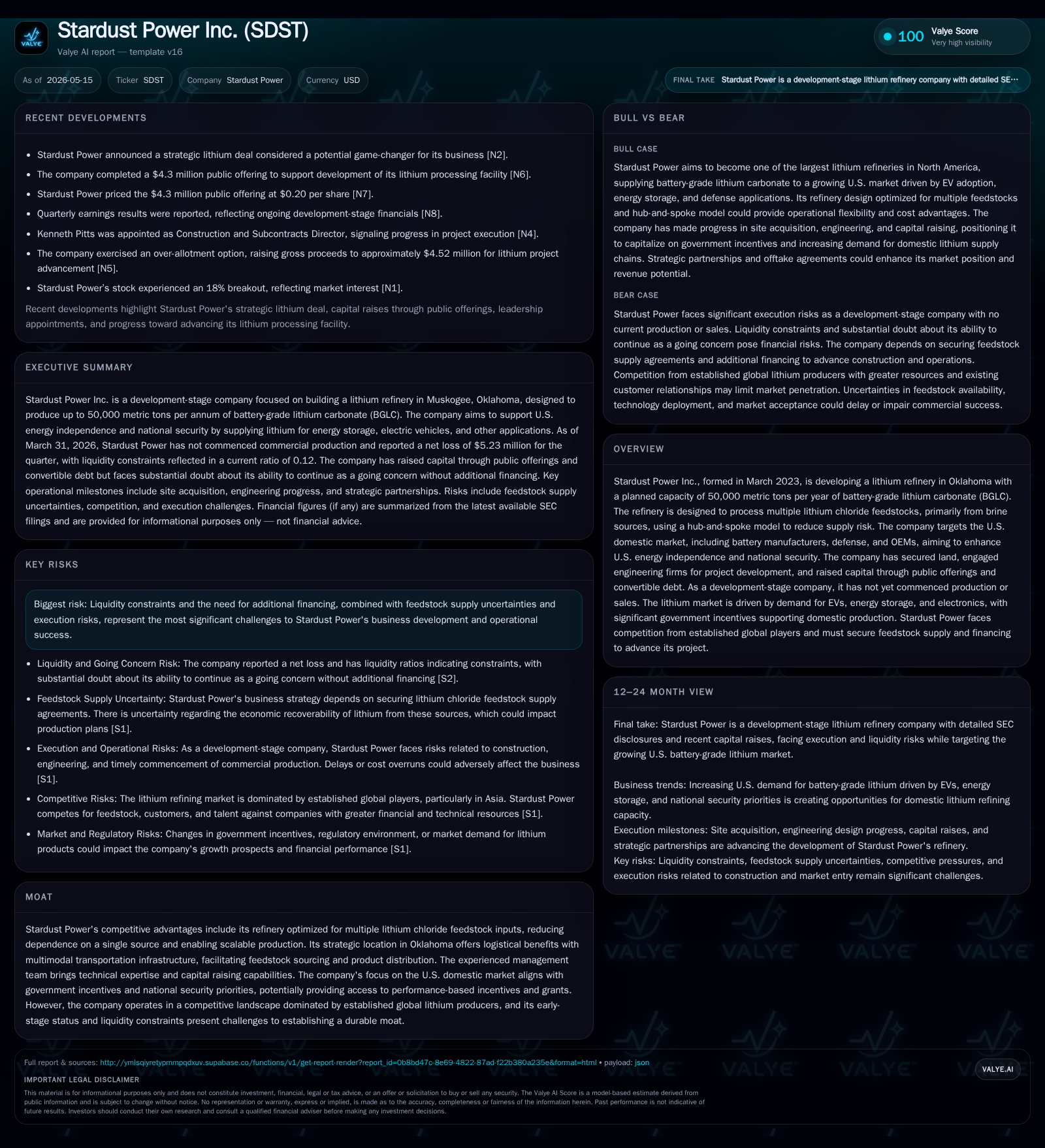
In its May 2026 quarterly filing, Stardust Power affirmed steady advancement toward commissioning a battery-grade lithium carbonate refinery in Oklahoma, designed to process diverse lithium chloride feedstocks. The company continues to grapple with liquidity constraints accentuated by a low current ratio and substantial current liabilities, posing risks to execution and growth timelines. While market forecasts anticipate a lithium surplus in the near term, sustained demand from electric vehicles, energy storage systems, and data centers underpins the strategic value of domestic production. Government incentives aligned with energy independence priorities enhance Stardust’s competitive standing despite stiff global competition and developmental uncertainties.
Recent Quarterly Operating Update: Progress and Challenges
Stardust Power’s latest 10-Q filing dated May 14, 2026 [S2] reiterates its status as a development-stage company working steadily toward operationalizing a lithium refinery in Muskogee, Oklahoma. The facility is designed for an annual capacity of 50,000 metric tons of battery-grade lithium carbonate (BGLC), optimized for processing various lithium chloride feedstocks sourced primarily from brines utilizing a hub-and-spoke model. While no commercial production or sales have commenced yet, the company has secured land rights and environmental permits—most notably the air quality construction permit obtained earlier in January [S26]—and engaged engineering firms to advance site preparations.
Operationally, the company maintains the same risk profile outlined in its March 2026 annual report [S1,S8], including substantial going concern doubts due to liquidity pressures. Unlike prior quarters, the latest filing does not indicate material new risk factors but reaffirms uncertainties related to feedstock sourcing and execution timelines inherent to early-stage mineral refining ventures. Importantly, recent event filings [S3,S16] disclose continuing efforts to raise capital via equity offerings and convertible debt transactions aimed at supporting construction activities and operational ramp-up.
Business Model Overview: Refining Strategy and Product Quality
Stardust Power's business model centers on producing battery-grade lithium carbonate tailored for the burgeoning U.S. battery manufacturing ecosystem. The company's strategic objective is to address a critical bottleneck in the U.S. supply chain by establishing one of North America's largest lithium refineries with an annual throughput capacity of 50,000 metric tons [S1].
Uniquely, the refinery is engineered to handle multiple lithium chloride feedstocks rather than relying on a single source or type of deposit. This flexibility stems from a hub-and-spoke approach where raw material inputs from various brine producers are consolidated at the Oklahoma facility [S1]. This mitigates supply concentration risks common in lithium refining dominated by hard-rock mined sources or single-origin brines. The ability to process diverse inputs enhances resilience against regional disruptions or supply variability.
The target customers comprise U.S.-based battery manufacturers serving key growth sectors including electric vehicles (EVs), energy storage systems (ESS), grid infrastructure projects, data centers leveraging AI advancements, and defense OEMs sensitive to secure domestic supply chains [S1]. The focus on sustainability is embedded throughout operations, aligning product standards with stringent quality requirements essential for high-performance battery chemistries.
Competitive Landscape and Industry Structure
The global lithium refining industry remains concentrated with established players predominantly outside the U.S., leading to supply chain vulnerabilities exposed by geopolitical tensions and trade uncertainties. Stardust Power aims to capitalize on an industry gap for domestic BGLC producers that meet rising American content requirements bolstered by government incentives.
Its choice of locating the refinery in Muskogee leverages logistical advantages afforded by Oklahoma’s multimodal transportation infrastructure—a vital element for inbound feedstock shipments and outbound product distribution across contiguous states. This centralized location enhances cost-efficiency relative to more remote lithium projects that often suffer elevated logistics expenses.
Additionally, alignment with U.S. national security and energy independence goals adds a structural advantage given increasing federal grants and tax credits targeting critical minerals processing facilities. Such policy tailwinds effectively raise entry barriers against purely cost-based international competitors.
Growth Drivers: Market Demand, Government Incentives, and Strategic Moats
Despite Fastmarkets revising its decade-long lithium forecast to a surplus beginning as soon as 2027-28—with anticipated surpluses of approximately 18,000 metric tons in 2027 and 14,000 tons in 2028—long-term structural demand continues growing robustly driven by accelerated EV penetration rates globally plus expansion in ESS deployments especially fueled by China’s policy support and emergent U.S. AI data center needs [S1].
Stardust’s growth potential is substantially underpinned by:
- Feedstock diversification that reduces reliance on any single supplier or chemical source through its flexible hub-and-spoke refinery design,
- Government incentives including an illustrative $257 million package from Oklahoma contingent on milestone achievements [S23], alongside expected federal support motivated by securing domestic critical minerals supply,
- Experienced management drawing upon decades of technical expertise spanning mining consulting firms and lithium-ion manufacturing technology verticals [S1], which enhances credibility with partners amid early development risks.
Strategic moats are nascent but potentially durable if successfully cementing off-take agreements with battery OEMs requiring traceable U.S.-origin materials combined with scalability enabled by modular expansion capability at their Oklahoma complex.
Risks and Constraints: Liquidity, Feedstock Supply, and Execution Uncertainty
As of March-end 2026 [F1], Stardust held approximately $1.24 million in cash equivalents against over $13.8 million in current liabilities—a stark current ratio of merely 0.12 signaling acute short-term funding pressure that threatens continuity absent successful capital raises or conversion events.
Total debt is modest at roughly $104K [F1]. The company depends on accessing equity or convertible debt markets amidst volatile valuation conditions inherent for pre-revenue resource developers.
Feedstock pipeline risks are material given dependency on third-party brine exploration success rates; unexpected geological or logistical impediments could disrupt planned input volumes further complicated by rising transportation costs associated with managing multiple smaller-volume suppliers under a hub-and-spoke logistics framework [S1].
Additionally, refinancing timing uncertainties compounded by regulatory compliance demands—including environmental permitting complexity—and ongoing litigation matters introduce execution risks that could delay or derail commercialization schedules.
What to Watch Next: Milestones and Strategic Developments
Key near-term milestones will be focal points for evaluating operational momentum:
- Progress toward completing construction phases as permitted since obtaining environmental clearances earlier this year [S26].
- Securing formalized feedstock supply agreements moving beyond non-binding memoranda already noted in filings [S1].
- Establishing binding off-take contracts with U.S.-based battery manufacturers or defense-related OEMs ensuring initial revenue streams upon product launch.
- Additional capital raising rounds critical for alleviating liquidity constraints highlighted in recent quarterly disclosures [S2,S3,S16]. Monitoring changes here will provide insight into financing viability under prevailing investor appetite.
- Resolution status updates regarding existing legal disputes which may otherwise pose contingent liabilities affecting financial health.
Successful achievement of these markers will validate Stardust’s claims toward establishing an integrated domestic battery-grade lithium supply chain element crucial for scaling downstream EV/ESS manufacturing sectors.
Financial Profile Snapshot
Latest financial snapshot
| Metric | Value | Period |
|---|---|---|
| Cash & equivalents | $1,235,564 | |
| 2026-03-31 | ||
| Total debt | $103,848 | |
| 2026-03-31 | ||
| Net debt | $-1,131,716 | |
| 2026-03-31 | ||
| Current assets | $1,714,674 | |
| 2026-03-31 | ||
| Current liabilities | $13,862,052 | |
| 2026-03-31 | ||
| Current ratio | 0.12x | |
| 2026-03-31 |
Source: SEC companyfacts cache [F1].
The March 31, 2026 balance sheet snapshot [F1] reflects prudent but constrained financial positioning typical for early-stage refiners:
| Metric | Value (USD) |
|---|---|
| Cash & Equivalents | 1,235,564 |
| Total Debt | 103,848 |
| Current Assets | 1,714,674 |
| Current Liabilities | 13,862,052 |
| Current Ratio | 0.12 |
| Net Income (Year ended) | -15,723,636 |
Operating losses deepened as expected during this development phase prior to production commencement [-15.7 million USD net loss for calendar year ended Dec 31, 2025] underscoring ongoing cash burn dynamics primarily funding corporate overheads plus project development expenditures [F1].
This snapshot crystalizes both the promising strategic foundation built so far—consisting of permitting achievements and technological designs—and underscores acute capital needs that must be managed cautiously alongside tight execution discipline.
This analysis is based solely on publicly available SEC filings as of May 15, 2026 ([S1]-[S29]) and associated structured financial data ([F1]). It does not constitute investment advice or recommendations.
Disclaimer: This is research-only, informational analysis and not investment advice. It may include AI-generated interpretation and general industry context. Always verify important details using primary sources.

Comments