
BIO-key Expands Biometric SaaS Access While Facing Capital and Customer Concentration Risks
Latest quarterly filing highlights growth in biometric IAM deployments amid sustained financial and listing challenges.
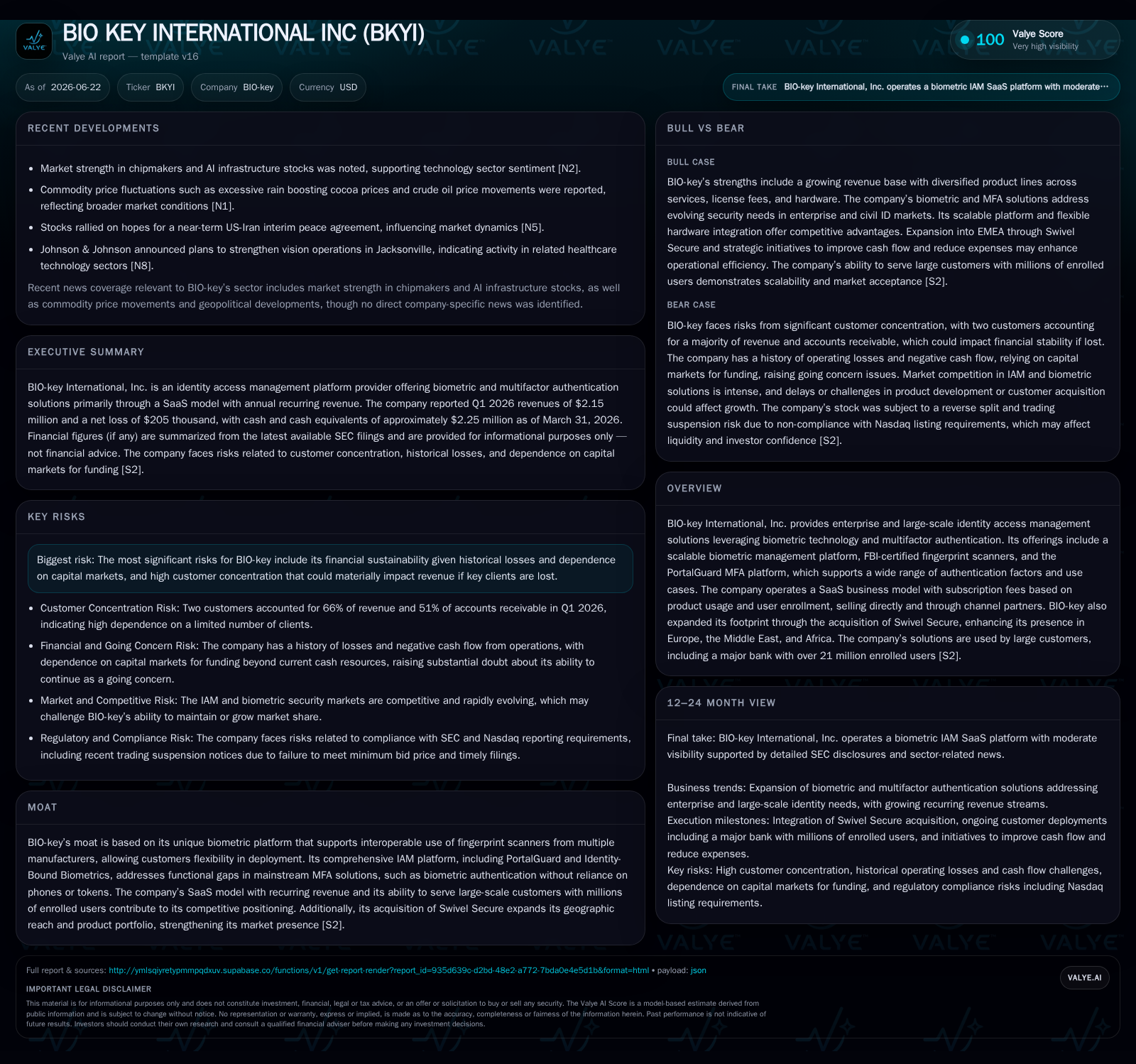
BIO-key International advanced its identity and access management (IAM) platform with increasing adoption of its biometric-enabled PortalGuard SaaS offering, serving millions of users including a major bank client. The company leverages its interoperable fingerprint biometrics and multifactor authentication to address gaps in mainstream MFA solutions, focusing on workforce flexibility without token or phone dependency. However, persistent operating losses, significant customer concentration, and recent Nasdaq delisting proceedings pose substantial risks to financial sustainability and growth execution. Management is pursuing strategic initiatives to streamline costs and expand geographic reach through previous acquisitions like Swivel Secure while maintaining working capital via warrant exercises and debt refinancings.
Recent Operating Update
Despite these operational improvements, BIO-key faced critical corporate governance headwinds when Nasdaq issued delisting notice due to failure to timely file Q1 10-Q reports; trading of common stock moved to the OTC Markets with an appeal currently under review [S3][S4]. This regulatory event underscores liquidity management challenges amid efforts to scale recurring software revenues.
Business Model Analysis
BIO-key operates predominantly via a SaaS model targeting enterprises requiring robust identity access management (IAM) solutions that incorporate biometric authentication—which differentiates it from mainstream MFA vendors dependent on phones or tokens. Customers subscribe annually based on the number of users enrolled in its PortalGuard platform, which integrates both cloud-based IAM capabilities and support for on-premise deployments [S20]. The offering prioritizes "Identity-Bound Biometrics" enabling employees, contractors, and customers seamless yet secure sign-in experiences without reliance on external devices—a critical advantage for remote workforces or shared device scenarios common in sectors like banking or education.
Revenue mechanics blend term license fees encompassing technical support and software maintenance with hardware sales of FBI-certified fingerprint scanners compliant with FIDO standards [S20]. Contracts average approximately one year with noncancelable commitments, providing a foundation for annual recurring revenue (ARR).
Notably, BIO-key's platform APIs enable software developers to embed biometric MFA capabilities across diverse applications without constraining hardware vendor choices—supporting federated authentication environments compatible with existing enterprise IAM frameworks such as Microsoft or Okta [S2].
Industry Structure and Competitive Position
The IAM software space is rapidly evolving under pressure from escalating cybersecurity threats and compliance regulations. While peers focus heavily on app-based or token MFA methods (e.g., Duo Security or Ping Identity), BIO-key’s emphasis on interoperable biometric technology addresses functional gaps: tokenless authentication reduces friction especially where users lack personal mobile devices or operate kiosks.
By integrating prior acquisitions—most prominently Swivel Secure—BIO-key has expanded its EMEA footprint and product breadth into complementary MFA modalities, enhancing competitive positioning against larger cloud-native IAM providers who bundle authentication services within broader digital ecosystems [S1][S2].
However, BIO-key operates without the scale or enterprise penetration of leading SaaS IAM vendors such as Okta or Microsoft Azure Active Directory. High customer revenue concentration further exposes the firm to volatility; in Q1 2026 two customers accounted for two-thirds of revenues [S13], illustrating dependency risks uncommon among more diversified peers.
Growth Drivers
Key growth drivers include:
- Continued broad enterprise adoption of MFA driven by growing regulatory demands and security insurance standards incentivizing enhanced access controls.
- Rising preference for biometric and passwordless authentication approaches that improve user experience while mitigating phishing risks.
- Expansion into EMESA through Swivel Secure acquisition which provides channels into emerging digital infrastructure markets.
- Increasing demand for solutions supporting secure remote work environments spanning multiple devices and federated applications.
- Planned product portfolio enhancements aiming to underpin full-spectrum IAM needs under a unified umbrella.
Growth execution depends heavily on scaling user enrollment rates across existing major customers while diversifying client base to manage concentration risk.
Risks and Constraints
Besides customer concentration risks noted earlier, BIO-key faces significant financial sustainability challenges given a history of operating losses fueled by necessary R&D investment amid competitive technology shifts. The company’s dependence on capital market funding introduces execution uncertainty—illustrated by recent Nasdaq delisting proceedings stemming from regulatory filings delays [S3][S4].
The pace of innovation required to keep pace with evolving cybersecurity threats necessitates sustained R&D expenditure despite tight resource constraints. Moreover, hardware supply chain complexities for biometric devices could constrain deployment growth if not proactively managed.
Integration complexities persist when deploying identity-bound biometrics alongside heterogeneous enterprise IT stacks requiring federation interfaces and SSO compatibility. Lastly, geopolitical factors affecting customers in Europe, Africa, Asia—coupled with currency volatility—may impact international expansion plans adversely.
What to Watch Next
- Resolution outcome of Nasdaq listing appeal impacting stock market liquidity.
- Quarterly updates on subscription user enrollment trends indicating traction within core clients.
- Progress metrics related to integrating Swivel Secure technologies across new geographic markets.
- Operational cash burn rate versus liquidity runway considering recent warrant exercise proceeds (~$3 million net) used for working capital [S23][S18].
- Moves toward diversifying customer base beyond high-revenue-concentration clients remain critical to mitigating revenue volatility.[S13]
- Strategic partnerships or channel expansions extending distribution network particularly across EMESA territories.
Financial Profile Summary
At March 31, 2026 end-quarter balance sheet snapshots reveal cash & equivalents at approximately $2.25 million against modest total debt near $135k providing a current ratio of around 1.41—indicating reasonable near-term liquidity [F1]. Operating results show gross margin expansion driven by increased license fee revenues despite higher hardware sales costs partially offset by reserves for inventory obsolescence.[S22] Research & development expenses remained elevated around $617k matching prior-year levels reflective of ongoing technology investments.[S22] Overall losses narrowed but remain material at ~$158k operating loss for Q1 2026 signaling continued need for vigilant expense management coupled with top-line growth.[S22]
Warrant exercise agreements completed since January 2025 have injected capital exceeding $3 million before fees aiding current funding runway.[S18][S23] However, consistent profitability remains elusive amid competitive pressures and scale limitations.
This analysis is grounded strictly in BIO-key's latest SEC filings supplemented by validated industry context; it refrains from speculative forward-looking claims unsupported by disclosed data. No investment advice is provided.
Disclaimer: This is research-only, informational analysis and not investment advice. It may include AI-generated interpretation and general industry context. Always verify important details using primary sources.

Comments