
AeroVironment Accelerates Counter-Drone Production Amid Internal Controls Shakeup
June 2026 filings spotlight a major production scale-up in counter-drone systems coinciding with critical financial reporting weaknesses, influencing AeroVironment’s defense market stance.
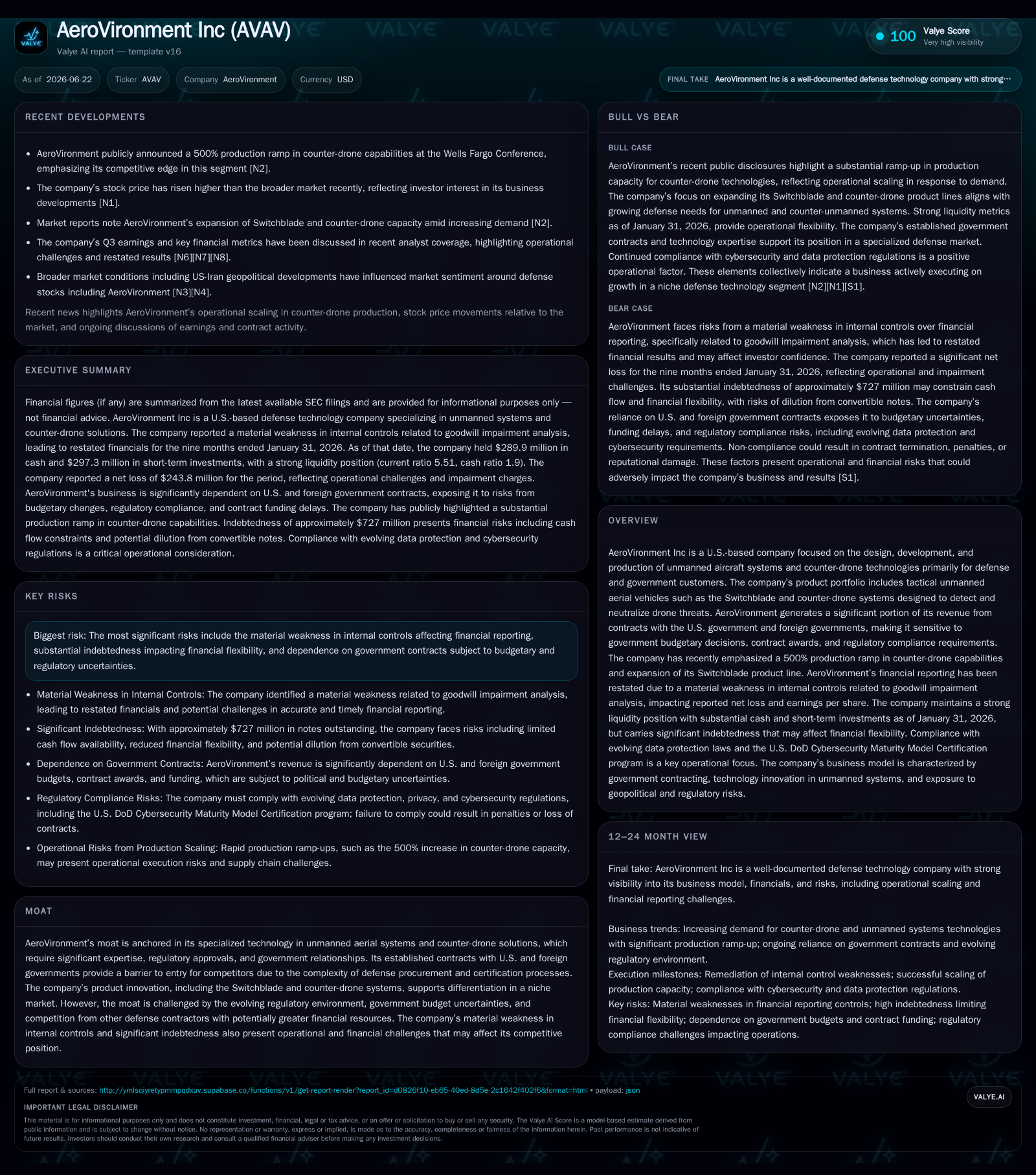
AeroVironment’s June 16, 2026, SEC 8-K filing reveals a striking 500% production ramp in its counter-drone capabilities and expansions in its Switchblade tactical drone lineup, underscoring intensified government demand. However, this operational momentum is tempered by the recognition of a material weakness in internal controls pertaining to goodwill impairment analysis, leading to restated financials that highlight significant net loss adjustments. The company remains reliant on U.S. and allied defense contracts amid budgetary and regulatory uncertainties while also grappling with elevated leverage. The unfolding balance between growth initiatives and financial governance challenges will be pivotal for AeroVironment’s positioning in the specialized unmanned aerial systems sector.
Latest Operational Update Highlights Production Expansion and Reporting Issues
AeroVironment’s June 16, 2026 Form 8-K filing reveals a strategic push to accelerate production of counter-drone technologies by an impressive factor of five times the prior output level [S3][N5]. This ramp-up coincides with enhancements to their flagship Switchblade tactical drone lineup, indicating an expansion both in capability breadth and volume response to heightened government demand [N6]. This operational acceleration reflects an acute geopolitical environment motivating increased expenditure on unmanned aerial systems (UAS) designed for both offensive tactical roles and defensive airspace security.
However, this growth narrative is clouded by disclosures of a newly identified material weakness in the company’s internal control over financial reporting. Specifically, errors related to the goodwill impairment analysis of its Space reporting unit necessitated restatement of prior quarterly results ending January 31, 2026 [S3][S19][S23]. The restatements uncovered understated operating losses by nearly $89 million for both three- and nine-month periods within fiscal year 2026. This internal control issue directly impacts investor confidence and underscores potential operational governance challenges amidst aggressive production scaling.
Business Model Focused on Tactical Drones and Counter-Drone Sales to Governments
AeroVironment primarily generates revenue through government contracts centered around the design, manufacture, and support of unmanned aerial vehicles such as the Switchblade tactical drone family and advanced counter-drone systems aimed at neutralizing hostile UAV threats. These government procurements involve complex negotiations under frameworks like Other Transaction Agreements (OTAs), reflecting long sales cycles but higher contract visibility [S2][S3]. The company leverages expertise in payload integration — including military-grade sensors and electronic countermeasures — embedded into small, portable systems tailored for frontline military applications.
Production ramp-up rates are closely tied to contract awards from U.S. defense agencies and allied foreign governments who prioritize rapid fielding of these systems during emerging aerial threat environments. Regulatory compliance across export controls and technology certifications plays a crucial role in product deployment timelines. Additionally, after-sales maintenance contracts contribute recurring revenue streams enhancing backlog stability.
Industry Competitive Dynamics within Specialized UAV Defense Platforms
Within the defense aerospace sector specializing in unmanned aircraft systems (UAS), AeroVironment occupies a niche focusing on tactical drones and counter-UAV technologies. Larger incumbents like Northrop Grumman deliver broad UAV platforms but operate at significantly greater scale with integrated defense systems offerings. Meanwhile, companies such as Kratos Defense specialize in tactical drones similar to AeroVironment’s Switchblade series; Raytheon Technologies competes strongly on counter-drone airspace security systems [N5].
AeroVironment differentiates itself through rapid innovation cycles enabling nimble product enhancements and aggressive capacity expansions illustrated by its announced 500% production ramp. However, this scale-up must contend with competitors benefiting from deeper financial war chests capable of absorbing procurement delays or volume fluctuations.
Growth Drivers Centered on Government Demand and Product Innovation
Key demand catalysts originate from escalating geopolitical tensions that elevate defense budgets globally. Modernization initiatives targeting legacy force structures increasingly incorporate unmanned systems for reconnaissance, precision strike (e.g., Switchblade drones), and layered airspace defense via counter-drone technologies [N6].
Foreign allied countries expanding their unmanned capabilities represent additional growth avenues backed by international government procurement agreements. Technological advances embedding AI-driven payload autonomy and sensor fusion further enhance system relevance against adaptive threats. AeroVironment’s production scale-up capability aligns closely with these trends by enabling fulfillment of accelerating order intake pipelines while sustaining delivery timelines critical to mission readiness.
Risks From Internal Control Weaknesses, Leverage, and Regulatory Challenges
The most immediate operational risk arises from the identified material weakness related to goodwill impairment controlling processes that required financial restatement impacting reported losses for FY2026 quarters [S3][S19]. Such deficiencies raise concerns about oversight efficacy during a period of business expansion.
Financial constraints surface given total debt exceeding $747 million against cash reserves near $290 million as of January-end 2026 [F1], translating into net debt approximating $458 million—elevated leverage for a company reliant on government funding subject to budget volatility [F1][S2]. Export control compliance adds complexity amid expanding foreign customer bases while rapid innovation demands continuous R&D investment risk obsolescence if not maintained effectively.
Supply chain sensitivities for critical components can exacerbate deployment delays or inflate costs particularly amidst global aerospace sector shortages.
What to Watch: Contract Awards, Production Delivery Timelines, and Remediation Efforts
Going forward, key markers will include announcements of new or renewed contracts especially involving allied foreign governments signaling international adoption momentum [N6][S3]. Effective execution against the ambitious 500% production scale-up target must manifest in timely unit deliveries meeting quality standards underpinning system reliability.
Regulatory certification milestones should be monitored carefully given their impact on deployment schedules across jurisdictions.
Progress on remedial measures addressing internal control weaknesses will be critical for restoring investor trust and ensuring sound management during scaling operations.
Debt management strategies balancing liquidity preservation against investment needs warrant scrutiny given current net leverage levels.
Supporting Financial Overview: Leverage, Liquidity, and Profitability Trends
From a liquidity perspective, AeroVironment maintains a strong current ratio exceeding 5.5 at fiscal Q3-end January 31, 2026 with current assets significantly covering liabilities ($1.7 billion vs $309 million) indicating solid short-term financial health [F1]. Cash & equivalents stand near $290 million providing usable runway for operational needs.
Conversely, total debt remains substantial at approximately $748 million yielding net debt around $458 million after cash offsets—a figure that constrains flexibility amid volatile defense procurement cycles [F1]. Recent non-GAAP disclosures including adjusted EBITDA provide enhanced comparability though underlying profitability is affected by restatements linked to goodwill impairments [S3].
This financial structure underscores the dual demands upon AeroVironment: capitalize swiftly on fast-growing UAV market segments while navigating credit considerations alongside internal governance improvements.
This analysis synthesizes AeroVironment’s recent SEC filings alongside sector context to frame its operational momentum against emerging risks without proffering investment advice or future projections.
Disclaimer: This is research-only, informational analysis and not investment advice. It may include AI-generated interpretation and general industry context. Always verify important details using primary sources.

Comments