
Panamera Holdings Advances Carbon Capture Integration Amid Severe Liquidity Challenges
Leadership changes and expanded technology licensing with Rain Cage Carbon mark Panamera Holdings' latest quarter, while liquidity constraints raise execution risks.
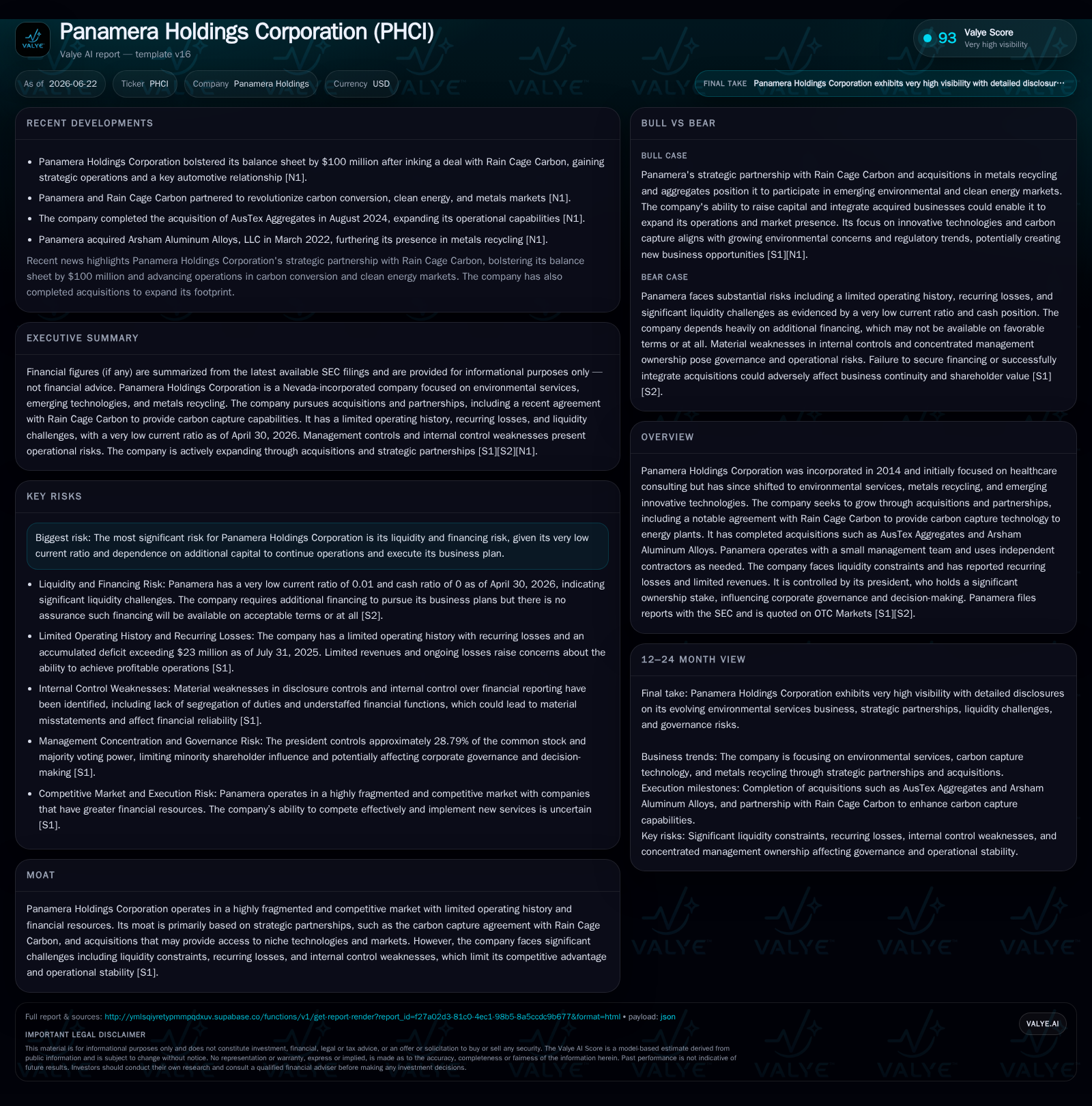
Panamera Holdings’ June 2026 quarterly filing highlights the appointment of Blair Aiken as President and interim CEO to accelerate integration of Rain Cage Carbon’s carbon capture technologies. The company’s business model centers on metals recycling, environmental services contracts, and technology licensing, supported by acquisitions such as AusTex Aggregates and Arsham Aluminum Alloys. Despite strategic growth initiatives, Panamera faces critical liquidity strains with a current ratio near 0.01 and nearly $4.9 million in debt, posing significant going concern risks that could hinder operational scaling and financial stability.
June 2026 Quarterly Update and Leadership Transition
Panamera Holdings Corporation's recent 10-Q filing dated June 22, 2026, details a pivotal leadership change with Blair Aiken elected President and interim CEO effective June 15, 2026; he was also appointed Chairman of the Board [S2][S3]. This leadership shift underscores a renewed focus on advancing the company's strategic partnership with Rain Cage Carbon to commercialize carbon capture technologies. This move comes during ongoing operational challenges tied to capital constraints.
Strategic Focus: Rain Cage Carbon Partnership and Acquisitions
The company's transformation from its original healthcare consulting roots towards environmental services is anchored by its August 2025 exclusive license agreement with Rain Cage Carbon [S1][S11][S12]. The 30-year license enables Panamera to manufacture and commercialize the Eden™ System — a proprietary carbon conversion technology producing nanocarbon materials like carbon nanotubes for energy storage applications.
Additionally, the partnership includes rights to deploy Knights Charge green power systems designed for clean energy generation at coal and other energy plants [S1][S11]. This positions Panamera at the nexus of carbon capture technology deployment combined with metals recycling of domestically sourced critical earth materials.
Complementing this technology pivot are acquisitions such as AusTex Aggregates and Arsham Aluminum Alloys which enhance Panamera's metals recycling capacity—a key input stream supporting its environmental services offerings [S1]. These acquisitions reflect a growth strategy blending inorganic expansion with deepening technology integration.
Business Model Overview
Panamera generates revenue through multiple channels typical in environmental services and metals recycling: service contracts related to scrap metal processing, volumes of materials recycled (tons processed), technology licensing fees from Rain Cage Carbon's innovations, and contributions from acquired subsidiaries [S1][S2]
The company maintains a small core management team supplemented heavily by independent contractors. This approach offers operational flexibility suited to project-based work common in the sector but limits internal scalability [S1].
Operating margins are pressured by limited scale and recurring losses; revenue growth depends critically on increasing recycled material volumes and progressing on technology deployment milestones such as installed carbon capture capacity. Effectiveness in integrating recent acquisitions will be crucial to expanding processing capabilities.
Industry Positioning and Competitive Landscape
Operating within a fragmented market populated by numerous regional operators alongside large incumbents like Veolia Environnement or Waste Management, Inc., Panamera differentiates itself through exclusive access to advanced clean energy technologies licensed from Rain Cage Carbon [S1].
Unlike vertically integrated waste management peers focused on broad service offerings, Panamera leverages technology partnerships to target niche sustainability-driven segments. Reliance on licensed intellectual property rather than extensive proprietary IP presents both rapid innovation adoption opportunities and risks if scale economies or integration falter.
Market adoption of carbon capture technology remains nascent industry-wide; successful commercial deployment within coal-fired energy plants is yet limited. Panamera faces the dual challenge of proving operational execution while managing constrained working capital.
Growth Drivers
Key demand drivers include tightening environmental regulations requiring emissions reductions that create structural need for carbon capture solutions [S1]. Government incentives supporting clean energy projects underpin investments necessary for deploying these technologies.
Corporate sustainability commitments drive outsourcing toward specialized providers capable of integrating metals recycling with emerging environmental remediation technologies. The fragmented nature of the market presents consolidation opportunities as smaller operators seek partnerships or acquisition to navigate regulatory pressures.
Panamera’s combined focus on recycling CO₂-derived critical earth materials alongside licensed carbon conversion tech positions it favorably across diverse end-markets including battery manufacturing and aerospace composites.
Risks and Watchpoints: Liquidity Constraints and Integration Challenges
Despite strategic advances, Panamera confronts acute liquidity challenges highlighted by a dismal current ratio near 0.01 (current assets approximately $62K against $4.3 million current liabilities) as of April 30, 2026 [F1]. Total debt stands near $4.9 million with minimal cash reserves reported previously (~$3K as of July 2022) [F1].
Such financial stress threatens execution of capital-intensive initiatives including acquisition integrations and commercialization efforts under the Rain Cage license agreement. Securing timely equity or debt financing is critical; failure would materially impair strategy execution.
Additionally, identified material weaknesses in internal controls around related party transactions present governance concerns that may deter institutional investor confidence [S9][S13].
Outlook: Critical Milestones Ahead
Upcoming milestones center on securing new capital infusions to replenish working capital without undue dilution [S2][S3]. Progress in commercial deployment metrics—such as installed carbon capture capacity or new service contracts linked to metals recycling acquisitions—will be key validation points for scalability prospects.
Operational execution under Mr. Aiken’s leadership will provide insight into balancing technological integration ambitions against pressing liquidity constraints.
Further acquisition activity beyond AusTex Aggregates and Arsham Aluminum Alloys would indicate momentum toward consolidation strategies within this fragmented sector.
Financial Summary: Capital Structure Snapshot
This fragile capital structure underscores acute funding risks that overshadow strategic growth ambitions until resolved through fresh equity or restructuring.
This analysis is based exclusively on Panamera Holdings’ SEC disclosures through June 22, 2026 ([S2], [S3], [S1]), company facts data ([F1]), and public domain information without speculative inference or projection. It aims to inform readers on recent business developments within the context of environmental services and metals recycling industry dynamics without offering investment advice.
Disclaimer: This is research-only, informational analysis and not investment advice. It may include AI-generated interpretation and general industry context. Always verify important details using primary sources.

Comments