
Hong Yuan Holding Group Battles Scale and Liquidity Constraints in Competitive FMCG Wholesale Sector
Recent quarterly filings highlight Hong Yuan’s operational consolidation and evolving loan-based store financing amid mounting industry pressures.
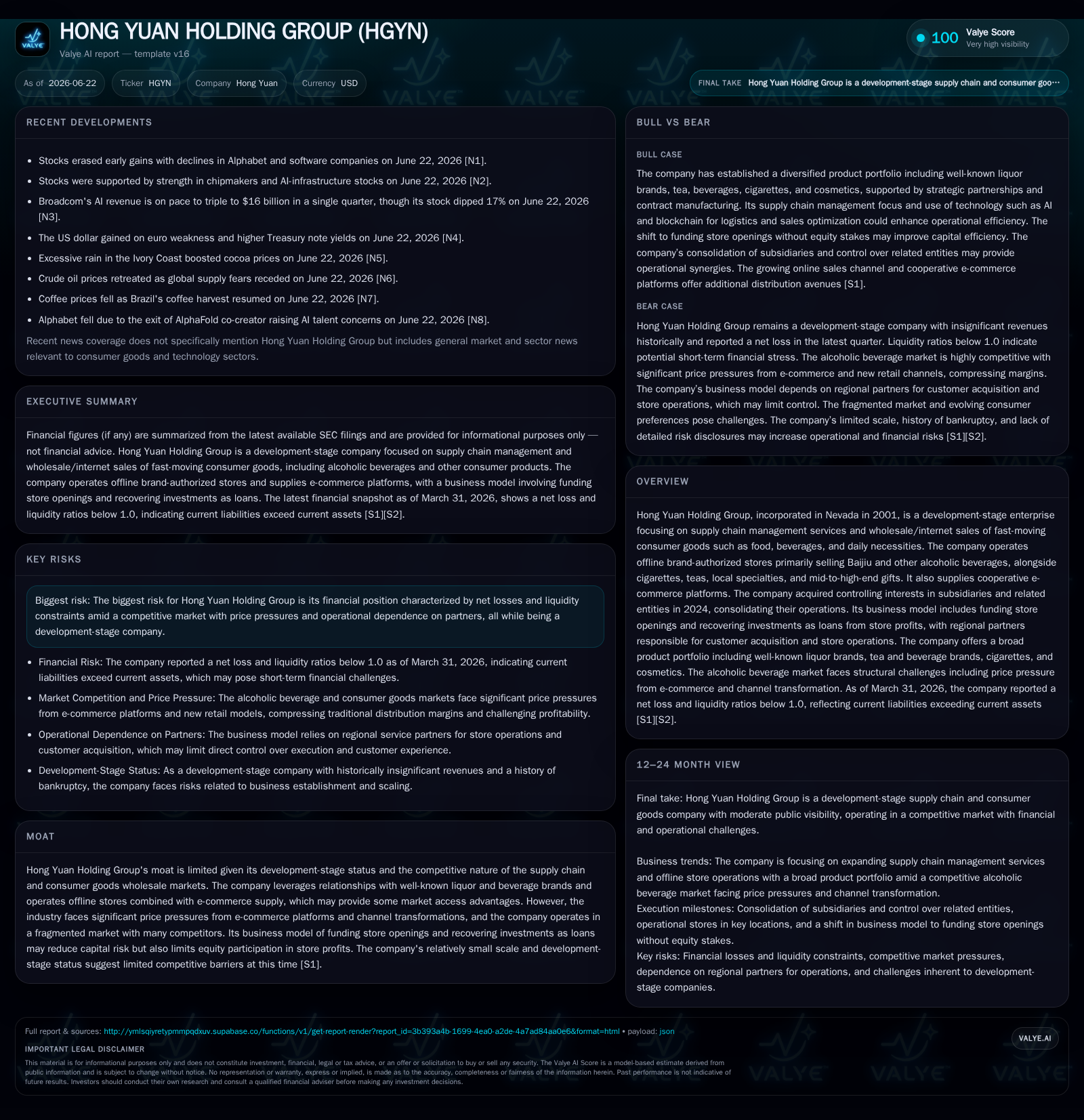
Hong Yuan Holding Group, a development-stage player in the fast-moving consumer goods (FMCG) wholesale and supply chain space, reported operational updates in its latest quarterly filing emphasizing consolidation of subsidiaries and a shift to a loan financing model for new stores. The company’s business centers on offline brand-authorized stores selling alcoholic beverages, cigarettes, teas, and related products, alongside supply chain services to e-commerce platforms. However, intense price competition from online channels, rising labor costs, and dependence on regional partners constrain scalability and profitability. Liquidity remains tight with a current ratio below 1. Hong Yuan’s path to growth hinges on expanding offline presence through partner-operated stores and navigating channel transformations while managing financial risks inherent to its development-stage status.
Latest Operating Update Anchors Strategic Shifts
Hong Yuan Holding Group’s most recent quarterly filing (10-Q as of June 22, 2026) confirms consolidation of key subsidiaries under Fengcuiyuan Chang Technology Development Co., Ltd., underscoring an extended footprint in the highly competitive FMCG wholesale sector primarily focused on southwestern China [S2],[S7]. Notably, the company modified its store financing approach in mid-2025: it continues funding store openings but has transitioned away from equity stakes toward recovering investments as loans derived from store profits. This loan financing model shifts financial risk away from direct ownership but also limits potential earnings participation from store success [S11].
The company operates offline brand-authorized retail outlets that predominantly sell Baijiu products spanning various price points along with classic wines, branded cigarettes, prestigious teas, local specialties, beverages, and mid-to-high-end gift items [S7],[S18]. These stores coexist with wholesale supply relationships to several cooperative e-commerce platforms enhancing reach beyond traditional channels.
Business Model Nuances: Multi-Channel FMCG Distribution
Hong Yuan serves as an intermediary between brand owners or manufacturers and end consumers or retail outlets by managing procurement, inventory, logistics, and multi-channel sales [S7]. The offline retail stores provide direct exposure to consumers while leveraging brand authorization agreements with well-known liquor manufacturers such as Moutai, Wuliangye, Luzhou Laojiao among others [S18]. Complementary categories including Zhongcha teas and Nongfu Spring beverages extend the product assortment to include high-demand daily necessities.
Revenue generation depends on sales volumes across diverse categories sold primarily through partner-operated stores funded by loans repaid from ongoing profits. This structure limits upfront capital expenditure risk but ties revenue growth closely to the successful customer acquisition efforts executed by regional partners responsible for day-to-day store operations [S11]. Customer engagement initiatives like zero-cost return policies and value-sharing plans aim to enhance loyalty and increase lifetime value [S19].
Industry Structure and Competitive Position
The FMCG wholesale market where Hong Yuan competes is characterized by fragmentation with significant pricing pressure driven by large-scale e-commerce platforms such as Tmall and JD.com offering aggressive promotions disrupting traditional distribution channels [S9]. Data indicates online alcohol sales grew rapidly to surpass RMB 30 billion in 2025 representing nearly 29% of industry volumes with live-streaming sales surging at over 137% annual growth—factors compressing margins for conventional offline retailers
Hong Yuan's position is constrained by limited scale relative to dominant players controlling a vast share of premium alcohol profits (CR6 enterprises holding ~86% profit share) while smaller brands face declining market presence [S10]. Additionally, third- and fourth-tier brands suffer from inconsistent pricing strategies exacerbating channel disarray [S9].
Operationally, roughly half of individual alcohol retailers report sliding same-store sales necessitating transformation towards chain models or online-to-offline integration to sustain viability amidst rising labor costs expected at 12% annual increments coupled with increasing rents squeezing gross margins down towards thin 15%-20% levels [S9]. These structural cost pressures erode standalone store profitability reinforcing the need for scale economies which Hong Yuan is still developing through regional partnerships.
Growth Drivers: Expanding Partner-Operated Store Footprint and Product Innovation
Despite challenges in price competition and channel transformation, underlying demand signals support growth prospects centered on:
- Expanding the number of offline brand-authorized stores operated via regional partners who manage customer acquisition efforts while Hong Yuan provides financing through recoverable loans; this asset-light approach mitigates capital intensity but requires sharp execution oversight [S11].
- Product portfolio diversification incorporating mid-to-high-end liquor varieties plus strategic cooperation with reputable tea (e.g., Zhongcha) and beverage (Nongfu Spring) brands positions the company to capture consumption upgrade trends demonstrated by growing consumer preference for premiumized offerings [S18],[S10].
- Leveraging supply chain management expertise enhanced by technology adoption - AI, IoT, blockchain - aimed at optimizing procurement efficiency, logistics effectiveness, inventory turnover rates, and order fulfillment for both physical stores and e-commerce platforms [S7].
- Enhancing customer retention via service guarantees such as zero-cost returns/replacement policies which fortify user stickiness and increase average transaction values relative to competitors [S19].
Risks & Constraints: Liquidity Tightness & Partner Dependency
Further operational risks stem from dependence on regional partners for effective customer acquisition and store-level management. Given many small operators lack advanced digital capabilities or professional merchandising expertise—the company acknowledges over 70% of local stores are family-run businesses vulnerable to evolving retail dynamics—execution missteps could impair growth scaling plans [S9].
Price pressures induced by dominant e-commerce players threaten gross margin stability while regulatory scrutiny around tobacco/alcohol distribution potentially adds compliance complexity.
Upcoming quarterly filings should clarify how these operational KPIs evolve alongside any material changes in revenue composition or margin structures.
Brief Financial Profile Contextualizing Operating Risks
This financial snapshot aligns with the reported challenges faced ramping up scale while managing operating costs within a low-margin segment contending with aggressive online competition.
Disclaimer: This analysis synthesizes information solely from publicly filed SEC documents () supplemented by structured financial facts ([F1]) without inferring unreported data. It reflects industry context common to FMCG wholesale operators but does not constitute investment advice or predictive valuation commentary.
Disclaimer: This is research-only, informational analysis and not investment advice. It may include AI-generated interpretation and general industry context. Always verify important details using primary sources.

Comments