
Tianci International Ventures Beyond Asia-Pacific with Asset-Light Ocean Freight Strategy
Tianci International's recent public offering fuels expansion of its asset-light logistics business leveraging chartered cargo space in bulk and container shipping.
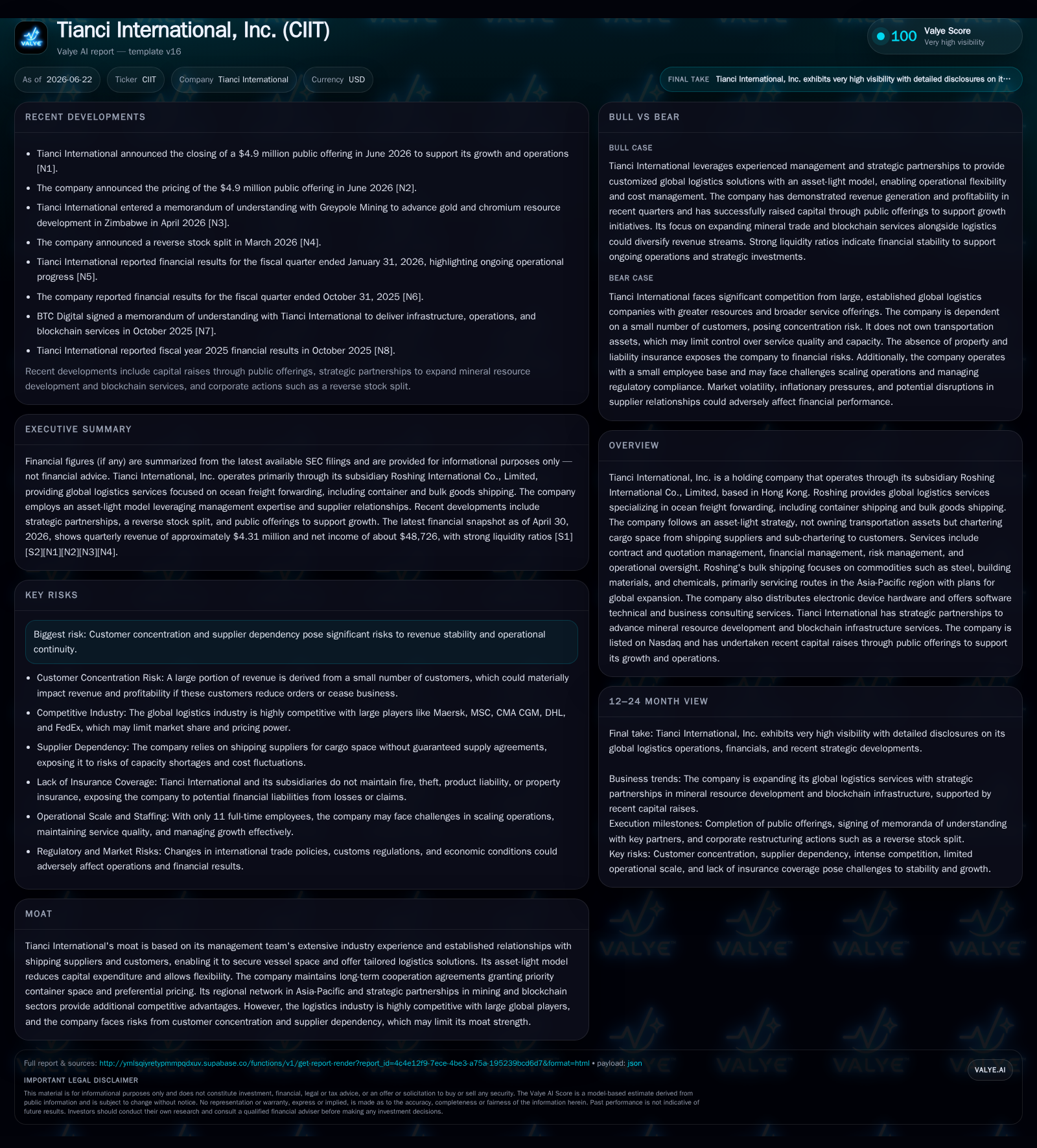
Tianci International’s latest 10-Q filing highlights a strategic scaling of its core ocean freight forwarding operations conducted through its Hong Kong-based subsidiary, Roshing International Co., Limited. The company utilizes an asset-light model, chartering cargo space from suppliers and sub-chartering to customers while providing contract and risk management services. A recent $4.9 million public offering provides fresh capital to increase vessel chartering capacity and enhance cost competitiveness, supporting expansion beyond its Asia-Pacific bulk commodity shipping base. Despite competitive pressures from global shipping lines and integrated logistics providers, Tianci’s management expertise and strategic relationships underpin its growth ambitions amid inherent customer and supplier concentration risks.
Latest Quarterly Operating Highlights Reflect Strategic Expansion Initiatives
On June 22, 2026, Tianci International filed its most recent Form 10-Q reporting ongoing progress in scaling operations through its Hong Kong subsidiary Roshing International Co., Limited [S2]. Concurrently, the company closed a $4.9 million public offering earlier that month [N1], which represents a pivotal capital infusion aimed explicitly at supporting growth initiatives in freight forwarding. This fresh equity enables Tianci to secure additional cargo space charters—critical to expanding cost-effective container and bulk shipping offerings beyond its existing Asia-Pacific focus [S3].
The capital raise addresses fundamental scaling constraints intrinsic to asset-light forwarders: without owning vessels themselves, Tianci depends on securing cargo space via time charters from shipping suppliers. Increasing these contracted volumes improves negotiating leverage while allowing margin enhancement through sub-chartering upside to cargo owners [S1]. The quarterly disclosures indicate active gearing of these new resources into augmenting vessel charter capacity to serve clients with larger shipment loads at competitive pricing
Asset-Light Business Model Shapes Flexible Ocean Freight Forwarding Operations
Tianci’s operating model centers on Roshing acting as an intermediary between shipowners or non-vessel operating common carriers (NVOCCs) and end customers seeking logistics solutions for containerized and bulk freight [S1]. Through chartering agreements with shipping suppliers rather than owning transportation assets, Roshing maintains flexibility to adjust capacity in line with fluctuating demand while minimizing fixed asset investments.
For container shipments, Roshing charters cargo space — measured in TEUs — from carriers then sub-charters this capacity to customers such as industrial shippers or freight agents. For bulk goods like steel or chemicals central to Asia-Pacific industries, the company issues fixture notes confirming specific vessel bookings before signing contracts with suppliers. This process requires detailed contract management and risk oversight capabilities to ensure timely performance under variable global shipping conditions.
The asset-light approach leverages CEO Shufang Gao’s two decades of senior experience within major global shipping firms, whose industry relationships facilitate long-term cooperation agreements granting priority cargo space access on preferred terms [S1]. This dynamic reduces upfront capital burdens relative to asset-heavy peers but necessitates maintaining strong supplier relations amid competitive pressures.
Competitive Landscape: Positioning Among Global Shipping Lines and NVOCCs
Within the ocean freight forwarding sector, Tianci’s business contrasts markedly with global shipping conglomerates like Maersk or Mediterranean Shipping Company (MSC), which own extensive fleets providing end-to-end container carriage coupled with owned assets enabling durable pricing power and technology-enabled tracking solutions [S1]. These players compete on breadth of geographic coverage and vertically integrated service offerings.
Integrated logistics providers such as DHL or FedEx also present competition through multimodal transport networks often bundled with customs clearance and last-mile delivery services. Tianci’s niche is more focused: it occupies the role of an NVOCC-type operator specialized in flexible chartering arrangements without bearing ship maintenance or ownership costs.
While this model offers nimbleness in scaling up or down based on market demand shifts — particularly in volatile bulk commodity trade lanes — it limits pricing power since the company relies substantially on third-party shipowners’ rates [S1]. Additionally, Tianci primarily targets routes within Asia-Pacific currently with ambitions of global expansion but lacks the network effects wielded by larger integrated providers
Growth Catalysts: Public Offering Fuels Scale-Up in Charter Operations
The recently closed $4.9 million public offering serves as a strategic enabler for enlarging Tianci’s vessel charter portfolio [N1][N2]. By injecting fresh capital specifically aimed at securing additional cargo space bookings, the company anticipates enhancing scale economies necessary for attracting larger-load customers requiring cost-efficient logistic solutions.
This scale-up initiative aligns with longer-term industry growth drivers including expanding international commerce volumes and rising demand for adaptable freight booking options as supply chains become more complex globally. Furthermore, by fortifying relationships through long-term cooperation agreements with select shipping suppliers — granting priority container slots — Tianci aims to improve its chartered cargo space utilization rates, a critical KPI that directly impacts gross margins per shipment.
Value-added services such as financial management support and risk mitigation during transport further differentiate Roshing amid commoditized price competition common in freight forwarding. Success in increasing the number of active contracts coupled with lengthening average contract durations will be key metrics evidencing traction from the scale investment [S1][S2].
Risks on the Horizon: Customer Concentration and Supplier Dependencies
Notwithstanding growth opportunities, significant risks stem from high customer concentration ratios; historically two customers accounted for approximately 69% of total revenue during fiscal periods ending July 31, 2025 [S17]. Such dependence introduces pronounced revenue volatility should one or both clients curtail orders or negotiate pricing adjustments unfavorably.
Supplier concentration also poses threats since the company relies on a limited number of shipowners or NVOCCs to source cargo space under time charter contracts [S17]. Disruptions in these relationships or unfavorable changes in charter terms may constrain operational capacity and increase costs.
Geopolitical instability affecting trade routes—such as escalating US-China tensions or regional conflicts—could depress overall shipping demand while protectionist policies may increase tariffs or lengthen transit times impairing service reliability [S1]. Additionally, emerging regulatory requirements related to maritime security or environmental codes could add compliance complexities exacerbating operational risk.
Mitigation strategies focus on diversifying customer base over time alongside securing multi-year supplier cooperation agreements providing preferential pricing tiers where feasible [S1][S2]
Forward-Looking Indicators: Key Milestones and Demand Signals to Monitor
Monitoring Tianci’s expansion trajectory encompasses several operational KPIs grounded in the latest filings:
- Chartered Cargo Space Utilization Rate: Increased utilization signals better leverage of vessel capacity translating into higher margins.
- Number of Active Customer Contracts: Growth indicates success broadening customer base mitigating concentration risks.
- Average Contract Duration: Longer durations imply stronger customer retention reducing volume variability.
- Freight Volume (TEUs for containers / tons for bulk goods): Reflects true scale expansion aligned with market demand.
- Freight Rate Trends: Movement here affects revenue per shipment; upwards pressure aids profitability if managed effectively.
These metrics should be contextualized amid macroeconomic indicators such as global trade flows and bulk commodity market health within Asia-Pacific regions targeted by Roshing [N1][N2][S1]. Progress against capital deployment plans post-offering will also furnish insight into execution effectiveness.
Financial Snapshot: Liquidity Strength Amidst Scaling Investments
As of April 30, 2026, Tianci reported current assets totaling approximately $2.69 million against current liabilities near $92 thousand delivering an exceptionally strong current ratio around 29x—a signal of robust short-term liquidity supporting operational flexibility [F1][S2]
Despite modest net debt estimated near $126 thousand due to legacy borrowings exceeding cash reserves [F1], the balance sheet scale is relatively conservative reflective of its asset-light nature minimizing heavy capital expenditure commitments. The recent equity raise further reinforces financial positioning enabling incremental investments without immediate funding stress [N1][S3].
Operating income has remained negative aligned with growth stage investments; however, improved top-line trends driven by scaling logistics services ought to drive margin improvements provided efficient utilization of newly secured vessel charters occurs [F1]. Maintaining disciplined working capital management while navigating competitive pricing pressures will be paramount.
This analysis synthesizes publicly available SEC filings through mid-2026 alongside recent market disclosures to frame Tianci International's evolving positioning within the ocean freight forwarding sector. It highlights structural advantages derived from an asset-light strategy alongside palpable challenges posed by concentrated revenue streams and dependence on key suppliers amid intensifying industry competition. Ongoing monitoring centered on contractual expansions, cargo utilization metrics, freight rate dynamics, and geopolitical trade developments will be critical for assessing future operational scalability. This report does not constitute investment advice but seeks to provide informed industry context grounded firmly in documented disclosures.
Disclaimer: This is research-only, informational analysis and not investment advice. It may include AI-generated interpretation and general industry context. Always verify important details using primary sources.

Comments